
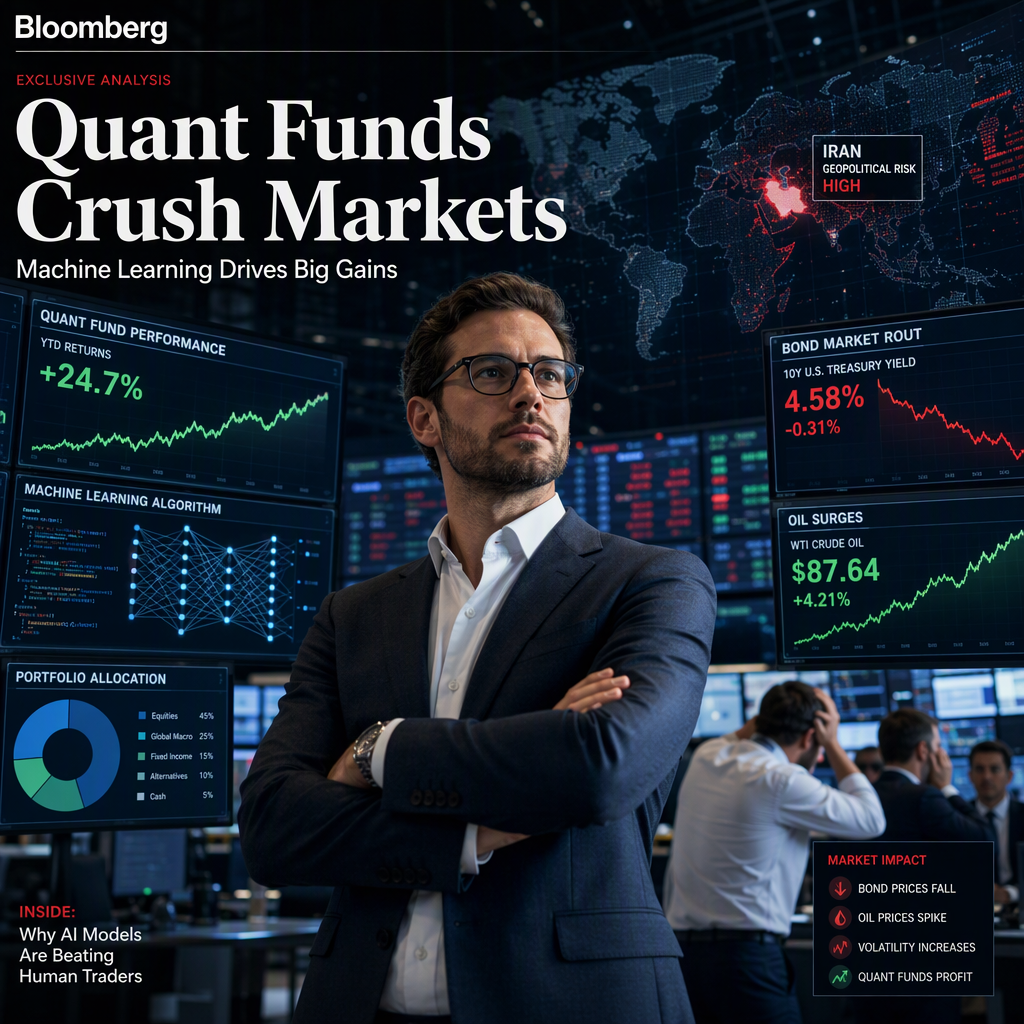
Computer-driven trend-following hedge funds, also known as commodity trading advisors (CTAs) or managed futures strategies, have outperformed the broader stock market this year by capitalizing on significant market movements, including September’s bond rout and the surge in oil prices ahead of the Iran war [1]. These funds utilize complex algorithms, machine learning technology, and statistical models to analyze large volumes of data and invest across futures markets, aiming to profit from consistent trends in equities, bonds, commodities, and currencies [1].
Societe Generale's SG CTA Index, which tracks the daily net returns of major strategies such as Man Group, PIMCO, AQR, and Winton Capital funds, recorded a 15.7% return in the nine months to the end of the third quarter, surpassing the S&P 500’s 11.7% gain over the same period [1]. CTAs were noted for their early and contrarian positions, including shorts against U.S. Treasurys during September’s bond sell-off and bullish dollar positions, as well as pre-Iran war long oil bets [1]. Andrew Beer, managing member at Dynamic Beta Investments, stated that CTAs have been “crushing the rest of the hedge fund world this year,” attributing their success to being “early, contrarian and right” in their trades [1].
Nicolas Gaussel, CEO and CIO of Metori Capital Management, highlighted that CTAs have effectively navigated inflationary tensions by taking short positions in fixed income, and that the negative correlation between stocks and oil has further bolstered their performance [1]. This year’s market environment has been defined by a strong positive correlation between equities and bonds, and a strong negative correlation between energy and both equities and bonds, which has posed challenges for traditional 60/40 portfolios [1]. Gaussel noted that the positive correlation between equities and bonds has been particularly difficult for traditional long-only diversified portfolios, as bond performance has been weak [1].
Industry professionals emphasized that CTAs have successfully captured the major market themes of AI-driven optimism in equities and panic about oil prices and inflation, with machines proving more effective than humans in timing these trends [1].
CONCLUSION
Quant funds have leveraged machine-driven strategies to outperform traditional portfolios and the broader stock market, particularly during periods of bond market turmoil and oil price surges. Their ability to identify and act on major market trends has resulted in significant gains, highlighting the challenges faced by conventional 60/40 portfolios in the current environment. The market takeaway is that algorithmic trading strategies are proving superior in navigating complex and volatile market conditions.