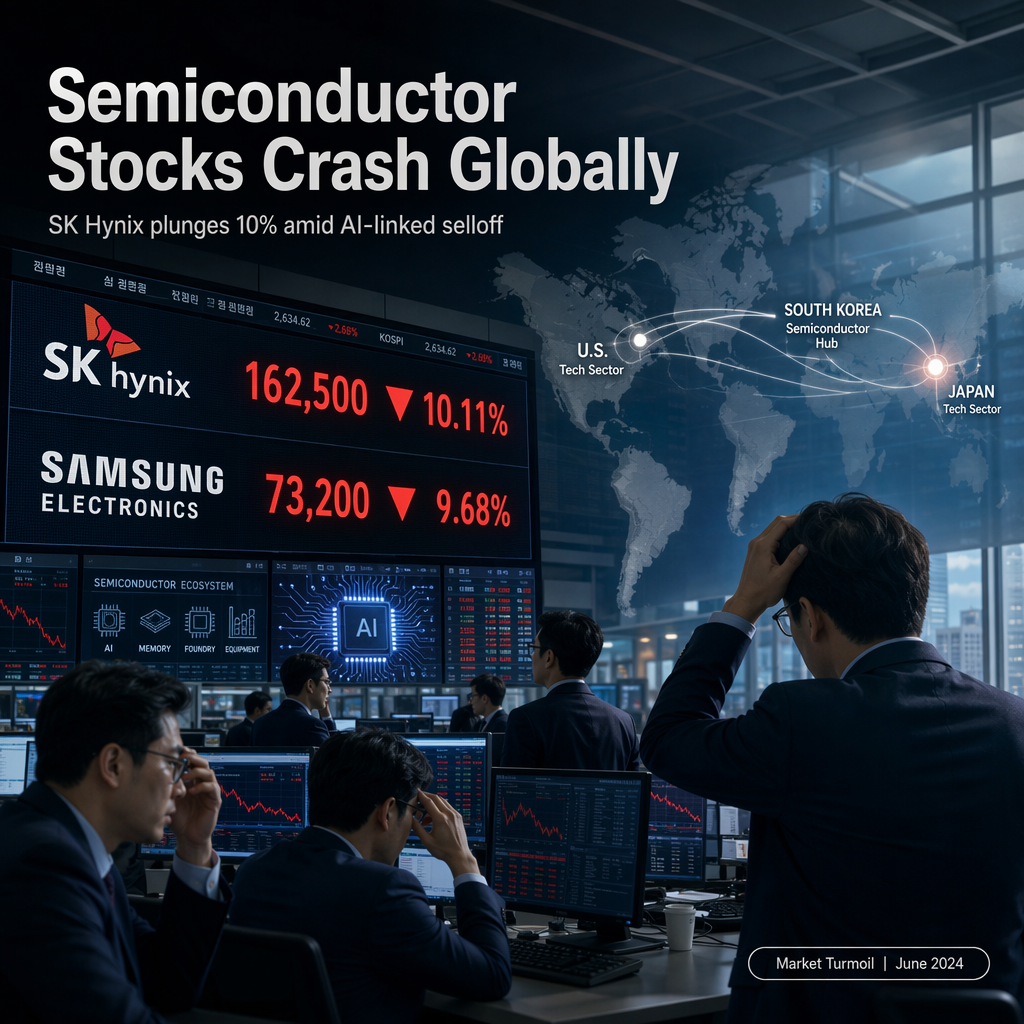
Shares of South Korean semiconductor companies experienced a sharp decline on Tuesday, with SK Hynix plunging more than 10% and Samsung Electronics falling over 8% [1]. The selloff extended to other AI-linked names, including Samsung SDI, which dropped over 7%, LG Innotek sliding nearly 14%, Seoul Semiconductor falling about 6%, and LG Chem losing more than 4% [1].
The downturn was not limited to South Korea. Japan's semiconductor sector also saw significant losses, with Tokyo Electron dropping more than 9%, Advantest sliding over 8%, and SoftBank Group, a major AI investment proxy through its stake in Arm, falling nearly 5%. Shares of Japanese computer memory manufacturer Kioxia plunged more than 15% [1].
This widespread selloff followed another weak session for U.S. semiconductor stocks on Monday, where the VanEck Semiconductor ETF (SMH) lost more than 2%, adding to its Friday losses. AMD and Teradyne led the declines in the U.S., dropping 5% and 4% respectively, while Micron Technology shed about 2% [1].
The article highlights the increasing interconnection between Asian technology shares and the U.S. AI trade, noting that Samsung Electronics and SK Hynix are among the world's largest suppliers of high-bandwidth memory chips used in AI servers. This makes their shares particularly sensitive to shifts in expectations for spending by U.S. hyperscalers [1].
CONCLUSION
The global semiconductor selloff has led to significant declines in both Asian and U.S. chipmaker stocks, with SK Hynix and Samsung Electronics among the hardest hit. The market reaction underscores the sector's sensitivity to U.S. AI spending trends and the growing interdependence between Asian and American technology markets.