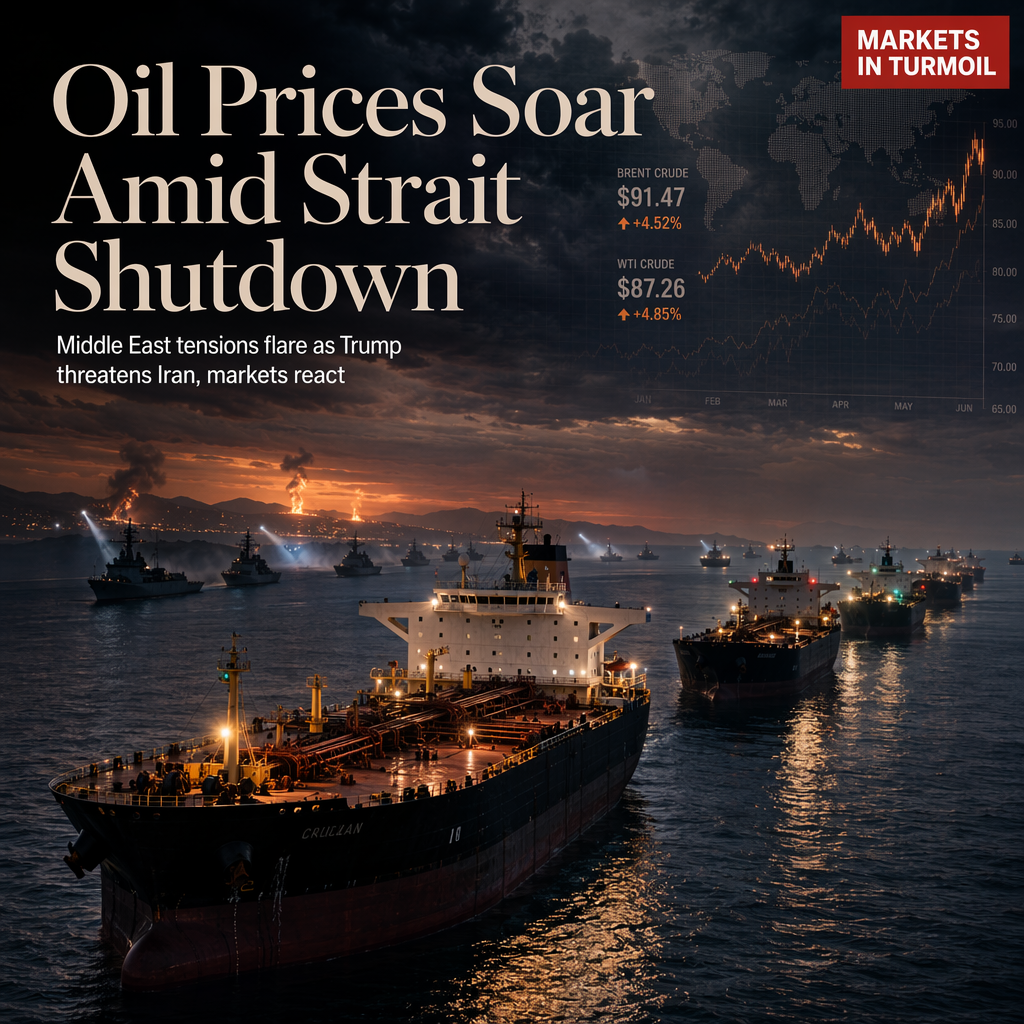
Oil markets experienced significant volatility at the start of the week after Iran announced the closure of the Strait of Hormuz on Saturday, a critical chokepoint for global oil shipments, in response to renewed hostilities by Israel in Lebanon and threats from U.S. President Donald Trump to strike Iran 'harder' if provocations continued [1][2][3][4]. Trump’s threats, including a statement that Iran 'won't have a country' if the strait remains closed, led Iranian negotiators to walk out of high-stakes peace talks with the U.S. in Switzerland, casting doubt on the resumption of negotiations and the durability of a fragile interim peace agreement signed last week [1][2][3][4].
The immediate market reaction was a sharp rise in oil prices. West Texas Intermediate (WTI) opened Monday’s Asian session with an over $1 bullish gap, retesting the $78 mark and rising nearly 2% in early dealings, holding above $77 as of writing [1]. U.S. WTI futures for July jumped 3.04% to $78.93 per barrel, while international benchmark Brent crude for August rose 1.23% to $81.56 a barrel [4]. The closure of the Strait and the uncertainty around peace talks have reignited supply concerns, despite reports that Middle East oil supply is close to prewar levels when including crude held in storage and aboard tankers [4]. However, analyst David Roche cautioned that this apparent abundance is due to inventory liquidation rather than a recovery in production, leaving the market vulnerable once stockpiles are depleted [4].
The geopolitical tensions also impacted currency markets. The Japanese Yen struggled near 161.50 against the U.S. Dollar, with the USD/JPY pair approaching its highest level since July 2024, as safe-haven demand for the Greenback increased amid the risk-off sentiment triggered by the strained U.S.-Iran talks [2]. The Australian Dollar weakened to around 0.7005 against the U.S. Dollar, with traders citing uncertainty and fears of a prolonged Middle East conflict as drivers for the risk-off move and Greenback strength [3].
Market participants are closely monitoring further developments, as any escalation—particularly continued Israeli strikes in Lebanon—could significantly influence oil prices [1]. Additionally, traders now see over a 90% chance of a U.S. Federal Reserve rate hike in December, up from 61% prior to the Fed decision, as inflationary pressures from the Iran conflict mount [3]. Goldman Sachs noted that while current supply shocks are pushing oil prices higher, sustained disruptions could accelerate the shift toward electric vehicles, potentially eroding long-term crude demand and adding downside risks for oil prices [4].
CONCLUSION
The closure of the Strait of Hormuz and renewed U.S.-Iran tensions have driven oil prices sharply higher and triggered risk-off moves in currency markets. While inventories have cushioned immediate supply shocks, analysts warn of future vulnerabilities if stockpiles run low. The situation remains fluid, with further escalation likely to impact both energy and financial markets.