
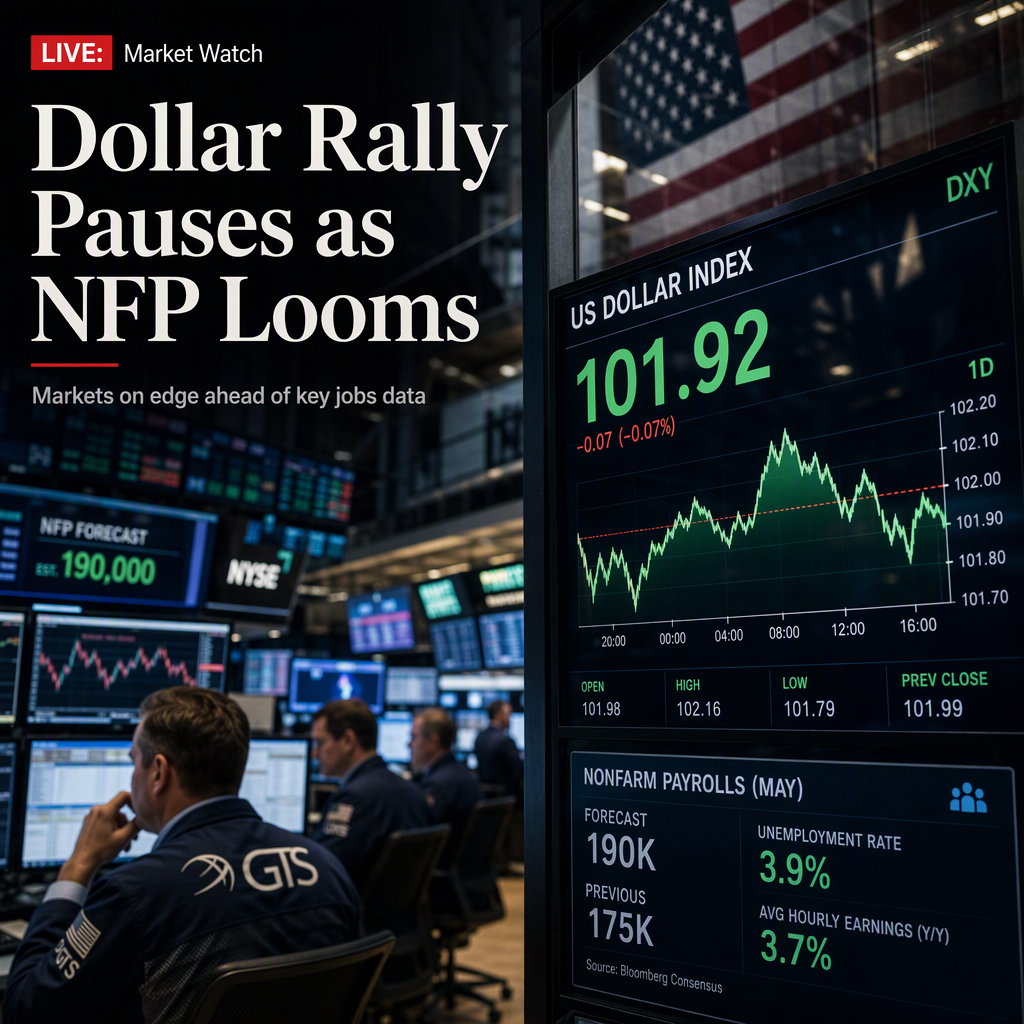
The US Dollar (USD) corrected lower against major rivals early Friday as investors awaited the critical September Nonfarm Payrolls (NFP) report, which will include wage inflation and Unemployment Rate figures [1]. This follows a week where the USD was the strongest performer against the Euro, gaining 1.07%, and also posted gains against other major currencies such as the British Pound (0.19%), Japanese Yen (0.30%), Canadian Dollar (0.57%), Australian Dollar (1.02%), New Zealand Dollar (0.82%), and Swiss Franc (0.09%) [1]. On Thursday, surging US Treasury bond yields propelled the USD Index to its highest level since April 2025 at 102.20, though it retreated below 102.00 in European trading on Friday [1].
Market expectations for the September NFP are for a rise of 90,000 jobs, following an increase of 162,000 in August, with the Unemployment Rate forecast to remain unchanged at 4.1% [1]. However, TD Securities projects a more subdued report, anticipating NFP growth of only 50,000 and an uptick in the Unemployment Rate to 4.2% [1]. TD Securities also expects the softness in hiring to be concentrated outside healthcare and leisure & hospitality, with government hiring likely flat due to a reversal in local hiring trends [1]. Average Hourly Earnings (AHE) are forecast by TD to be subdued at 0.1% month-over-month (3.0% year-over-year) [1].
Despite the anticipated softness, TD Securities urges investors to 'look through' any dovish signals in the report, attributing potential weakness to seasonal factors and rising labor force participation [1]. The market's focus remains on the employment data's implications for US monetary policy and the USD's recent strength [1].
CONCLUSION
The US Dollar's recent rally has paused as markets await the September Nonfarm Payrolls report, with expectations of a slowdown in job growth and a potential rise in the Unemployment Rate. While some analysts anticipate a soft report, they advise caution in interpreting the data due to seasonal effects. The outcome of the employment figures is likely to have a significant impact on USD direction and market sentiment.