
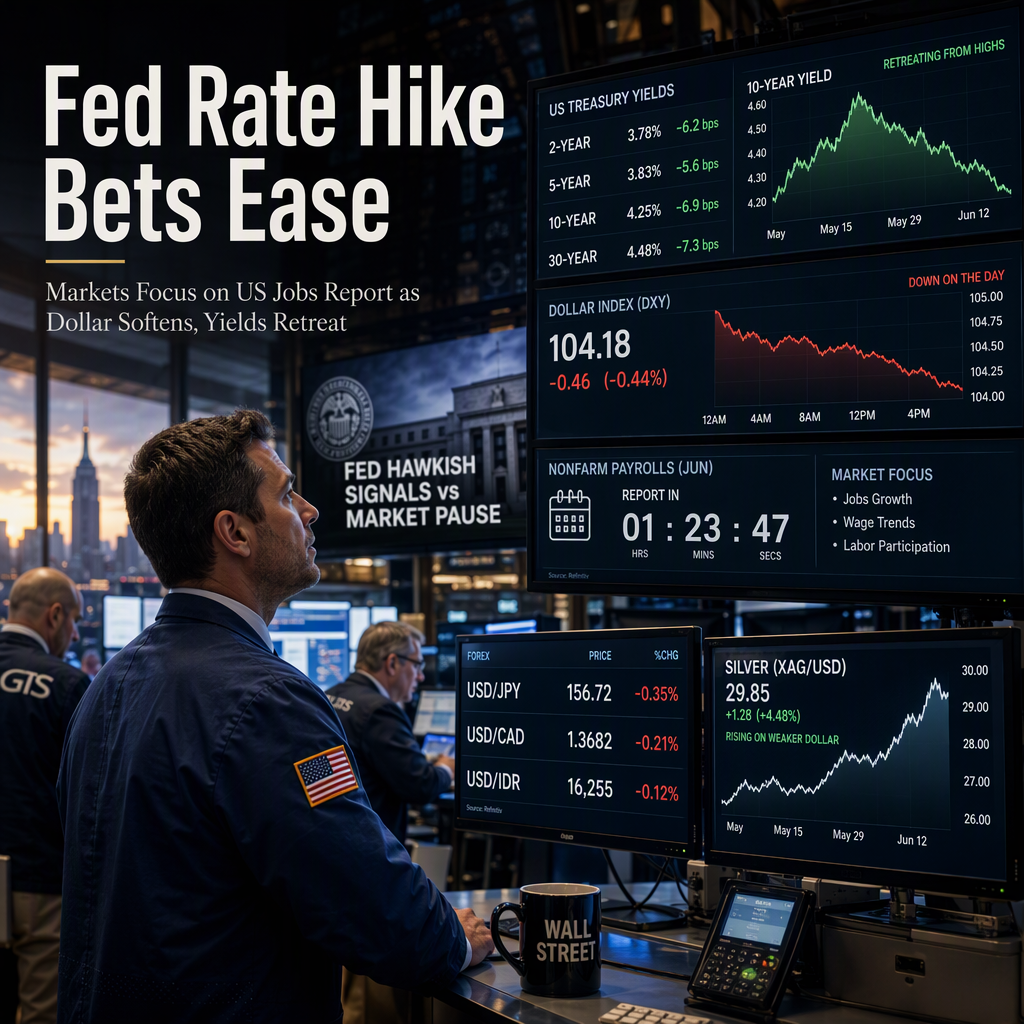
A broad shift in market sentiment has emerged as expectations for imminent US Federal Reserve (Fed) rate hikes have eased, leading to a softening of the US Dollar (USD) and a pullback in US Treasury yields from multi-decade highs [1][2][4][5]. The CME FedWatch Tool indicates that traders are now pricing in less than a 28% chance of a Fed rate increase at the October meeting [1][5]. Despite this, persistent inflation concerns—particularly from elevated energy costs—alongside expectations for a potential December rate hike, continue to provide some support for the Greenback [1][5].
US Treasury yields, which recently reached 5.34% for the 10-year (the highest since 2002) and 5.62% for the 30-year (the highest in 24 years), have retreated to around 5.25% and 5.62%, respectively [2][4][5]. This moderation in yields has improved the short-term appeal of non-yielding assets such as silver, with XAG/USD rising 0.55% to near $61.38 [4]. However, the broader trend in yields remains firm, as Fed officials, notably Dallas Fed President Lorie Logan, have signaled a continued hawkish stance. Logan emphasized the need for at least 50 basis points more in rate hikes to achieve a 'modestly restrictive' policy and bring inflation back to the 2% target [2][3][4]. The FXS Fed Sentiment Index rose by 1.68 points to 136.59, confirming a deeper move into hawkish territory [2][3][4].
Currency markets have responded to these developments. The Japanese Yen (JPY) strengthened against the USD, with USD/JPY declining to around 157.90 after stronger-than-expected Tokyo CPI data showed headline inflation at 2.7% YoY in September, up from 1.9% previously [1]. The New Zealand Dollar (NZD) rebounded to near 0.5610, though upside was capped by US yield strength and domestic election uncertainty [2]. The Canadian Dollar (CAD) faced headwinds as the US-Canada yield gap widened, with USD/CAD trading around 1.4210 after pulling back from an 18-month high of 1.4262 [3]. The Indonesian Rupiah (IDR) also strengthened as the USD weakened, with USD/IDR trading near 17,910 [5].
Looking ahead, market participants are focused on the upcoming US Nonfarm Payrolls (NFP) report, with economists forecasting job gains to moderate to 90,000 in September from 162,000 in August, and the unemployment rate expected to remain steady at 4.1% [1][2][4][5]. Analysts highlight that the outcome of the NFP could influence the Fed's policy trajectory and, by extension, global currency and bond markets [1][2][3][4][5].
Analyst commentary underscores the tension between higher yields potentially reducing the need for further tightening and explicit calls for additional rate hikes [2][3][4]. The ongoing divergence in central bank policies, particularly between the Fed and other major central banks, remains a key driver for currency pairs such as USD/CAD [3].
CONCLUSION
Easing expectations for immediate Fed rate hikes have led to a softer US Dollar and a retreat in Treasury yields, though underlying inflation concerns and hawkish Fed commentary continue to support the case for further tightening. Market attention is now firmly on the US Nonfarm Payrolls report, which is expected to provide critical guidance for the Fed's next moves and global market direction.