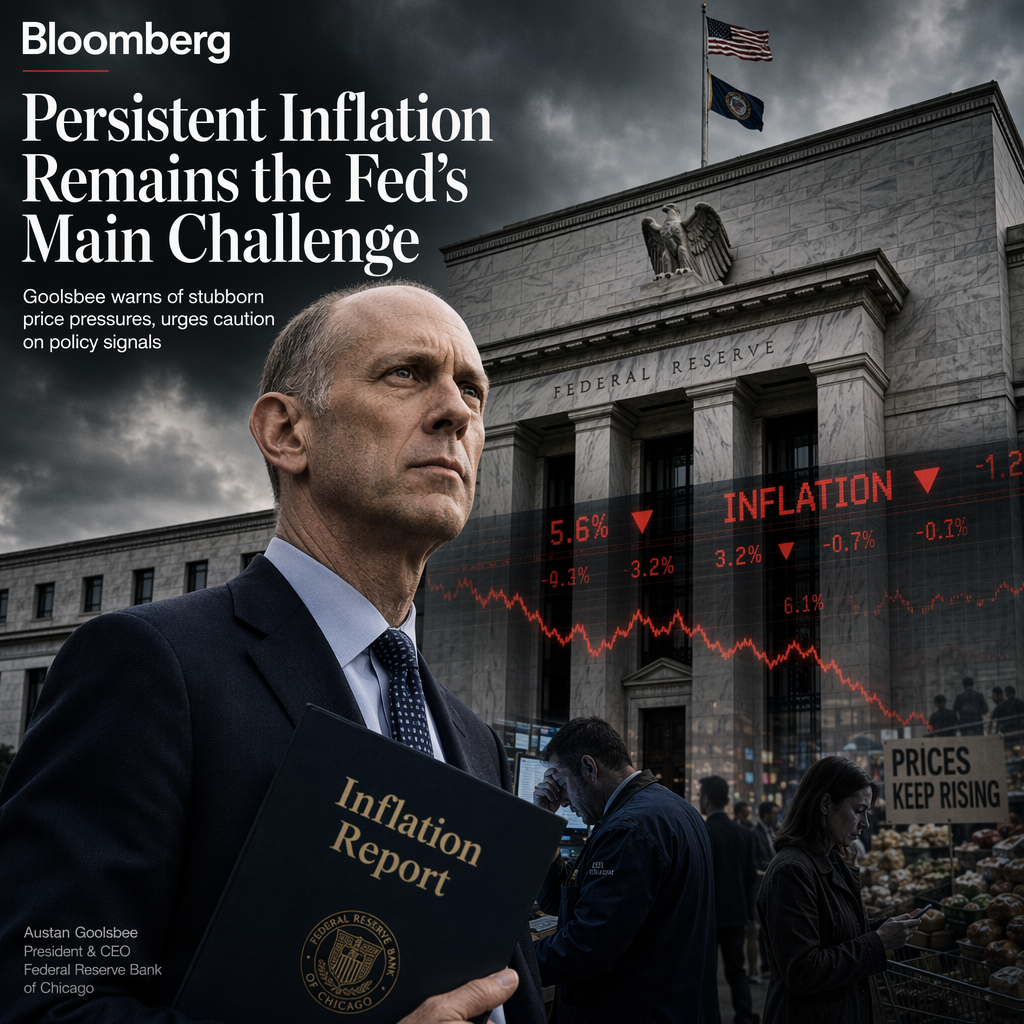
Federal Reserve Bank of Chicago President Austan Goolsbee stated that inflation remains the primary challenge for U.S. monetary policymakers, emphasizing that price pressures are still moving in the wrong direction despite some improvement in services inflation, as reflected in the latest Personal Consumption Expenditure (PCE) inflation report [1]. Goolsbee described the PCE report as not being 'all negative,' but highlighted that core inflation is still 'well too high' and trending unfavorably, keeping the inflation side of the Fed’s mandate as the main problem [1].
Goolsbee noted that while some inflationary pressures may be due to one-off factors, services inflation is particularly concerning and 'a little more disturbing' [1]. He expressed uncertainty about how much of the current inflation is temporary versus persistent, and reiterated that inflation remains well above the desired level [1].
Regarding monetary policy communication, Goolsbee expressed discomfort with providing forward guidance or committing to long-term forecasts, though he does not dislike the Fed’s dot plot. He welcomed the Fed Chair’s task force reviewing the dot plot and supported efforts to streamline the Fed’s policy statement [1].
On the topic of artificial intelligence, Goolsbee warned that if markets and consumers price in future productivity gains and increase spending based on those expectations, it could lead to overheating risks and further inflationary pressure. He also cautioned that wages are not a reliable leading indicator for inflation, suggesting that inflation could accelerate before wage growth picks up [1].
CONCLUSION
Fed President Goolsbee’s remarks underscore persistent inflation as the central concern for U.S. monetary policy, with core inflation still above target levels. His comments suggest caution regarding forward guidance and highlight risks from market expectations and consumer behavior. The market takeaway is that the Fed remains vigilant on inflation, with no clear signal of imminent policy easing.