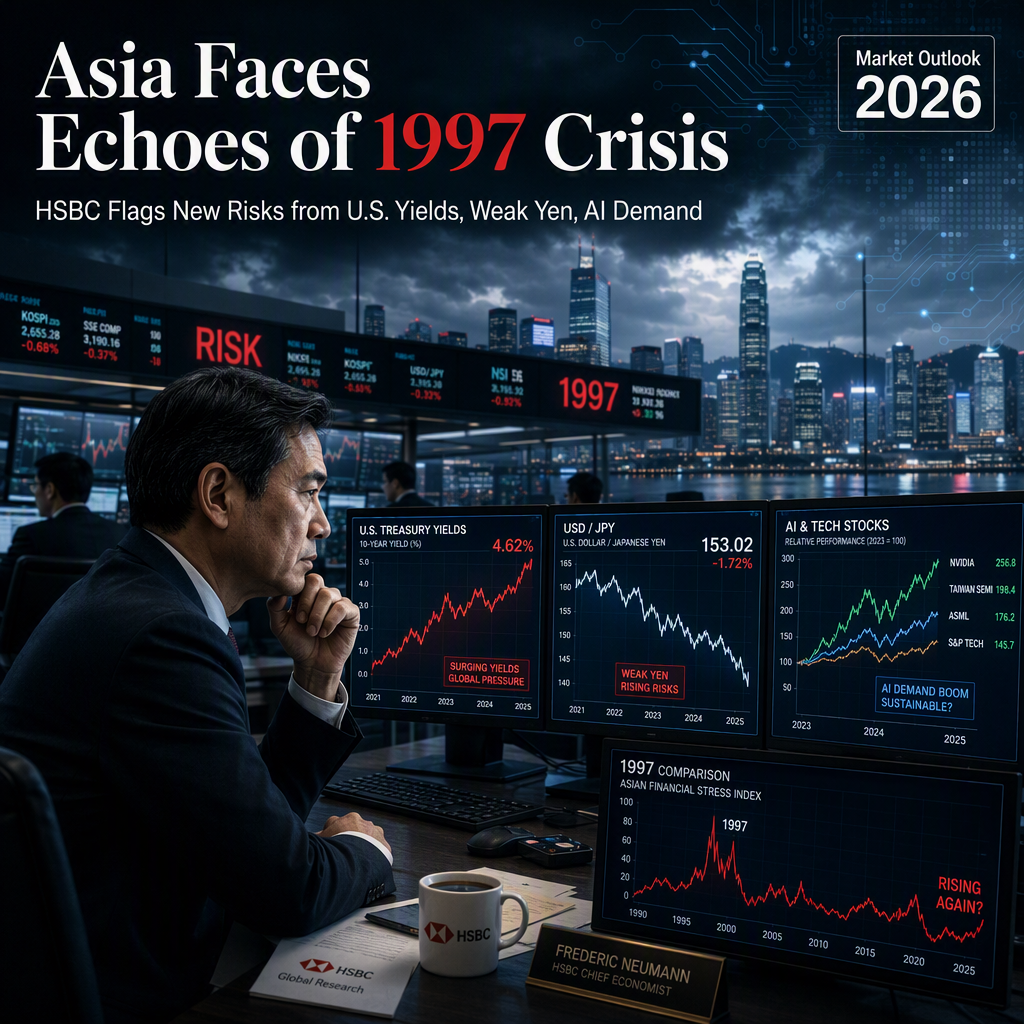
HSBC's chief economist, Frederick Neumann, has drawn parallels between Asia's current financial environment and the period preceding the 1997 Asian financial crisis, which was marked by recessions, currency collapses, capital flight, and banking failures across the region [1]. Neumann highlighted several key similarities, including elevated U.S. Treasury yields, a weak Japanese yen, and heightened tech optimism. Specifically, he noted that U.S. benchmark 10-year bond yields have risen from a low of 0.5% in August 2020 to around 4.79% as of early Tuesday, with an 80 basis point jump since February 2026 alone [1]. The U.S. Treasury recently announced plans to target the 10-year to 30-year portion of the market for buybacks, doubling the maximum size of its operations from $2 billion to at least $4 billion [1].
The Japanese yen has also experienced significant depreciation, weakening 57% from a low of about 103 in January 2021 to a high of 163 in July 2026, before joint intervention by Washington and Tokyo strengthened it to current levels around 160. Markets are now considering the possibility of further intervention [1]. Neumann also pointed out that the current AI boom mirrors the tech optimism seen during the internet era leading up to the 1997 crisis [1].
Despite these similarities, Neumann emphasized that the differences between 1997 and 2026 are more significant. In the 1990s, most Asian economies were importers of capital with insufficient savings, making them vulnerable to rising USD funding costs and a volatile yen. Today, Asian economies are exporters of capital, and higher U.S. funding costs and a weaker yen are not major pressure points [1]. However, Neumann cautioned that Asia is not immune to risks, with the most pressing threat now being a potential slowdown in U.S. AI demand, which could impact regional growth [1].
Market implications discussed include the possibility of further currency intervention and the impact of U.S. Treasury actions on global yields. While the similarities to the 1997 crisis are notable, the structural changes in Asian economies suggest a different risk profile, with demand vulnerability replacing financial vulnerability as the primary concern [1].
CONCLUSION
HSBC's analysis indicates that while Asia faces risks reminiscent of the 1997 financial crisis, structural changes in the region have shifted the nature of these vulnerabilities. The main threat now is a slowdown in U.S. AI demand rather than financial instability, suggesting a medium market impact with cautious sentiment.