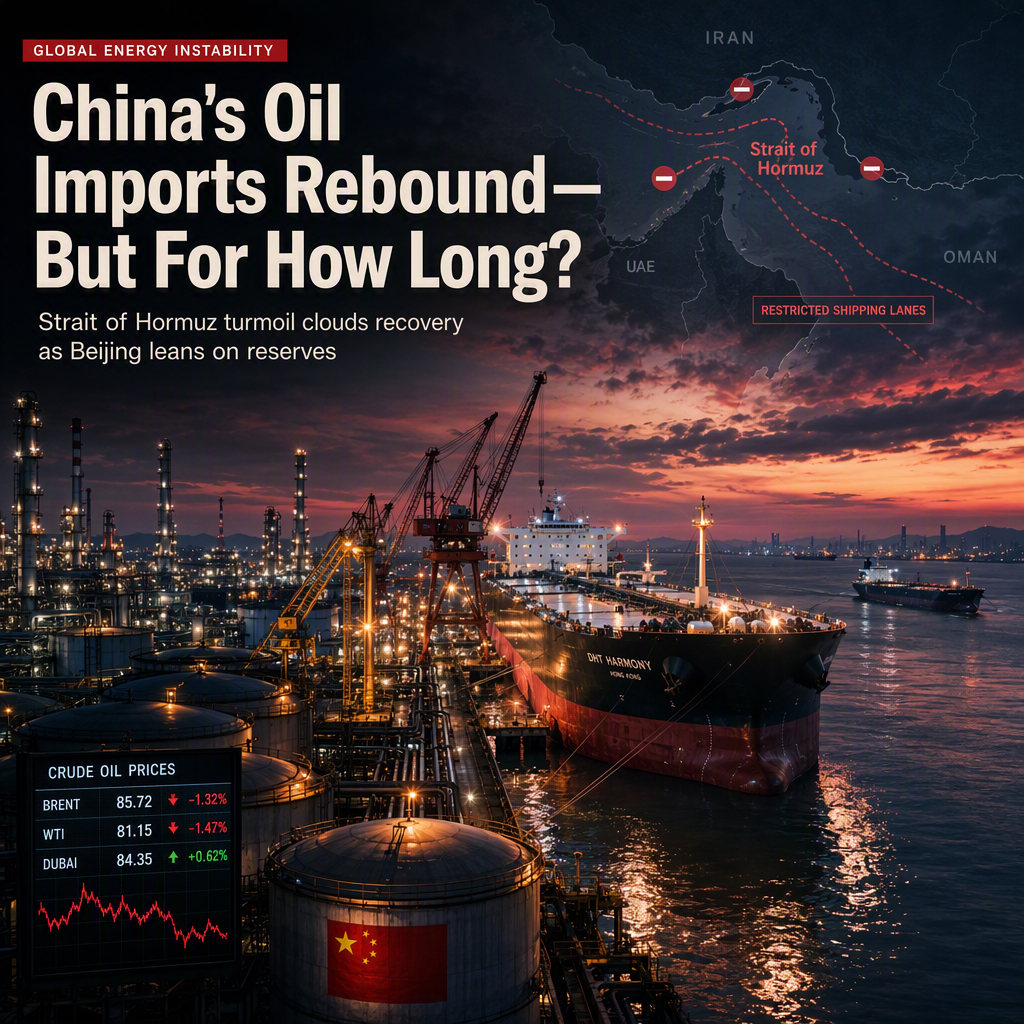
China's crude oil imports reached their highest level in three months in July, supported by the brief reopening of the Strait of Hormuz at the end of the second quarter, according to official customs data compiled by Wind Information and comments from Julian Evans-Pritchard, head of China economics at Capital Economics [1]. Despite this rebound, imports were still down 24% from a year earlier, though this was an improvement from June's 41% year-on-year slump, which brought imports to near a decade low at about 29.3 million tons—the lowest since October 2016 [1]. The short-lived recovery was attributed to a U.S.-Iran memorandum in mid-June that temporarily reopened the Strait of Hormuz to commercial traffic. However, renewed attacks on vessels in early July led to the waterway's closure once again, causing transits to collapse to a trickle and pushing energy prices higher [1]. Shipping traffic through the Strait of Hormuz has fallen sharply, with only two vessels transiting on Wednesday compared to eight a day earlier and a pre-war baseline of 130 to 140 daily transits, according to Kpler vessel-tracking data [1]. Chinese refiners have relied on massive stockpiles, reducing crude processing rather than paying wartime premiums. China's strategic crude oil inventories reached nearly 1.4 billion barrels as of December 2025, according to the U.S. Energy Information Administration [1]. Tianchen Xu, senior economist at the Economist Intelligence Unit, noted that Beijing sees little urgency in resuming imports while inventories remain high, describing China as an 'opportunistic buyer of oil' and suggesting that only a sustained de-escalation would prompt large-scale purchases [1]. Julian Evans-Pritchard warned that the recovery may already be fading, with oil import volumes likely to stall in August and possibly reverse, as higher oil prices amid the renewed closure encourage refiners to draw down inventories rather than import [1]. Iran and Oman were reportedly close to finalizing a framework for shipping traffic, but the arrangement would restrict ships from certain countries, including the U.S. and Israel [1].
CONCLUSION
China's brief rebound in crude oil imports in July was driven by a temporary reopening of the Strait of Hormuz, but renewed closures and rising energy prices are likely to stall or reverse this recovery. With high strategic inventories and soft domestic demand, China is expected to rely more on stockpiles than imports in the near term. The ongoing instability in the Gulf region continues to pose significant risks to global oil supply and prices.