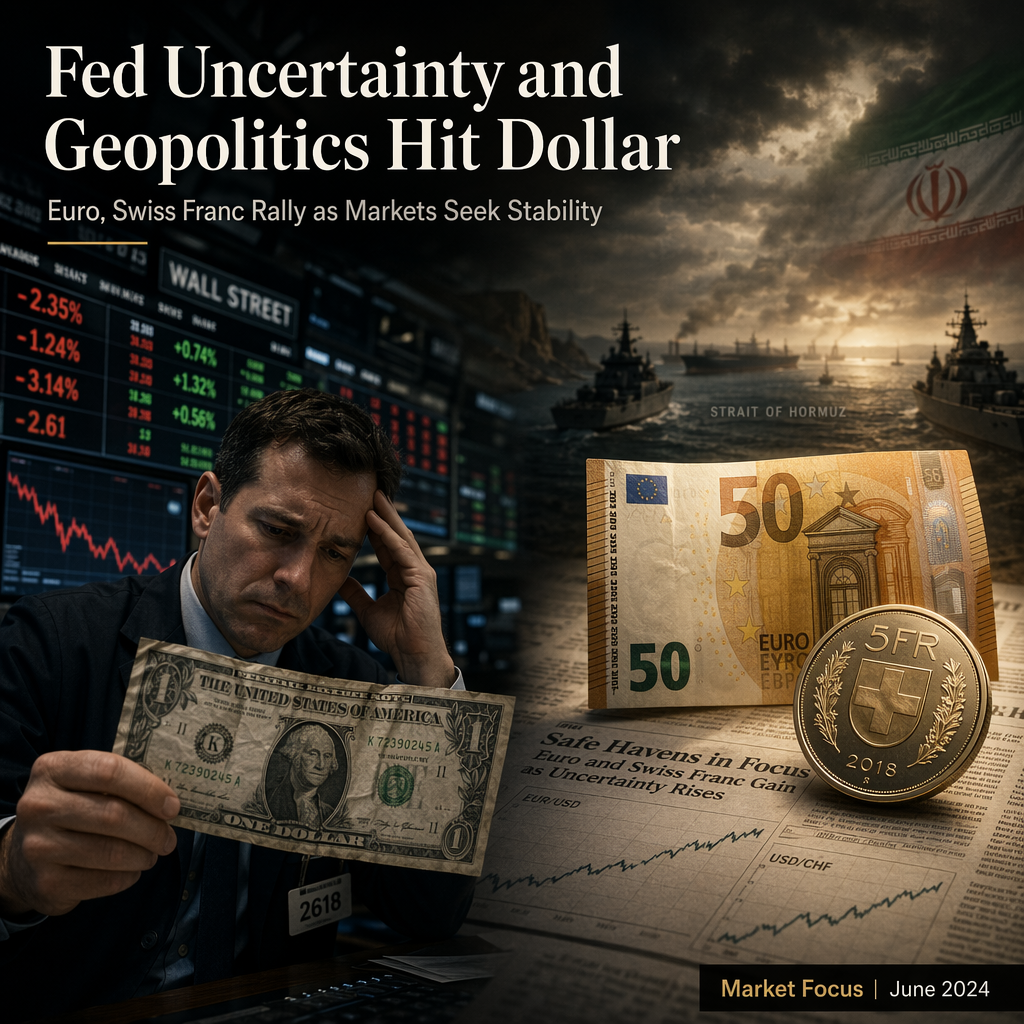
The US Dollar (USD) weakened against both the Euro (EUR) and the Swiss Franc (CHF) during Asian trading hours on Thursday, as markets reacted to the Federal Reserve's June Meeting Minutes and escalating geopolitical tensions between the US and Iran [1][2]. The EUR/USD pair extended its gains for a second consecutive day, trading around 1.1430, supported by anticipation of Germany’s Trade Balance data and upcoming Harmonized Index of Consumer Prices (HICP) figures [1]. Similarly, USD/CHF remained subdued near 0.8070, with the Swiss Franc benefiting from safe-haven demand amid rising inflation fears and geopolitical uncertainty [2].
The Federal Reserve’s June 16–17 meeting, which marked Kevin Warsh’s debut as FOMC Chairman, revealed a significant split among policymakers. Some committee members expected the benchmark rate—currently in the 3.50% to 3.75% range according to [1], or at 3.6% as stated in [2]—to remain unchanged or decrease by year-end, while others advocated for a rate hike due to persistent inflation pressures [1][2]. This division has led market participants to anticipate that the Fed will maintain higher interest rates for longer, with the CME FedWatch tool indicating that the probability of a rate hike at the next Fed meeting has surged to over 30%, up from less than 20% the previous week [1][2].
Geopolitical developments further influenced market sentiment. Following two days of renewed US military strikes, Iranian Parliament Speaker Mohammad Bagher Ghalibaf warned that any further American action would prompt immediate retaliation and reiterated Iran’s control over access to the strategic Strait of Hormuz, heightening concerns about potential energy supply shocks and global inflation [1][2]. This has provided some support to the US Dollar through safe-haven flows, but overall, the currency remains under pressure [1][2].
In Switzerland, the Swiss National Bank (SNB) reiterated its readiness to intervene in foreign exchange markets if necessary to prevent excessive appreciation of the CHF and to temper imported inflation [2]. The CHF’s safe-haven status was reinforced by these statements and the broader risk-off sentiment in global markets [2].
Traders are now shifting their focus to upcoming economic data releases, including Germany’s Trade Balance and HICP data, which could further influence the direction of the Euro [1].
CONCLUSION
The US Dollar is under pressure due to internal Fed policy divisions and heightened geopolitical risks, resulting in gains for both the Euro and Swiss Franc. Market participants are increasingly pricing in the possibility of a Fed rate hike, while upcoming European data and ongoing geopolitical developments remain key factors to watch.