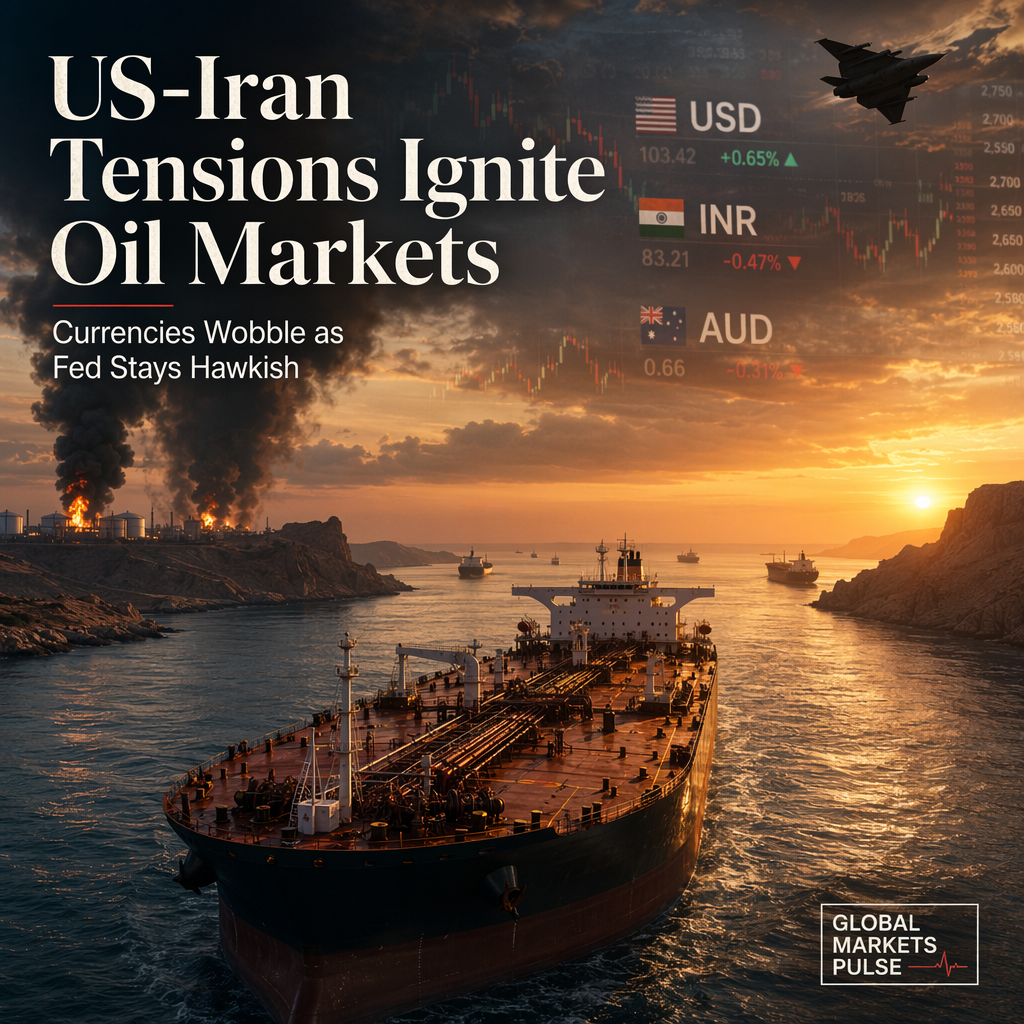
Geopolitical tensions in the Middle East escalated after the United States military conducted attacks on Iranian infrastructure, including the bombing of railway bridges in Iran on Wednesday, as reported by both sources [1][2]. According to Source 2, these strikes followed Iranian attacks on three commercial ships in the Strait of Hormuz, a critical passage for nearly 20% of global energy supply [2]. The collapse of the US-Iran memorandum of understanding (MoU), announced by US President Donald Trump, further heightened hostilities [2].
The immediate market reaction included a rise in oil prices, with the MCX Crude Oil contract expiring July 20 holding gains near Rs.7,115, up over 10% from last week's multi-month low of Rs.6,505 [2]. Higher oil prices are seen as unfavorable for oil-importing economies like India, pressuring the Indian Rupee (INR), while also supporting the appeal of safe-haven assets [1][2].
Despite the geopolitical risks and hawkish signals from the Federal Open Market Committee (FOMC) June meeting minutes, the US Dollar Index (DXY) traded marginally lower, near 100.92–100.95 at press time [1][2]. The FOMC minutes revealed that policymakers remain concerned about upside inflation risks, with several officials seeing the need for further tightening to ease price pressures [1][2].
In currency markets, the Australian Dollar (AUD) traded slightly higher at around 0.6935–0.6936 against the US Dollar (USD), but maintained a bearish near-term tone, remaining below the 20-period EMA at 0.6963, with key support at 0.6865 [1]. The Indian Rupee opened higher against the USD, with USD/INR dropping to near 95.44, though the pair retains a bullish bias as it trades above the 20-day EMA at 95.10 [2]. Foreign Institutional Investors (FIIs) continued to increase their stake in the Indian stock market, remaining net buyers for four consecutive trading days and raising their stake by Rs. 3,954.35 crore, despite the renewed geopolitical risks [2].
In Australia, Reserve Bank of Australia (RBA) Assistant Governor Sarah Hunter reiterated the central bank's readiness to act if needed to return inflation to target and maintain sustainable full employment, though traders had recently pared hawkish RBA bets due to cooling CPI data [1].
CONCLUSION
The escalation of US-Iran tensions has driven oil prices higher, pressuring currencies of oil-importing nations and supporting safe-haven demand. Despite hawkish FOMC minutes, the US Dollar softened, while the AUD and INR showed mixed performance amid ongoing geopolitical and monetary policy uncertainties. Market sentiment remains cautious, with investors closely monitoring further developments in the Middle East and central bank policy signals.