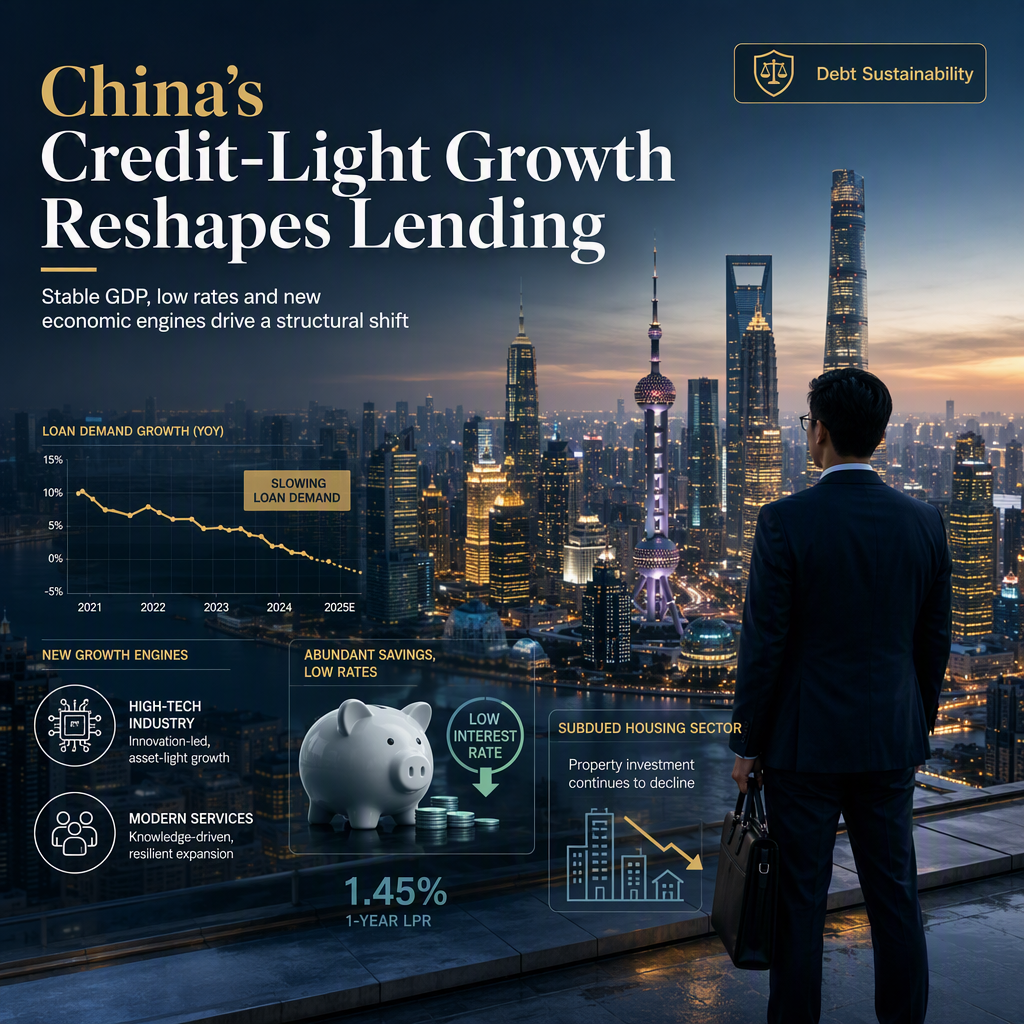
Standard Chartered analysts Carol Liao and Moriarty Lam report that China's loan growth has continued to decelerate, even as real Gross Domestic Product (GDP) remains relatively stable and recent reflation efforts have been implemented [1]. The slowdown in loan growth is broad-based, with housing-related lending contracting and loan growth in other sectors, including light industries and services, also slowing since 2023 [1]. The analysts highlight that China's new growth engines, particularly in services and high-tech industries, are less reliant on loans compared to traditional sectors such as housing and infrastructure [1].
This structural shift towards credit-light growth is considered critical for China's debt sustainability and the development of its financial markets [1]. The abundance of savings, coupled with softening loan demand, is expected to keep interest rates low for an extended period [1]. No specific figures, dates, or ticker symbols are mentioned in the article.
Market implications include a likely prolonged period of low interest rates, which may affect banking sector profitability and lending dynamics. The transition to direct financing and less loan-intensive sectors signals a fundamental change in China's economic structure, with potential impacts on credit markets and investor strategies [1].
No forward-looking statements or analyst opinions beyond the structural shift and its implications for debt sustainability and financial-market development are provided in the source [1].
CONCLUSION
China's shift towards credit-light growth is slowing loan demand across multiple sectors, despite stable GDP and recent reflation. This transition is expected to support debt sustainability and keep interest rates low for longer. Investors and market participants should monitor the evolving dynamics as China pivots to new growth engines.