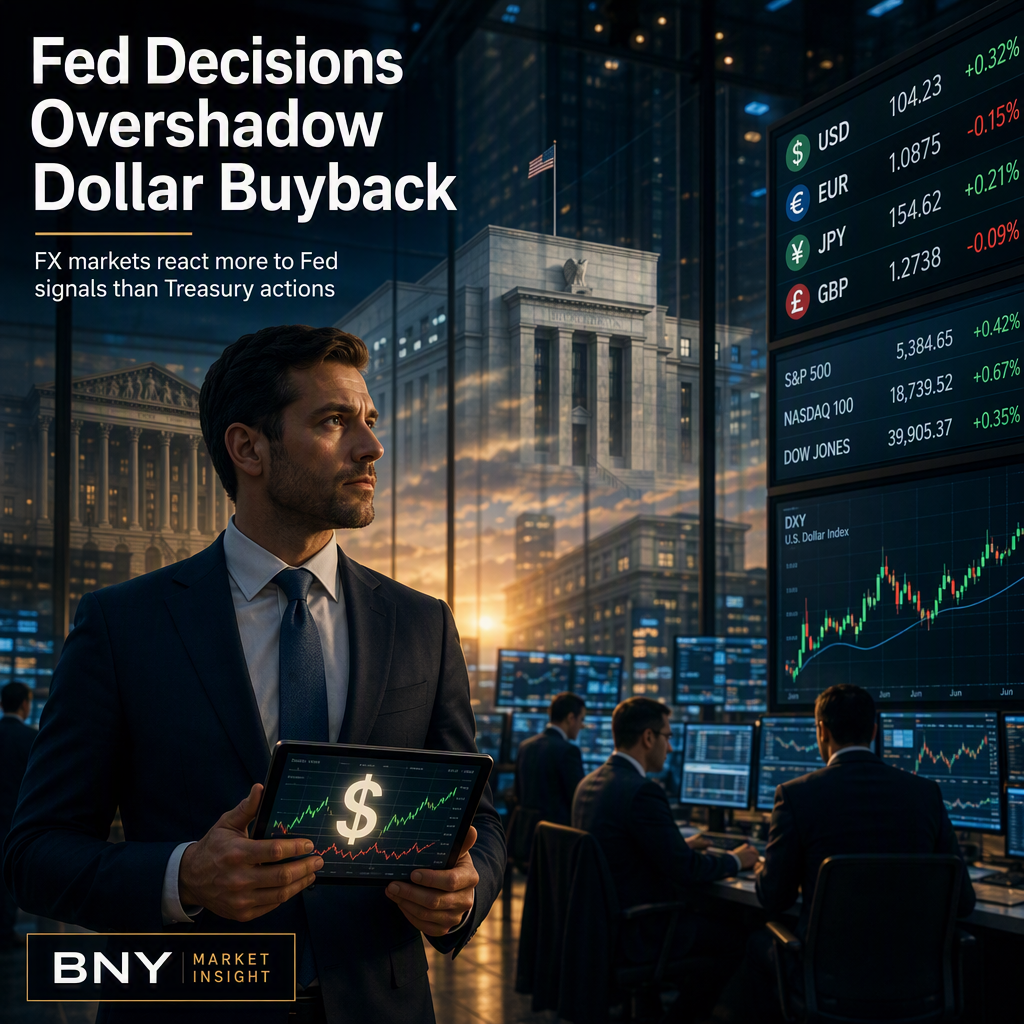
According to BNY's Geoff Yu, the impact of the recent US Treasury buyback on the US Dollar has been marginal, with cross-border exposures stabilizing and FX hedges remaining broadly unchanged over the past two weeks [1]. Yu notes that non-US domiciled investors are not significantly reducing their US asset exposures, and there has been some improvement in US equity holdings as risk sentiment has stabilized [1].
Yu emphasizes that the July Federal Reserve decision had a greater influence on FX markets than the Treasury buyback, stating that the drop in US exposures was primarily driven by an increase in dollar hedges rather than the buyback itself [1]. He explains that while the market initially reacted to the buyback announcement with a rally and yield retrenchment, the maneuver had limited direct effects on the market beyond this initial response [1].
Looking ahead, Yu suggests that unless US economic data and corporate earnings deteriorate, there is no strong impetus for a comprehensive rotation away from US assets, especially given the lack of attractive alternatives [1]. He advises monitoring dollar cash flows, FX hedging, inflation expectations, and US data for signs of a potential shift from tactical diversification to a more structural reduction in US exposure [1].
CONCLUSION
The market impact of the US Treasury buyback has been limited, with the Federal Reserve's decisions exerting a more significant influence on FX sentiment. Unless US economic fundamentals weaken, broad-based rotation away from US assets appears unlikely, and investors remain selectively diversified.