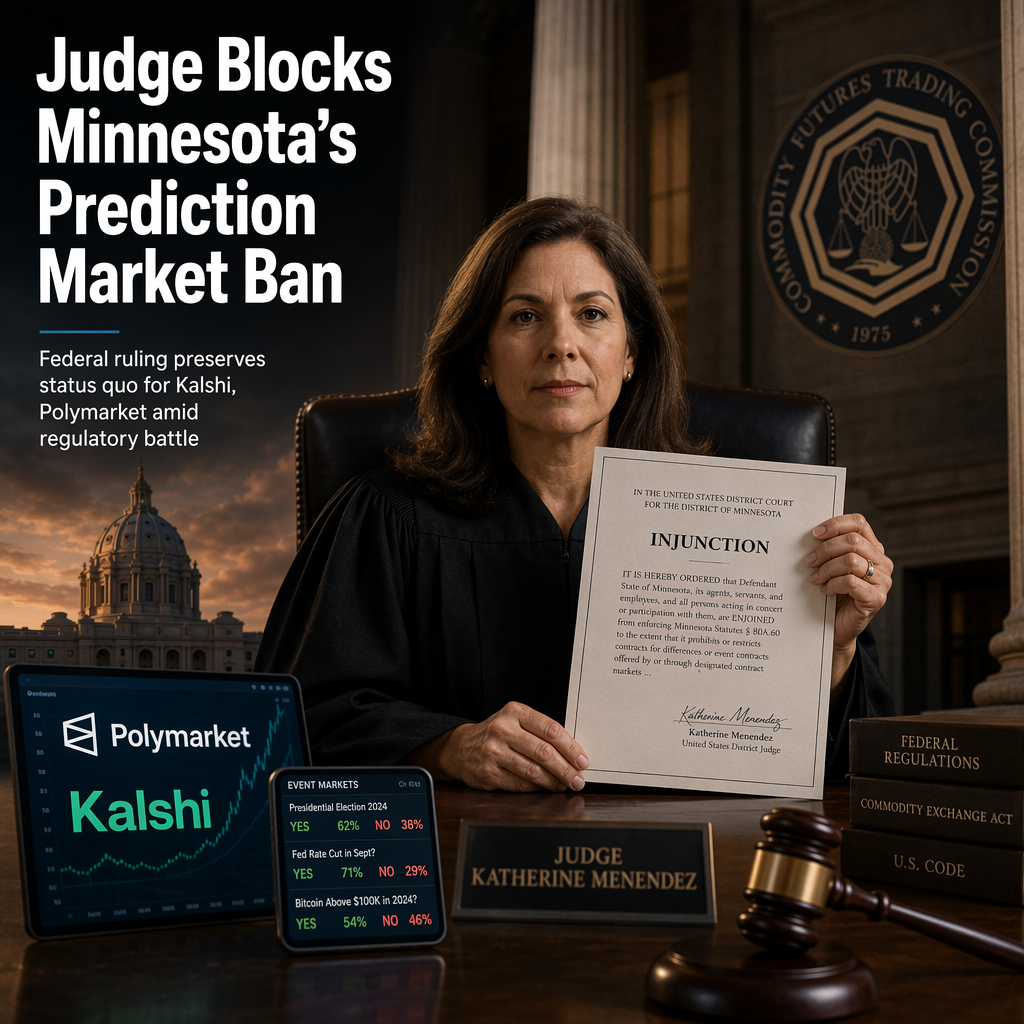
A federal judge has issued a preliminary injunction blocking Minnesota's impending ban on prediction markets, just days before the law was set to take effect on August 1, 2026 [1]. The injunction was granted after lawsuits were filed by the Justice Department, the Commodity Futures Trading Commission (CFTC), Kalshi, and Polymarket US, challenging the state's new law [1]. U.S. District Judge Katherine Menendez ruled that the plaintiffs demonstrated they are likely to succeed, at least in part, on their claims that federal law preempts the Minnesota ban and that they would face irreparable harm if the law were enforced [1]. The order specifically prohibits enforcement of the ban against entities registered as designated contract markets with the CFTC [1].
The plaintiffs argued that the CFTC holds exclusive authority to regulate event contracts traded on federally registered exchanges, and that Minnesota's law would disrupt a 'nationally uniform market' and cause irreparable harm to companies like Polymarket and Kalshi [1]. Polymarket also contended that the ban would violate their First Amendment right to advertise, though the court did not address this issue at this stage [1]. Judge Menendez noted that while the Minnesota statute may not be preempted in all applications, it is likely preempted in many respects, and the injunction maintains the status quo while further legal arguments are developed [1].
The CFTC has been actively opposing Minnesota's ban, initially requesting a court decision by July 17, 2026, and later indicating plans to escalate the matter to the appellate court if a response was not received promptly [1]. The Minnesota ban, embedded in a broader public safety bill, classified prediction markets as gambling and a public health and safety issue, according to state Rep. Emily Greenman [1]. The law did not penalize in-state residents for using prediction markets but prohibited companies from operating within the state [1].
The case reflects broader national scrutiny of prediction markets, with Arizona also taking action against Kalshi earlier in the year by filing criminal charges in March to ban transactions that mimic sports betting [1].
CONCLUSION
The federal court's decision to block Minnesota's prediction market ban preserves the operational status quo for companies like Kalshi and Polymarket, at least temporarily. The ruling highlights ongoing legal debates over state versus federal authority in regulating prediction markets and signals continued uncertainty for the industry as further court proceedings unfold.