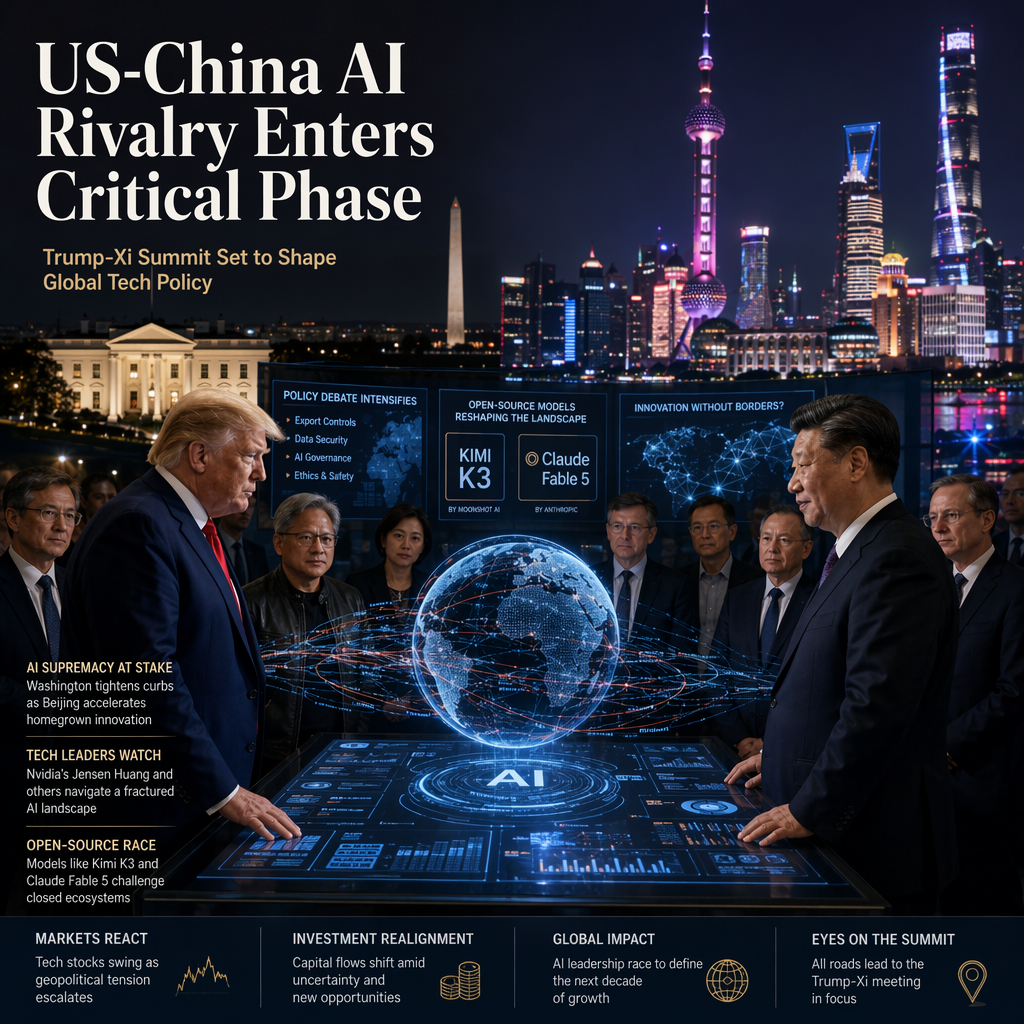
The ongoing competition between the United States and China in artificial intelligence (AI) is escalating, with both countries' companies dominating the global AI landscape and raising the stakes for bilateral relations [1]. Chinese President Xi Jinping delivered a significant AI speech on July 17, coinciding with the release of the Kimi K3 model, a rival to Claude Fable 5, marking a new phase in China's AI ambitions [1]. This development has triggered a strong response in Washington, where the release of Chinese open-weight AI models has led to a heated debate about potential restrictions. In response to U.S. government pushback, Nvidia's Jensen Huang and over 20 other tech companies signed an open letter on Friday opposing 'premature restrictions' on these models [1].
U.S. President Donald Trump announced plans to discuss AI with President Xi during a visit to the U.S. in late September, a move welcomed by Beijing, which expressed readiness to cooperate on AI matters [1]. The upcoming Trump-Xi summit in Washington, D.C., will be the first opportunity for the two leaders to address AI diplomacy directly [1]. Lex Zhao, managing partner at One Way Ventures, highlighted the commercial interdependence between the two nations, noting that many American startups utilize Chinese AI models and vice versa, which he believes limits the extent of unilateral actions either country can take [1].
China has recently hosted major AI-related events, including the World AI Conference in Shanghai and the APEC Digital Weeks in Chengdu, attended by nearly two dozen senior tech officials from various countries, including the U.S. [1]. George Chen of The Asia Group observed that Beijing now views AI as a diplomatic tool to attract more allies and partners, further underscoring the geopolitical significance of AI development [1].
The debate over open-source Chinese AI models and the upcoming high-level discussions between the U.S. and China signal that the AI rivalry is becoming a central issue in their broader relationship, with potential implications for global technology markets and international diplomacy [1].
CONCLUSION
The intensifying US-China AI rivalry, highlighted by the release of new Chinese models and upcoming Trump-Xi talks, is reshaping both diplomatic and commercial dynamics. The outcome of these discussions could have significant consequences for global technology policy and market access. Market participants are closely watching for signals on future cooperation or confrontation in the AI sector.