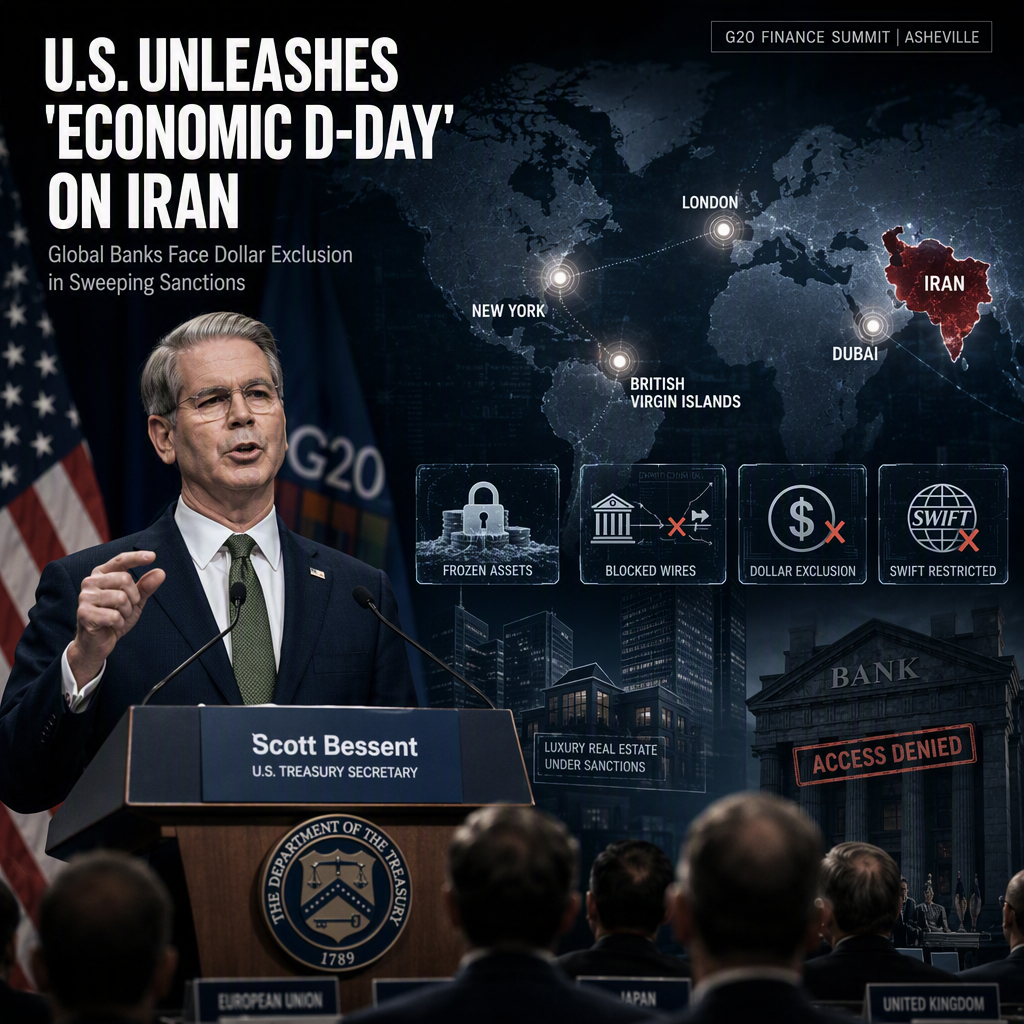
U.S. Treasury Secretary Scott Bessent announced a sweeping campaign of economic 'asphyxiation' targeting Iran, warning that the Trump administration is prepared to strip banks, firms, or other entities conducting business with the Iranian regime of access to the U.S. dollar-based financial system [1]. Speaking at the G20 Finance Ministerial in Asheville, North Carolina, Bessent detailed that the U.S. has identified offshore accounts held by the Islamic Revolutionary Guard Corps (IRGC) through trust companies and luxury real estate holdings [1].
Bessent explicitly stated that secondary sanctions would be imposed on any country or entity violating the embargo, including removal from the U.S. banking system, the Federal Reserve wire, and the SWIFT ledger, referencing a recent case involving a bank in Dubai [1]. He emphasized that the U.S. is tracking the IRGC's assets globally, including accounts in the British Virgin Islands and luxury properties valued at $100 million, with intentions to freeze these assets [1].
The Treasury Secretary asserted that the U.S. would collaborate with international partners to close down the regime's illegitimate assets, with the possibility of redirecting these funds to the Iranian people or victims of terror, such as families of soldiers from the USS Cole attack [1]. Bessent's remarks follow President Donald Trump's commitment to launch an 'economic D-Day' against Iran, likening the pressure campaign to the military strategy used against Nazi Germany [1].
The comprehensive sanctions are expected to have significant effects on Iran's economy and its population of more than 90 million people [1]. Bessent also stated the U.S. goal is to halt Iran's ability to develop nuclear weapons, maintain highly-enriched uranium, and project power through proxy networks [1]. He issued a clear ultimatum to the international community: 'either you are with us or against us' [1]. Representative Rich McCormick echoed Bessent's warning that any nation or bank aiding Iran will face secondary sanctions and exclusion from the U.S. dollar system [1]. Bessent also noted that the U.S. shares more common ground with China on the Iran issue than differences [1].
CONCLUSION
The U.S. Treasury's aggressive new sanctions regime signals a major escalation in economic pressure on Iran and its global partners. By threatening secondary sanctions and targeting offshore assets, the U.S. aims to isolate Iran financially and deter international cooperation with the regime. The measures are expected to have significant repercussions for global financial institutions and entities with exposure to Iran.