
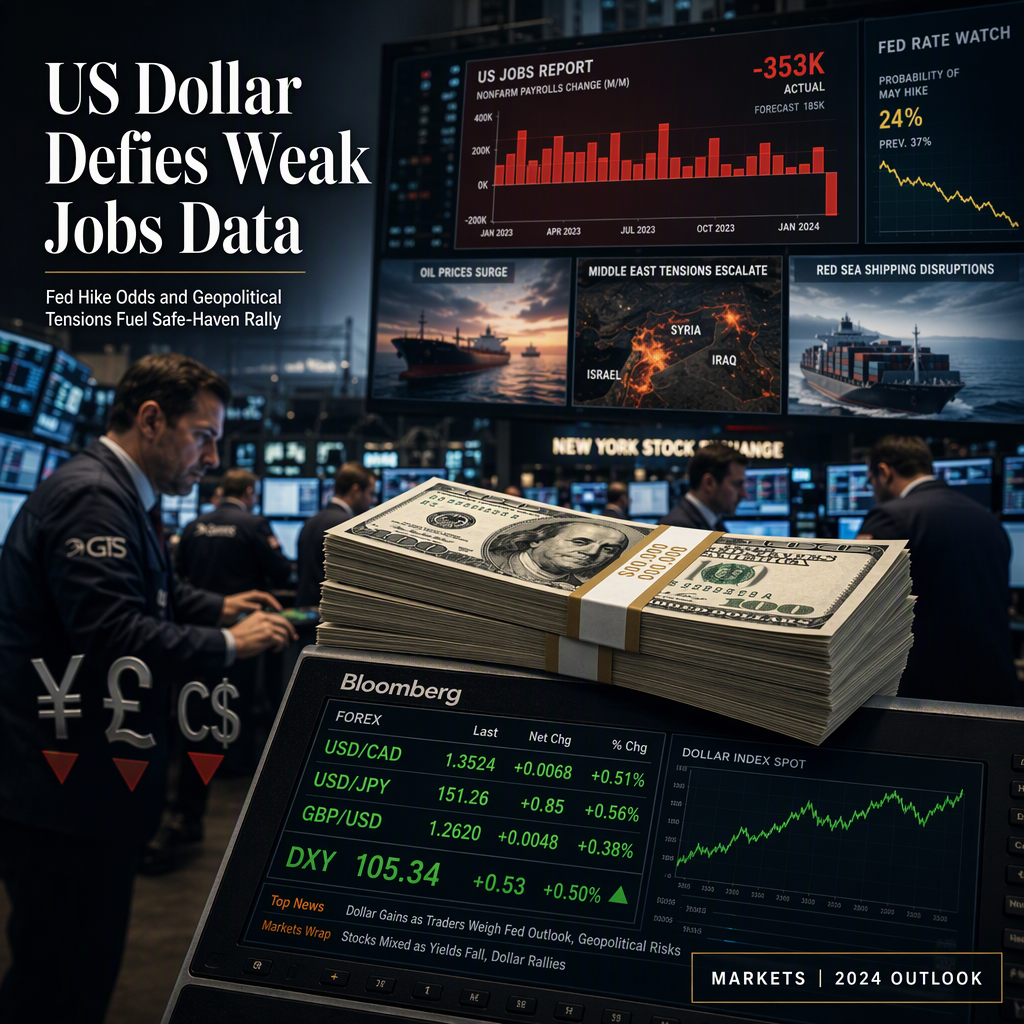
The US Dollar (USD) maintained its strength against major currencies at the start of the week, despite a weaker-than-expected US Nonfarm Payrolls (NFP) report for September. The NFP showed an increase of only 29,000 jobs, a significant miss compared to consensus forecasts of 90,000 and a sharp slowdown from August's downwardly revised gain of 133,000. The US unemployment rate also edged higher to 4.2%, while wage growth cooled to a 3% year-over-year rate and the labor force participation rate rose slightly to 61.8% [2][3].
Despite the soft labor data, traders are still pricing in over an 80% chance that the Federal Reserve (Fed) will hike interest rates by the end of the year, with the CME Group's FedWatch Tool indicating persistent expectations for a December move, driven by ongoing inflation risks from elevated energy prices [1][2]. However, the probability of a rate hike at the October meeting has decreased, with financial markets now assigning a 77.9% chance that the Fed will leave rates unchanged, up from 74% before the jobs report [3]. Analysts at ABN Amro noted that the recent labor market softness removes pressure for an October hike but still anticipate one more increase in December to counter inflationary pressures [2].
Geopolitical tensions, including the Middle East conflict, the Russia-Ukraine war, and developments in Yemen and Iran, have revived demand for the safe-haven US Dollar. This has contributed to the USD/CAD pair holding above the mid-1.4200s, near its highest level since April 2025, and supported the USD/JPY pair around the 157.70-157.75 region [1][2]. The Canadian Dollar (CAD) remains under pressure due to a dovish Bank of Canada stance, weaker crude oil prices, and US-Canada trade tensions, while the British Pound (GBP) has softened as the USD gains, despite improved UK growth forecasts and expectations for further Bank of England tightening [1][3].
Technical analysis across the pairs suggests that the USD/CAD uptrend could extend toward the 1.4300 mark, with support near 1.4200, while the USD/JPY maintains a constructive bias above key moving averages. GBP/USD trades around 1.3240 with a bearish near-term tone, and rallies are likely to be capped below key exponential moving averages [1][2][3].
Looking ahead, investors are closely watching the upcoming FOMC Minutes for further policy cues, while analysts highlight that resilient domestic activity in the UK could help support the Pound even as it trades near year-to-date lows against the Dollar [2][3].
CONCLUSION
Despite weaker US employment data, the US Dollar remains strong against the Canadian Dollar, Japanese Yen, and British Pound, supported by persistent Fed rate hike expectations and heightened geopolitical risks. Technical and fundamental factors suggest continued USD strength in the near term, though market participants are watching upcoming Fed communications for further direction.