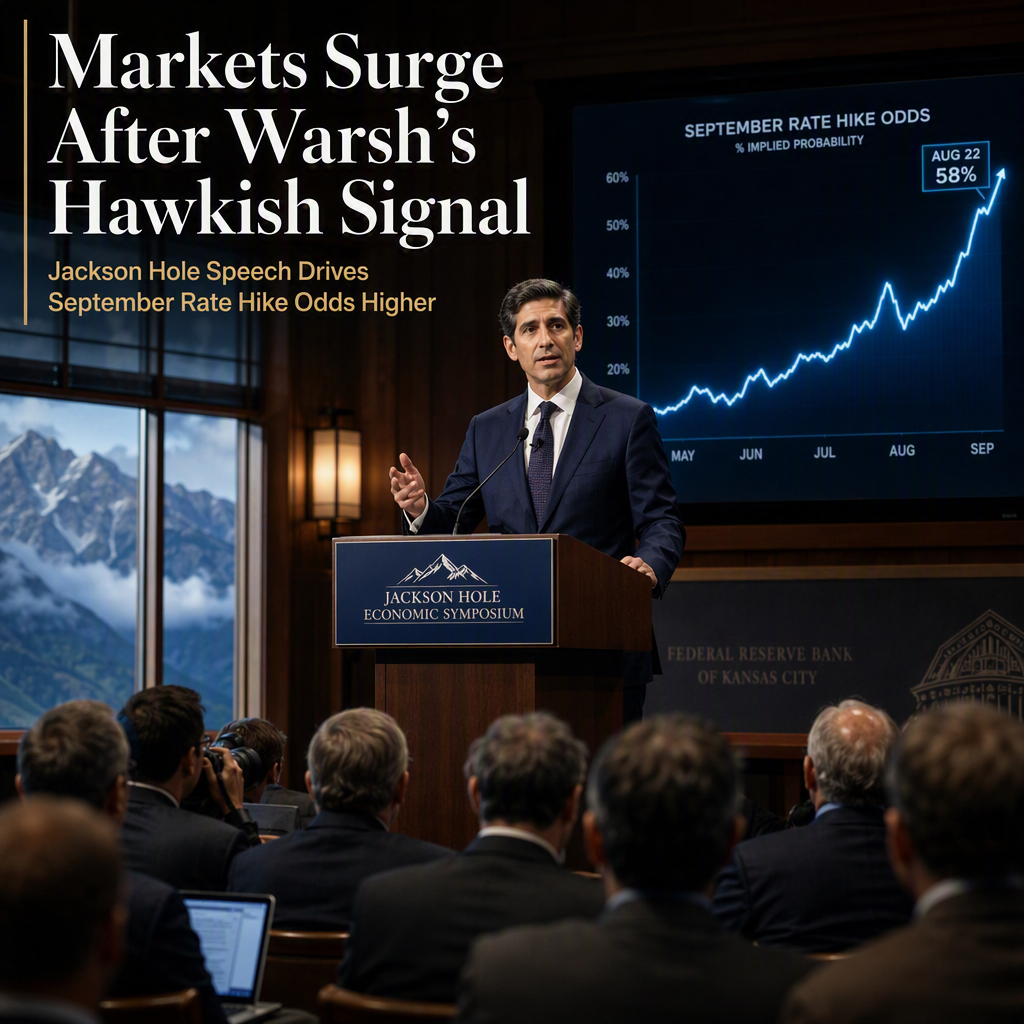
Federal Reserve Chairman Kevin Warsh's keynote speech at the Jackson Hole symposium on Friday led markets to sharply increase expectations for an interest rate hike at the upcoming Federal Open Market Committee (FOMC) meeting scheduled for September 15-16. Prior to Warsh's remarks, markets had priced in little likelihood of a rate increase before December, but following the speech, the probability of a September hike jumped to 66.1% on Monday, nearly double the level before Warsh spoke, according to CME Group's FedWatch tool [1].
Warsh emphasized the need for confidence that underlying inflation is moving toward the Fed's objective "clearly and at sufficient speed," stating, "Otherwise, we have work to do." He acknowledged that recent inflation numbers have been soft but argued that the progress is insufficient and does not indicate a meaningful improvement in underlying trends [1].
Despite the market's reaction, some participants and analysts remain skeptical about the necessity of a rate hike. Treasury Secretary Scott Bessent, speaking from the G20 summit in Asheville, N.C., argued that the current environment reflects a supply shock and that "traditionally you don't raise into a supply shock unless you see second- or third-order effects," noting that core inflation has remained "very, very restrained" [1]. Citigroup economist Andrew Hollenhorst described Warsh's comments as only "marginally" more hawkish than usual and pointed out that recent economic data does not indicate an urgent need for tighter monetary policy [1].
The Fed will receive additional reports on labor, housing, and consumer spending before the September meeting, which could further influence the decision. The path to a rate hike remains uncertain, with Warsh's remarks prompting a repricing in market expectations but not convincing all observers of the necessity for immediate action [1].
CONCLUSION
Chairman Warsh's Jackson Hole speech significantly increased market expectations for a September rate hike, but skepticism remains among some analysts and policymakers regarding the urgency for tighter policy. The final decision will likely depend on upcoming economic data, leaving the market in a state of heightened anticipation.