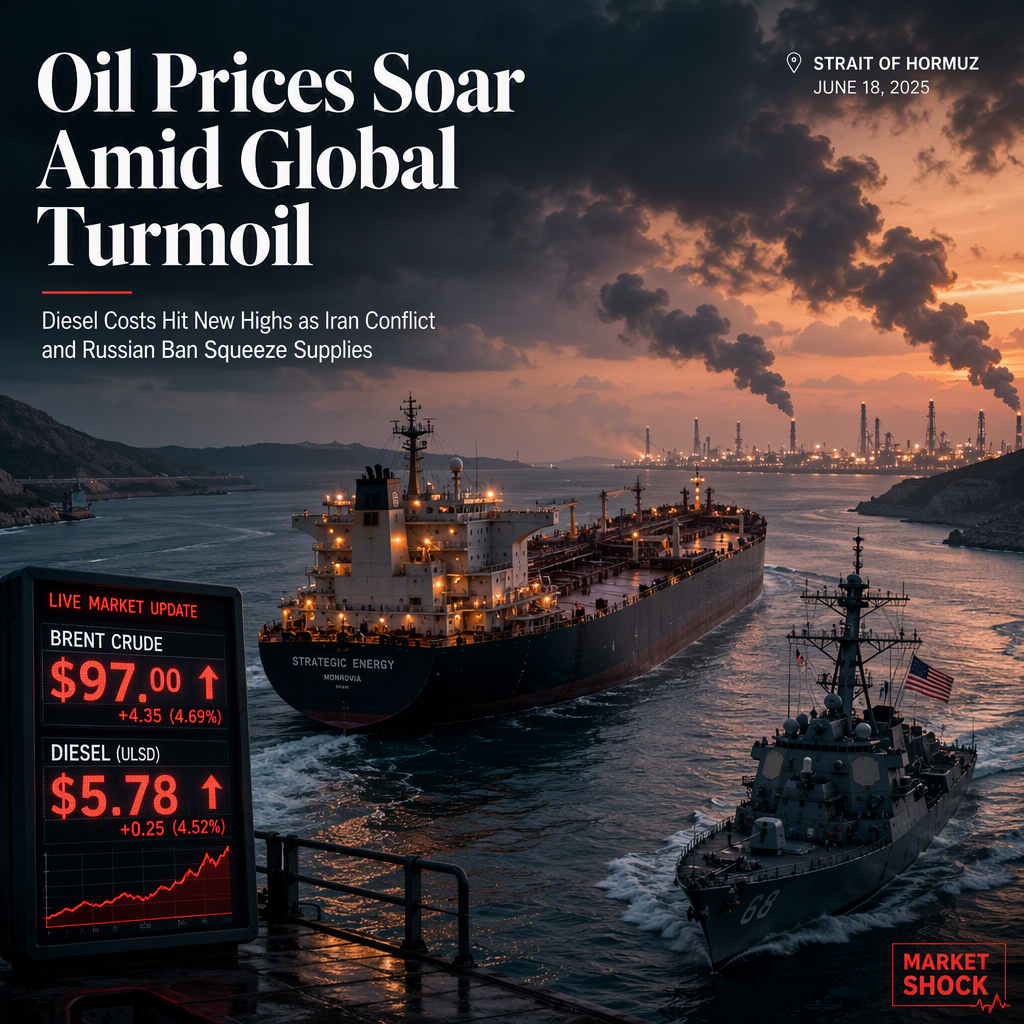
Crude oil prices climbed for a fourth consecutive trading session, with international benchmark Brent surpassing $97 per barrel on Thursday morning, marking an increase of nearly 10% since the start of the week [1]. This surge in oil prices has contributed to a sharp rise in diesel costs, which reached $5.78 per gallon on Thursday, up more than 53% from $3.76 per gallon in late February when the war with Iran began [1]. The average price of unleaded gasoline also increased, reaching $4.14 per gallon, a two-cent rise from the previous day [1].
The escalation in energy prices is primarily attributed to the ongoing war in Iran, which has severely disrupted major maritime routes for oil and gas. Attacks on ships in the Strait of Hormuz and retaliatory U.S. strikes on Iranian targets have reduced daily vessel traffic through this critical waterway, which previously handled about 20% of the world’s oil supply [1]. Additionally, the recent intensification of the Ukraine war has led Russia to ban diesel exports until the end of September following Ukrainian drone attacks on refineries, further tightening global supply. ING commodities analysts noted that these combined disruptions account for approximately 20% of global seaborne diesel trade [1].
Experts warn that higher diesel prices could lead to increased grocery costs later in the year, as diesel powers essential agricultural and transportation equipment worldwide [1]. Analysts suggest that only two developments could bring significant relief to oil and gas prices: increased flow through the Persian Gulf or the resumption of Russian exports [1].
Despite President Donald Trump’s statement that recent U.S. strikes on Iran would not last long and his assertion that U.S. forces are facilitating vessel movement through the Strait of Hormuz, these comments have not alleviated market pressures [1]. Goldman Sachs Research estimated last week that Persian Gulf oil exports have recovered to about two-thirds of pre-war levels [1].
CONCLUSION
The ongoing conflict in Iran and Russia’s diesel export ban have driven oil and diesel prices to multi-year highs, with significant implications for global supply chains and consumer costs. Market relief appears unlikely without a resolution to these geopolitical disruptions, keeping energy prices elevated in the near term.