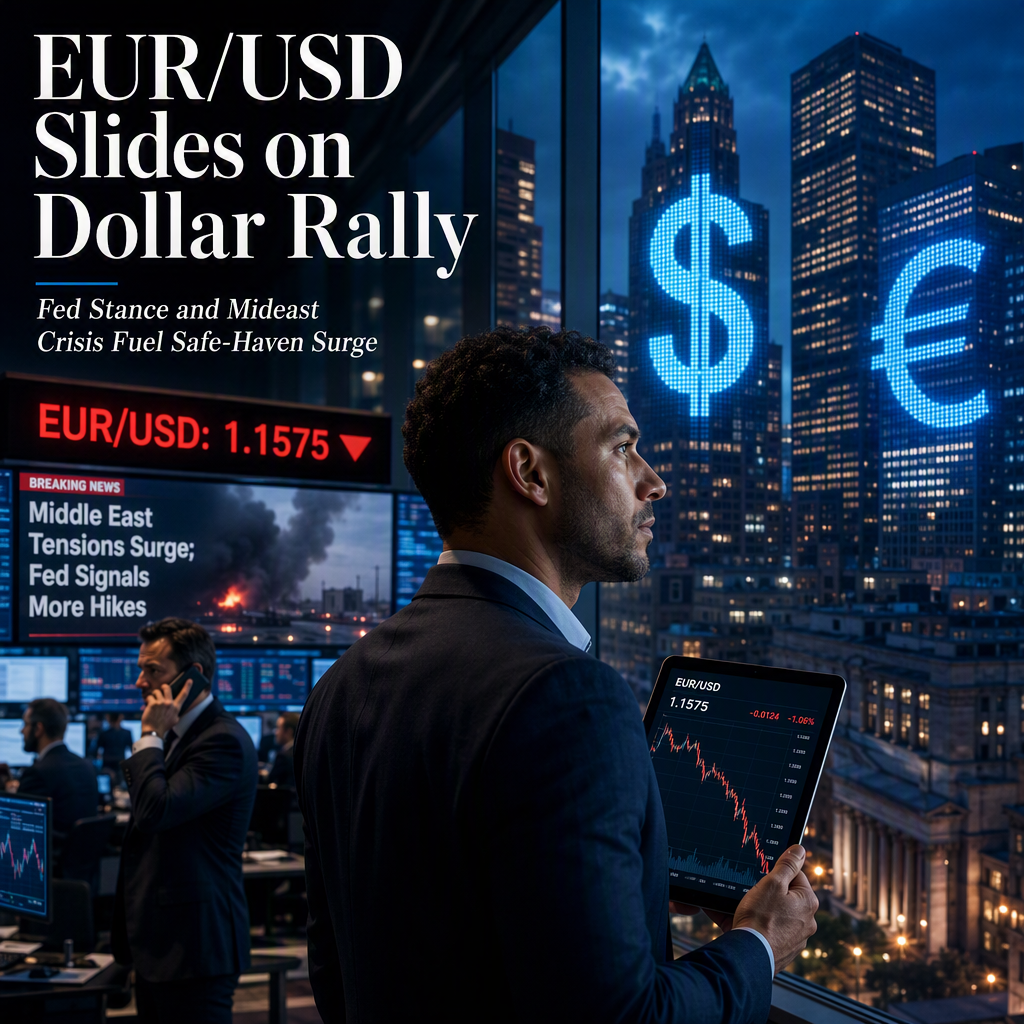
The EUR/USD currency pair weakened to around 1.1575 during the early European session on Wednesday, as the US Dollar gained strength against the Euro. This move was driven by a combination of a hawkish stance from the Federal Reserve and escalating geopolitical tensions in the Middle East. Specifically, Iran’s Islamic Revolutionary Guard Corps (IRGC) claimed responsibility for a 'heavy' ballistic missile attack on Prince Hassan airbase and a US Marine base in Jordan, in retaliation for earlier US strikes that reportedly killed civilians. The US military confirmed it had completed a wave of strikes against Iranian targets following attempted attacks by Iran on commercial shipping and American service members. These developments have heightened safe-haven flows, supporting the US Dollar and creating headwinds for the EUR/USD pair [1].
Additionally, comments from Fed Chair Kevin Warsh at the Jackson Hole symposium contributed to the US Dollar's upside. Warsh warned that policymakers may need to tighten monetary policy further if inflation does not convincingly move toward the 2% target. Following his remarks, market expectations for a September Fed rate hike increased to 68%, up from below 40% prior to his speech, according to the CME FedWatch tool [1].
On the European side, BNY’s Geoff Yu noted that European Central Bank (ECB) officials remain cautious about the inflation outlook. One ECB policymaker warned that prolonged disruption could sustain inflation pressure even without a wage-price spiral. Yu suggested that this perspective reinforces the likelihood of another ECB rate hike in September, with policymakers appearing more assertive than their peers in addressing inflation risks [1].
From a technical standpoint, EUR/USD retains a neutral outlook in the near term. The pair is just above the 100-day simple moving average (SMA) at 1.1565, which provides immediate support, but remains below the 20-day Bollinger middle band, capping upward movement. The Relative Strength Index (RSI) at 49.8 indicates directionless momentum, with the pair consolidating between support and resistance levels. Key resistance is at 1.1600 and 1.1710, while a break below 1.1565 could open the door to further declines toward 1.1490 [1].
Traders are closely watching upcoming Eurozone Retail Sales and US employment data, both due on Friday, for further direction [1].
CONCLUSION
EUR/USD has come under pressure due to a stronger US Dollar, fueled by Fed hawkishness and rising geopolitical tensions in the Middle East. Market participants are now focused on upcoming economic data and central bank policy signals, with both the Fed and ECB showing a bias toward further tightening. The pair remains in a consolidation phase, with technical indicators suggesting a neutral near-term outlook.