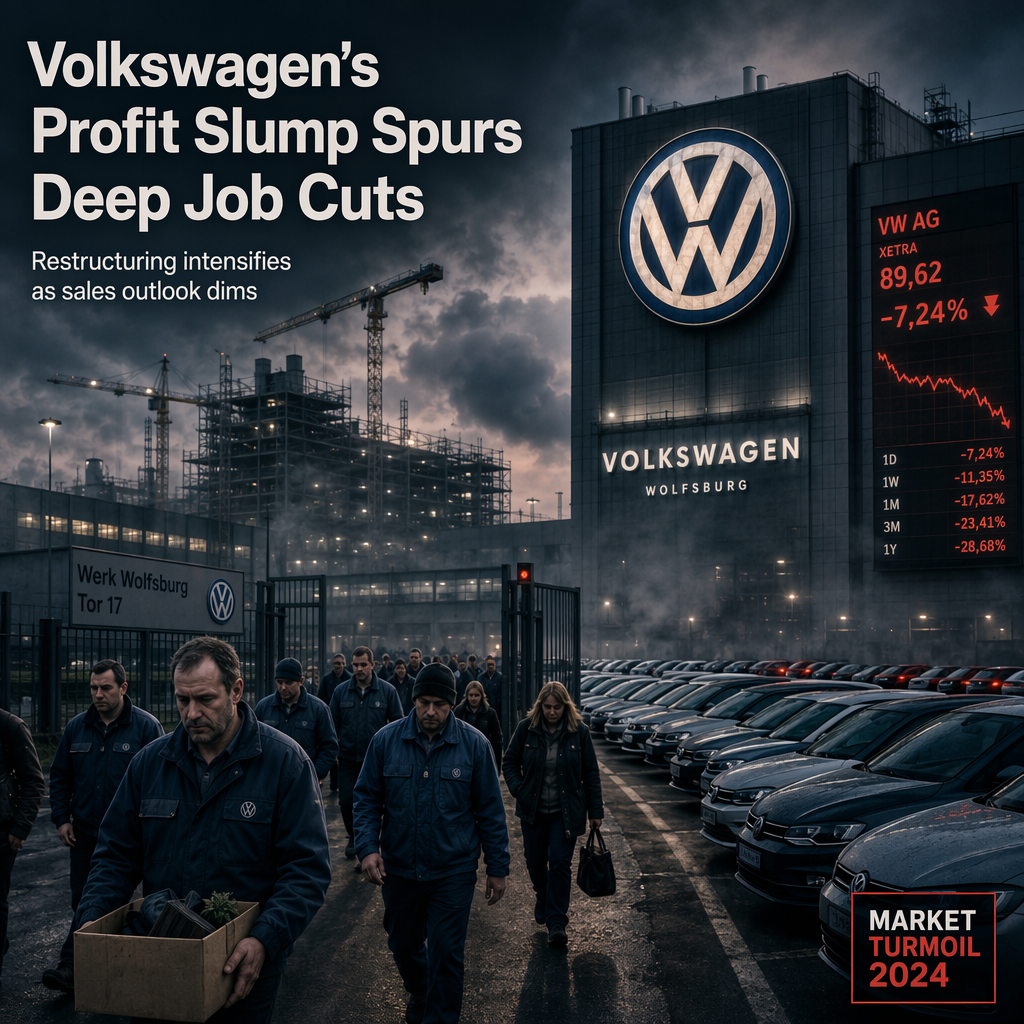
Volkswagen reported an operating profit of 3.5 billion euros ($3.98 billion) for the April to June period, representing a decline of nearly 10% compared to the same period last year [1]. This result missed analyst expectations, as the consensus forecast was 4.3 billion euros according to LSEG data [1]. The company also announced it is abandoning its previous target for sales revenue growth in 2026, now expecting a decline of up to 3% instead of the previously forecasted growth of up to 3% [1].
The profit slump comes as Volkswagen prepares for a significant restructuring, including plans to cut up to 100,000 jobs—double the number previously stated—in response to billions of euros in tariff costs and intensifying competition from Chinese car brands [1]. CEO Oliver Blume highlighted that the group's costs are 20% higher than comparable businesses, necessitating further cost reductions [1]. He also noted that the company has not been able to confirm alternative uses for four German factories previously threatened with closure: Hanover, Zwickau, Emden, and the Audi facility in Neckarsulm [1]. An agreement with unions in late 2024 had previously avoided factory closures in Germany and ruled out compulsory redundancies until the end of 2030 [1].
Blume described the current environment as 'extremely challenging,' citing geopolitical crises, trade conflicts, high regulatory requirements, volatile markets, and intensified competition as key risks [1]. He stated that Volkswagen is entering the next phase of its transformation 'from a position of strength and with a clear understanding of the opportunities ahead' [1].
Market reaction has been negative, with Volkswagen shares down nearly 30% year-to-date and falling 3.3% in premarket trading following the announcement [1]. The company also recently ended production of the ID.4 electric SUV at its Tennessee plant, citing a challenging U.S. environment for electric vehicles [1].
CONCLUSION
Volkswagen's disappointing profit results and the abandonment of its 2026 sales growth target have intensified investor concerns, as reflected in the company's significant share price decline. The planned job cuts and ongoing restructuring underscore the challenges Volkswagen faces from rising costs and global competition. The market is reacting negatively, with uncertainty surrounding the company's transformation efforts.