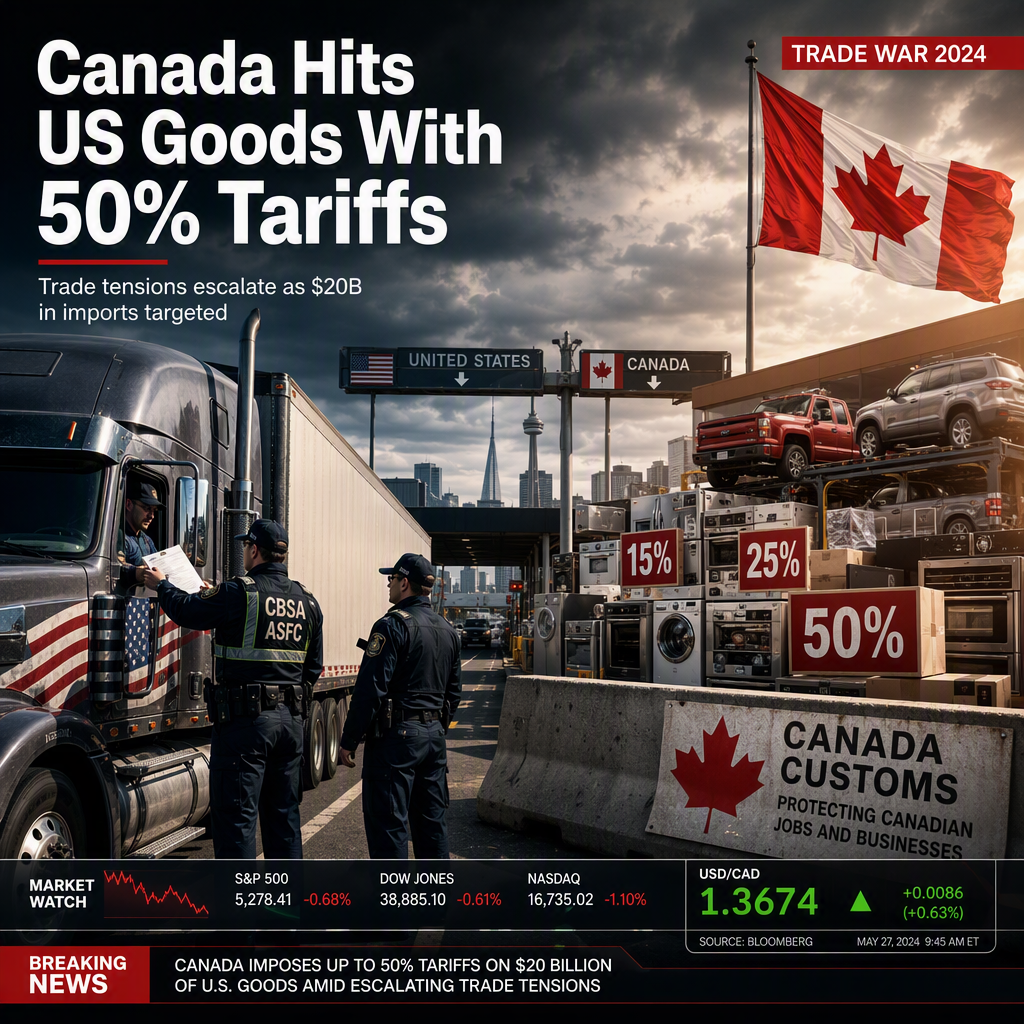
Canada has announced the implementation of retaliatory tariffs of up to 50% on $20 billion worth of US goods, following Prime Minister Mark Carney’s commitment to match US President Donald Trump’s tariffs 'dollar for dollar' [1]. The Canadian government stated that these measures will take effect from September 8 and will apply duties of 15%, 25%, and 50% across 700 different products [1]. Canadian Finance Minister François-Philippe Champagne described the situation as 'an unprecedented challenge imposed on Canada,' but affirmed that 'Canada will meet the moment' [1].
This move comes in direct response to President Trump’s announcement that he will increase tariffs on Canada-made cars and auto parts starting in January [1]. The tit-for-tat escalation underscores rising trade tensions between the two countries, with both sides targeting key sectors of each other's economies. At the time of reporting, the USD/CAD currency pair was up 0.03% on the day at 1.3842, indicating a modest market reaction to the news [1].
The article also provides context on tariffs, explaining that they are customs duties levied on imports to protect domestic industries and can be used as tools of protectionism [1]. It notes that while some economists support tariffs for protecting local producers and addressing trade imbalances, others warn that such measures can drive up prices and risk triggering damaging trade wars [1].
President Trump’s broader tariff strategy, especially in the lead-up to the November 2024 presidential election, targets major US trading partners including Mexico, China, and Canada, which together accounted for 42% of total US imports in 2024 [1]. Trump has indicated that tariff revenues could be used to lower personal income taxes [1].
CONCLUSION
Canada’s decision to impose up to 50% retaliatory tariffs on US goods marks a significant escalation in trade tensions with the United States. The market response has been relatively muted so far, but the situation introduces heightened uncertainty for cross-border trade and key industries. Both governments appear committed to their respective tariff strategies, suggesting the potential for further escalation.