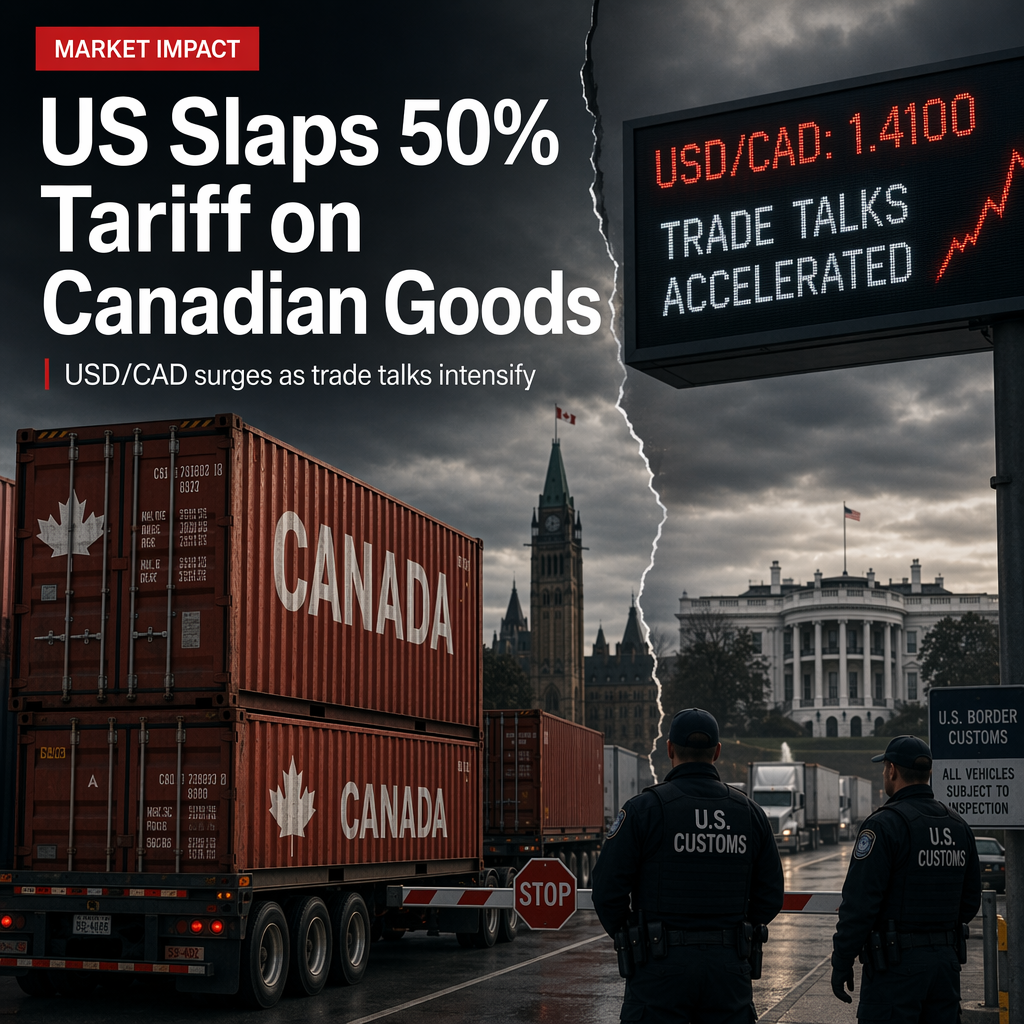
The United States has announced a new 50% tariff on most Canadian goods, a significant escalation in trade tensions between the two countries. The White House framed this move as retaliation for alleged trade discrimination against US products, with US Trade Representative Jamieson Greer confirming on television that similar actions against dozens of countries are imminent, as part of a broader wave of tariffs expected before the current 10% global regime expires [1].
The announcement had an immediate impact on the currency markets, with USD/CAD trading just above the 1.4100 level in the North American afternoon, up around 0.2% and on track for a second consecutive daily advance. This follows a July decline from the year's high near 1.4250, with the pair finding support at the 50-day EMA last week. The market interpreted the tariff headlines primarily as a US Dollar story, but also as a negative for Canadian growth prospects [1].
In response, Canadian Prime Minister Mark Carney agreed to accelerate trade talks with Washington, opting for negotiation rather than immediate retaliation. This move aligns with the United States-Mexico-Canada Agreement (USMCA) review cycle, after the US declined to renew the pact in its current form at the July 1 joint review, triggering annual reviews until the deal is extended or expires in 2036 [1].
The Bank of Canada's July Monetary Policy Report had assumed an average US tariff rate on Canada of 5.0%, with 1.5% in the opposite direction. However, the actual tariff imposed by the US administration is now 50%, rendering the central bank's projections outdated. The report also assumed the Canadian dollar would average roughly $0.71, and every cent below that level is expected to import inflation into an economy already in technical recession. As a result, markets have fully priced in a Bank of Canada rate hike by the December 9 meeting, with the weakening currency and tariff risks reinforcing expectations for tighter monetary policy [1].
Additionally, June's US import price index reached a record 150.8 points, highlighting the broader cost implications of tariff increases, even before this latest round was announced [1].
CONCLUSION
The US's imposition of a 50% tariff on Canadian goods marks a sharp escalation in trade tensions, immediately pressuring the Canadian dollar and prompting accelerated trade negotiations. With markets now fully pricing in a Bank of Canada rate hike and inflation risks rising, the tariff move is expected to have significant economic and market repercussions for both countries.