
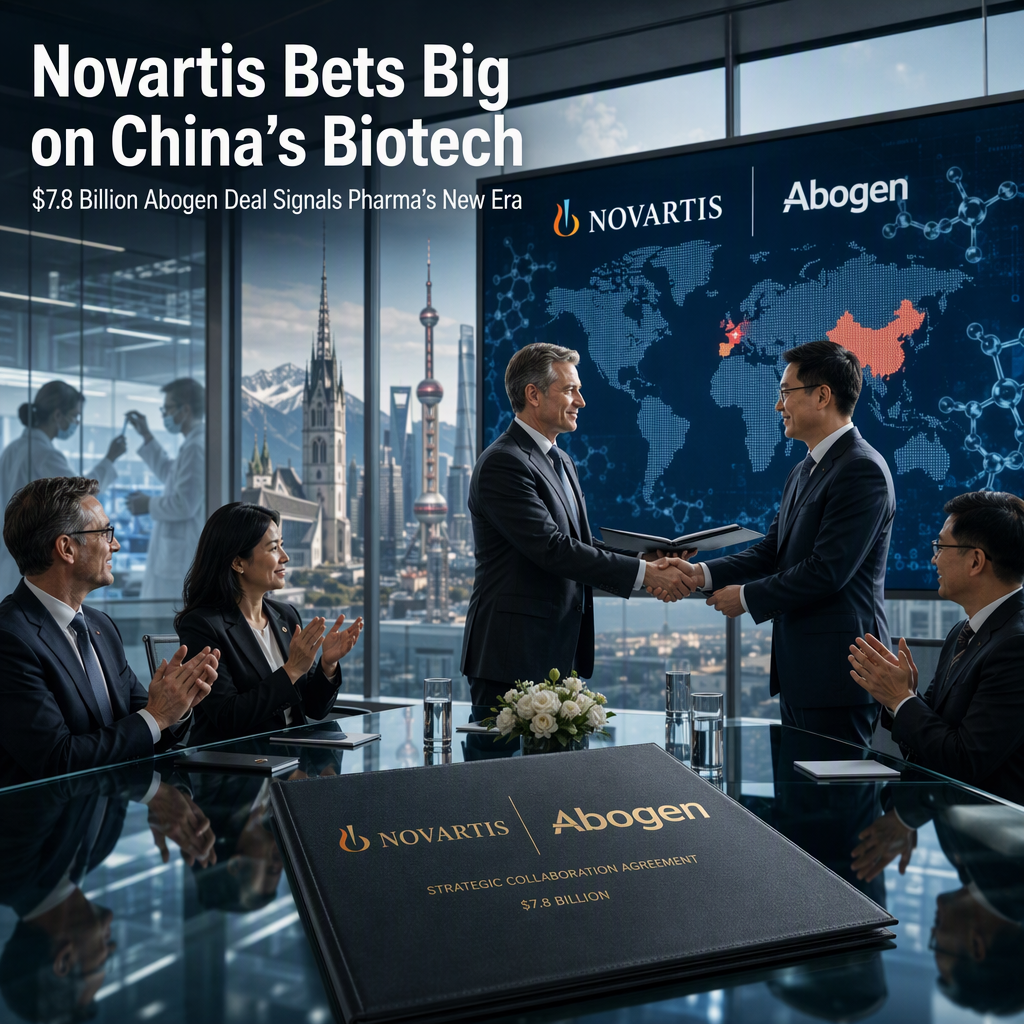
Novartis has entered into a licensing agreement with Chinese biotech Abogen Biosciences, valued at up to $7.8 billion, as part of a broader trend of Western pharmaceutical companies seeking new drug assets in China to address looming patent expirations on top-selling drugs in the early 2030s [1]. The deal includes a $575 million upfront payment for global rights to Abogen's lead messenger RNA therapy for autoimmune disease, with an additional $7.2 billion in milestone payments. Novartis also secured an exclusive option to license further assets developed on Abogen's RNA platform [1].
This agreement follows a series of similar deals, including Novo's exclusive licensing agreement with Hengrui Pharma for an early-stage GLP-1/GIP pill worth up to $2.6 billion, as Novo seeks to find a successor to its semaglutide-based drugs Wegovy and Ozempic amid falling share prices and increased competition in the anti-obesity market [1]. GSK also announced in mid-September the acquisition of a blood cancer medicine from Chinese Chimagen Biosciences for up to $750 million. GSK's head of business development, Chris Sheldon, highlighted the rapid increase in China's share of new biotech innovation [1].
Market reactions have been notable: Novartis' shares experienced their largest drop since 1987 last month following several clinical trial setbacks, raising concerns about the company's ability to replenish its drug pipeline ahead of the patent cliff [1]. ING estimates that by 2026, China will contribute about a third of all new molecules in global pharma pipelines, up from 4% in 2014, and expects the value of Chinese biotech outlicensing deals to surpass $250 billion in 2026 [1].
Additionally, AstraZeneca announced a partnership with Summit Therapeutics to test its oncology drugs in combination with Summit's ivonescimab, which was developed by Chinese biotech Akeso and licensed to Summit, further underscoring the growing integration of Chinese-developed drugs into global pharmaceutical development programs [1].
CONCLUSION
The Novartis-Abogen deal exemplifies a strategic shift by Big Pharma toward Chinese biotech innovation as companies seek to offset the impact of upcoming patent expirations. With significant financial commitments and increasing integration of Chinese assets into global pipelines, the market is witnessing high-value collaborations that could reshape the pharmaceutical landscape in the coming years.