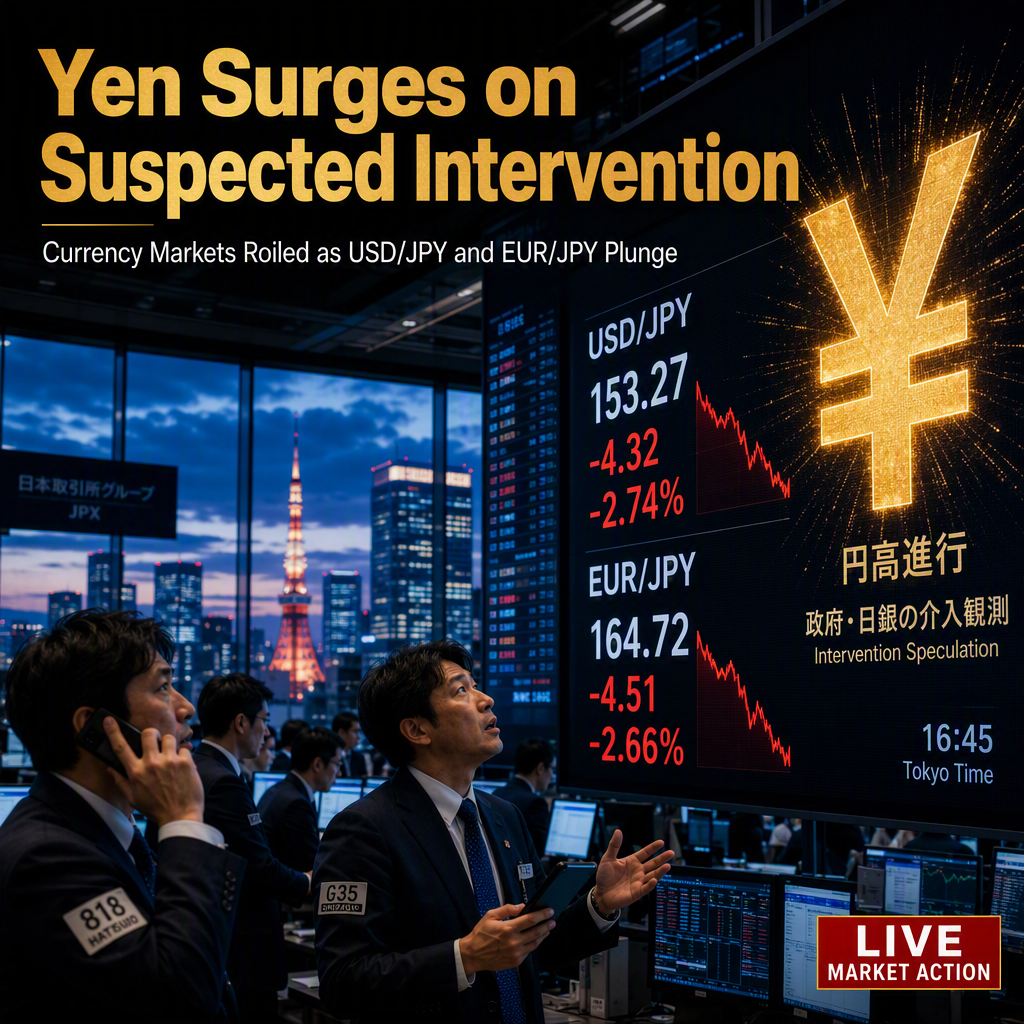
The Japanese Yen experienced a dramatic surge on Thursday, with multiple sources attributing the move to suspected intervention by Japanese authorities in the foreign exchange market, though no official confirmation was available at the time of reporting [1][3][4]. The USD/JPY pair plunged below 161.00, down as much as 1.8% on the day to 160.55 according to one source [1], while another reported it trading around 162.90, down 0.31% [2], and a third noted a sharp drop below 161.00 [3]. The EUR/JPY pair tumbled by as much as 2.26%, losing nearly 400 pips in minutes to trade around 183.10 [3], with other Yen crosses such as GBP/JPY also posting significant losses [1][3]. The Yen was the strongest performer against the US Dollar, with percentage changes ranging from 1.8% to 2.58% depending on the source and time of reporting [1][3][4].
This sharp appreciation in the Yen occurred in the absence of a clear economic catalyst, reinforcing speculation that the Japanese Ministry of Finance had intervened to support the currency after persistent weakness and previous warnings of 'decisive' action [1][3]. The move recalls a similar episode at the end of April, when Japanese authorities were reported to have intervened after the Yen's rapid depreciation [3]. Market participants are now closely watching for official confirmation and further price action, as volatility remains elevated [1][3].
The Yen's rally coincided with broader US Dollar weakness following the Federal Reserve's decision to leave its benchmark interest rate unchanged at 3.5%-3.75% on Wednesday, with three dissenting votes in favor of a hike [2][4]. The US economy grew at an annualized rate of 1.5% in the second quarter, below the 2.1% market forecast and the previous quarter's 2.1% growth [2][4]. Inflation data showed the Core PCE Price Index rising 0.1% month-on-month in June and slowing to 3.3% year-on-year, matching expectations but remaining above the Fed's 2% target [2][4]. The US Dollar Index (DXY) fell 0.80% on the day, trading near 100 [4].
On the European side, the Euro drew support from stronger-than-expected growth data, with Eurozone GDP expanding 0.4% quarter-on-quarter and 1% year-on-year in the second quarter, both beating forecasts [3][4]. Germany's GDP grew 0.2% QoQ, also exceeding expectations [3][4]. Strategists at Brown Brothers Harriman noted that the ECB projects real GDP growth to average 0.8% in 2026, with risks skewed to the downside, but the current recovery and above-target inflation could reinforce the case for further ECB rate hikes [4].
Looking ahead, market attention is focused on the Bank of Japan's policy decision on Friday, where the central bank is widely expected to leave its policy rate unchanged at 1% [2][3]. Investors will be watching for updated economic projections and comments from Governor Kazuo Ueda for clues on the timing of any future rate hikes, with some speculation about a move as early as October or as late as December [2][3]. A more hawkish message from the BoJ could provide additional support for the Yen and maintain downward pressure on USD/JPY [2][3].
CONCLUSION
The Japanese Yen's sudden surge, widely attributed to suspected government intervention, triggered sharp declines in USD/JPY and EUR/JPY, amplifying volatility across currency markets. The move coincided with US Dollar weakness following disappointing US economic data and a dovish Fed, while strong Eurozone growth data supported the Euro. Market participants are now focused on the upcoming Bank of Japan decision for further direction.