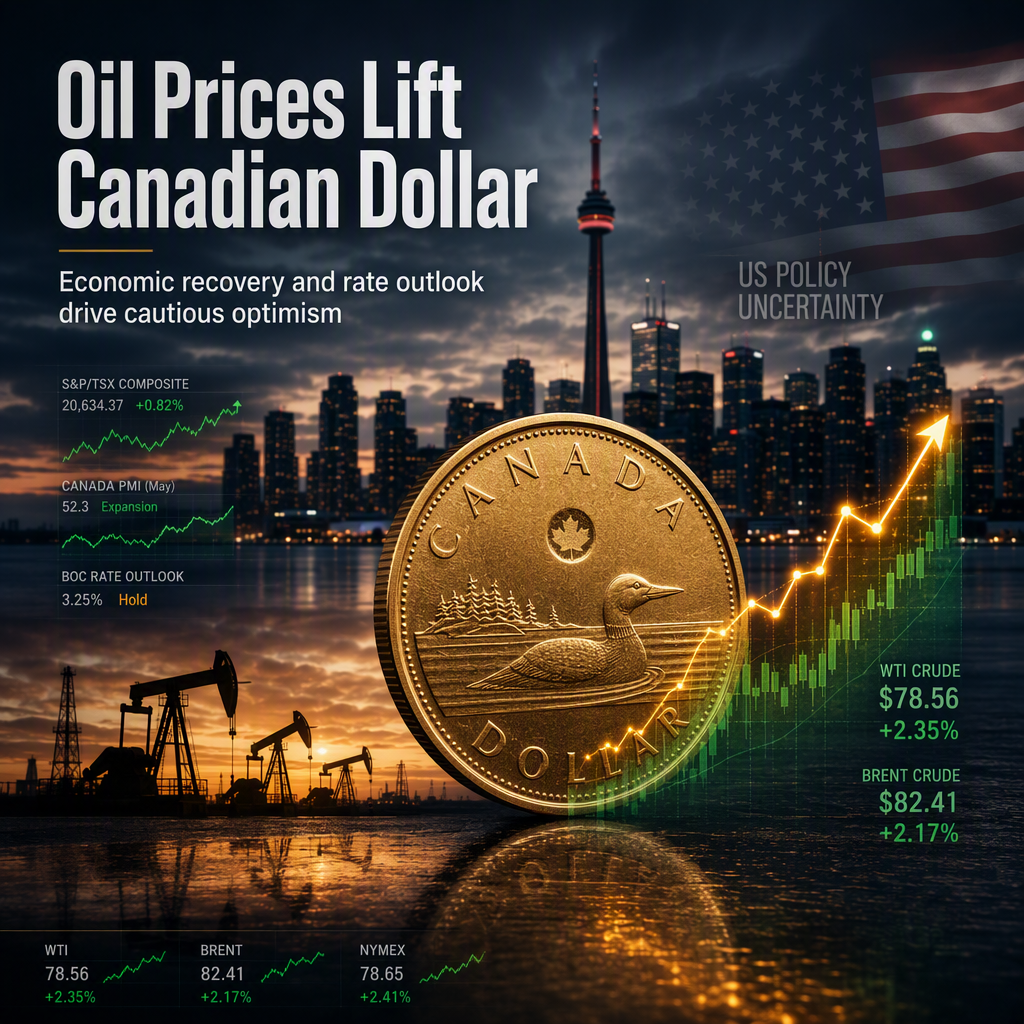
The Canadian Dollar (CAD) has received support from firming crude oil prices, with USD/CAD extending its losses for the fourth consecutive day and trading around 1.3870 during European hours on Tuesday [1]. West Texas Intermediate (WTI) crude stabilized at approximately $84.10 per barrel after two sessions of gains, while Brent crude rallied to $91.85 per barrel, its highest in over three weeks, amid ongoing US-Iran tensions and the expiration of a memorandum of understanding for peace negotiations [1]. Analysts from Brown Brothers Harriman and Elias Haddad's team emphasize that oil price swings are likely to dictate escalation risks, keeping Brent within a broad $70 to $100 range [1].
Despite the CAD's recent support from oil, Commerzbank FX analyst Michael Pfister notes that the currency remains one of the worst performers among G10 currencies this year, even as Canada's real economy shows signs of a fragile recovery [2]. Labour market data, GDP surprises, and stronger Purchasing Managers' Index (PMI) readings point to improving conditions, with the manufacturing PMI stabilizing in expansionary territory and exports increasing in recent months [2]. However, the CAD's performance is still closely tied to oil prices and relatively unattractive Canadian interest rate expectations compared to the US [2]. Market expectations for Bank of Canada (BoC) rate hikes have fallen behind those for the Bank of Japan, contributing to higher USD/CAD levels [2].
On the US side, the Greenback draws some support from safe-haven demand due to geopolitical uncertainty, but faces its own headwinds as expectations for Federal Reserve (Fed) rate hikes fade. The probability of a Fed rate hike at the upcoming meeting has dropped to 36.6%, down from 48.4% a week earlier, following weaker July Nonfarm Payrolls and mild inflation data [1]. Fed's Goolsbee expressed cautious optimism on inflation, describing recent price pressures as largely one-off shocks and suggesting a gradual return toward the 2% inflation target [1]. The FXS Fed Sentiment Index fell by 2.36 points to 134.61, indicating a modest pullback in perceived hawkishness, though it remains above the neutral threshold [1].
Commerzbank forecasts see EUR/CAD around 1.60–1.62 and USD/CAD easing toward 1.35 by late 2027, reflecting a fundamentally optimistic outlook for a more sustainable Canadian economic recovery and eventual CAD appreciation, albeit with potential setbacks linked to US policy developments [2].
CONCLUSION
The Canadian Dollar is currently benefiting from higher oil prices and signs of economic recovery, but remains vulnerable due to less attractive interest rate expectations and ongoing US-related risks. While analysts are cautiously optimistic about a more sustainable recovery and eventual CAD appreciation, the path forward is expected to be gradual and subject to volatility from both oil markets and US policy developments.