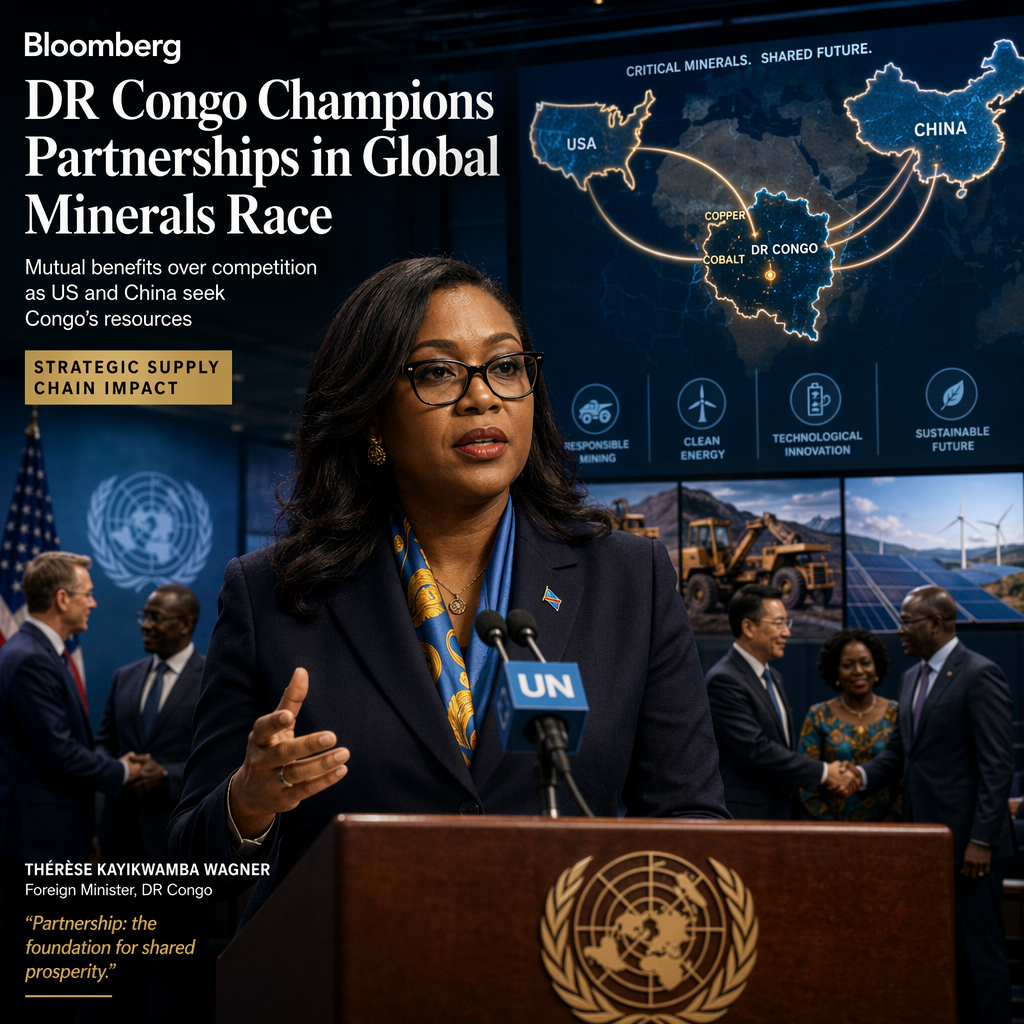
The Democratic Republic of Congo (DRC) has highlighted the importance of diversified international partnerships in its critical minerals sector, rather than framing the growing American involvement as a competition with China, according to Foreign Minister Thérèse Kayikwamba Wagner [1]. In an exclusive interview at the United Nations, Wagner stated, "I don’t like talking about competition. I like talking about complementarity," emphasizing that large nations like the USA, DRC, and China develop through multiple partnerships that bring different expertise [1].
This stance comes as the Trump administration seeks to expand U.S. access to Congo’s copper, cobalt, lithium, gold, and other strategic resources, aiming to reduce American reliance on mineral supply chains dominated by China [1]. On December 4, 2025, Washington and Kinshasa signed a strategic partnership agreement to boost economic cooperation, investment, and the development of secure and transparent critical-mineral supply chains. This agreement is part of a broader regional framework that links economic integration to efforts to resolve longstanding conflict between Congo and Rwanda [1].
Additionally, a separate arrangement involving DR Congo’s state mining company Gécamines and commodities trader Mercuria could provide U.S. buyers with priority access to certain copper and cobalt supplies. The U.S. International Development Finance Corporation has also shown interest in taking a strategic stake in this partnership [1]. Wagner noted that relations between the U.S. and DRC are taking "a more concrete shape" based on mutual economic interests, and welcomed increased U.S. involvement as a means to transform the country’s mineral wealth into tangible benefits for the Congolese people and American partners [1].
At a high-level U.N. meeting on critical minerals, Wagner cautioned that the global shift toward clean energy should not replicate past models where Africa exported raw materials while processing, technology, and profits remained abroad. She called for foreign partnerships to support local processing, infrastructure, technology transfers, research, industrialization, and access to financing, rather than simply securing raw material supplies [1]. The minerals initiative is closely linked to the U.S.-mediated peace process between the DRC and Rwanda [1].
CONCLUSION
The DRC is positioning itself as an advocate for diversified, mutually beneficial partnerships in the critical minerals sector, welcoming increased U.S. involvement while cautioning against extractive models of the past. The new agreements signal high market impact, with potential shifts in global supply chains and increased U.S. access to strategic resources.