
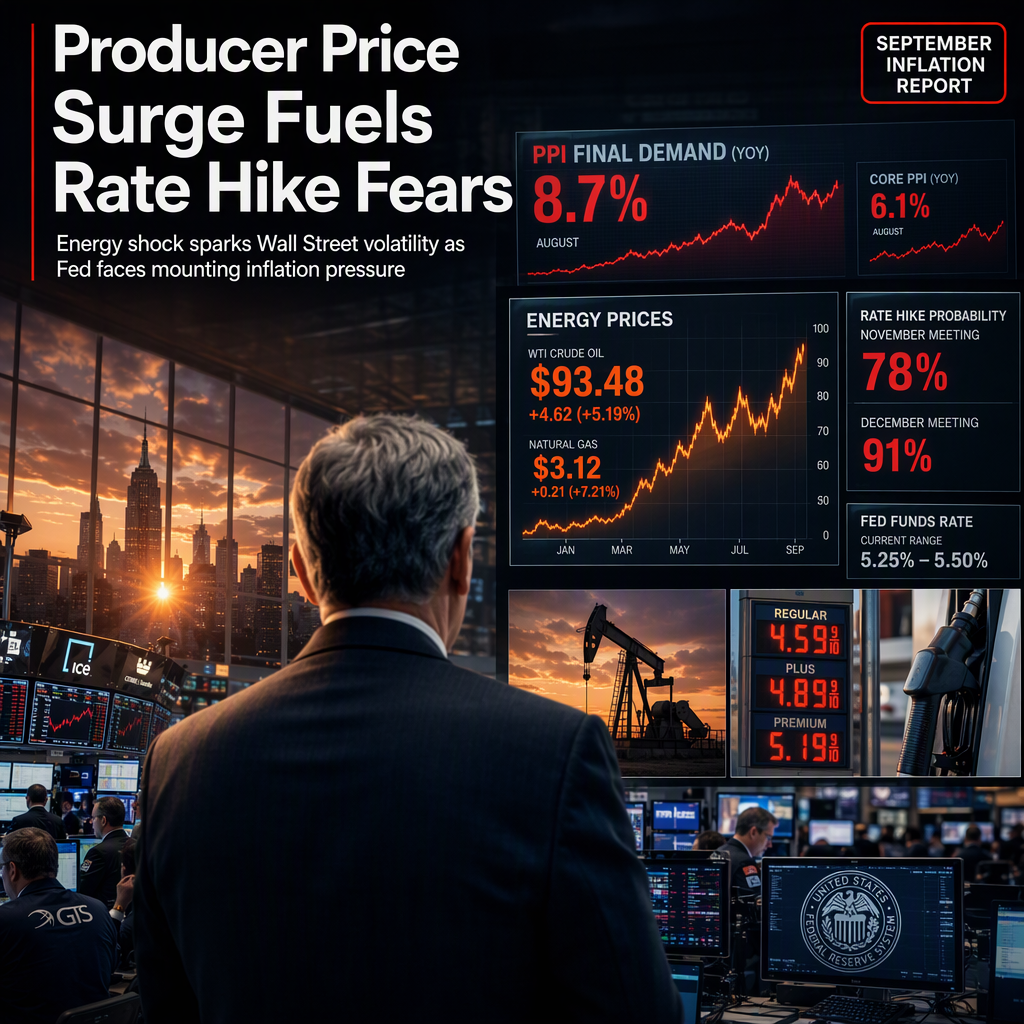
The U.S. producer price index (PPI) surged 6.3% year over year in September, marking the largest annual increase since 2022, with a monthly jump of 1.3%—both figures exceeding economist expectations and representing the biggest gains since March and December 2022, respectively [1][2]. Energy costs, particularly a 20% rise in gasoline prices, were the primary driver of this spike, as the ongoing Middle East conflict has curtailed oil supply and pushed prices higher [1][2]. The core PPI, which excludes food and energy, also rose significantly by 0.7% month-over-month and 5% annually [1], while a measure excluding food, energy, and trade services increased 0.5% in September, indicating that inflation pressures are broad-based and not limited to energy [2].
The Bureau of Labor Statistics noted that nearly half of September's increase in processed goods for immediate demand was linked to higher diesel fuel prices [1]. The consumer price index (CPI) also showed a 0.6% monthly and 3.7% annual increase, both slightly above expectations, with core CPI rising 0.3% month-over-month and 2.6% year-over-year [1]. Retail sales grew 0.8% in September, beating the 0.4% forecast, but this was a slowdown from the previous month, suggesting that high fuel prices are beginning to constrain consumer spending in other areas [1].
Market expectations for Federal Reserve action have shifted notably in response to the hot inflation data. Fed funds futures now price in a nearly 34% chance of a rate hike at the upcoming October 28 meeting, up from under 18% a week earlier, and about 90% expect at least one hike by year-end [1]. According to CME's FedWatch tool, Thursday's data also pushed the probability of a hike at the end of the month to 29%, with a 91% chance of at least one hike by December [2]. Wall Street economists now forecast that the Fed's preferred inflation gauge, the core personal consumption expenditures (PCE) index, will rise 0.32% in September, up from 0.25% in August, potentially lifting the year-over-year core PCE inflation rate to 3.1% [2]. Estimates for the monthly increase range from 0.29% to 0.35% [2].
Analysts and economists highlighted the implications for monetary policy. Chris Zaccarelli, chief investment officer at Northlight Asset Management, stated, "With a second day in a row of higher-than-expected inflation numbers, it seems the Fed will have no choice but to raise rates again this year" [1]. Mizuho's Alex Pelle wrote, "On the economic data alone, there is little reason for the Fed to hesitate to continue moving the policy rate higher" [2]. However, some Fed officials have indicated there is no need to rush, though more hikes are likely needed [2].
The Federal Reserve's Beige Book recorded the highest number of inflation-related mentions on record, underscoring the intensifying inflationary environment [1]. Both headline and core PCE inflation have remained above the Fed's 2% target since 2021 and have accelerated further since the onset of the Iran war [2].
CONCLUSION
September's hotter-than-expected producer and consumer inflation data, driven largely by surging energy prices, have heightened expectations for further Federal Reserve rate hikes this year. Market participants and economists now see a significantly increased likelihood of at least one more rate increase by December, as inflationary pressures remain broad-based and persistent.