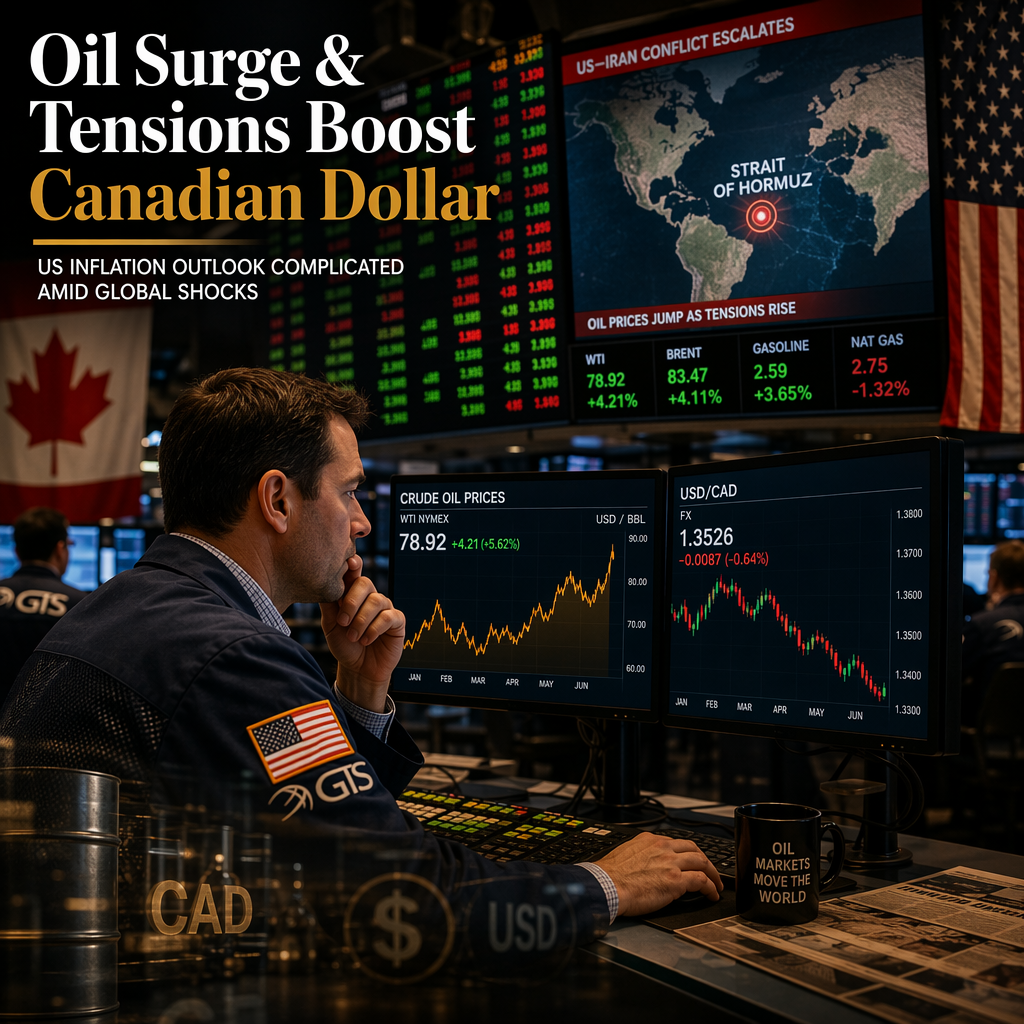
The Canadian Dollar (CAD) strengthened against the US Dollar (USD) on Friday, with USD/CAD trading around 1.4022, near a one-month low, as surging oil prices—up nearly 12% this week—supported the Loonie amid intensifying US-Iran conflict disrupting energy shipments through the Strait of Hormuz [1]. Canada, being a major crude oil exporter, benefits from higher oil prices, which also revive inflation concerns and complicate monetary policy for central banks [1]. The Bank of Canada (BoC) kept its policy rate unchanged at 2.25%, raised its 2026 inflation projection to 2.5% from 2.3%, and expects inflation to return to its 2% target by early 2027. The BoC adopted a more balanced tone, removing two-way policy guidance that had previously suggested rate cuts or hikes depending on US trade restrictions and energy prices [1].
In the US, the Dollar's initial weakness following softer-than-expected inflation data was reversed as higher oil prices fueled concerns of reaccelerating inflation, supporting expectations of a Federal Reserve (Fed) rate hike later this year [1][2]. The US Dollar Index (DXY) trades around 100.83 after hitting a three-week low of 100.35 on Wednesday [1]. MUFG’s Derek Halpenny notes that ongoing Middle East conflict, stronger US data, and crude oil risks are limiting USD selling, with attacks by the US expanding and Iran responding by targeting US bases in Kuwait, Jordan, and Bahrain [2]. The Philly Fed manufacturing index surged to 41.4 from 10.3, and retail sales (control group) posted a 0.5% gain after an upwardly revised 0.8% in May [2]. Halpenny warns that a sharp rise in Brent and escalation in conflict could bring forward Fed tightening and delay a renewed downtrend in the Dollar [2].
US consumer sentiment, as measured by the University of Michigan (UoM) Consumer Sentiment Index, is expected to improve to 51 in July from 49.5 in June, reflecting optimism about current conditions and the broader economic outlook [3]. This improvement is attributed to declining consumer prices earlier in the week, which may provide some support to a weak US Dollar [3]. However, sentiment remains well below pre-conflict levels, with crude prices nearly 30% below April and May highs, easing price pressures [3].
Import prices in the US posted a surprise gain of 0.3% for the month, with annual prices jumping 7.1%, the largest increase since August 2022, as a drop in energy was offset by increases in other goods, particularly those from China, which saw import prices rise 0.9%—the biggest monthly move since January 2008 [4]. Export prices to China fell 0.2% in June but rose 7.4% annually [4]. Despite a decline in oil costs helping lower prices in June, inflation is broadening beyond energy, with businesses facing rising costs in computers, peripherals, semiconductors, and industrial machinery [4]. Fed officials, including Chairman Kevin Warsh, Dallas Fed President Lorie Logan, and Cleveland Fed President Beth Hammack, indicated that softer June inflation reports do not signal the end of the central bank's efforts to return inflation to the 2% goal, with consumer prices up 3.5% and wholesale costs up 5.5% year-over-year [4]. Logan and Hammack suggested that policy needs to be tighter, with Hammack noting growing concerns from businesses and consumers about inflation [4].
CONCLUSION
Surging oil prices and escalating geopolitical tensions have strengthened the Canadian Dollar and complicated the US inflation outlook, prompting central banks to adopt more cautious stances. While US consumer sentiment is improving and inflation pressures have eased somewhat, Fed officials remain concerned about persistent inflation and signal the possibility of further tightening. The market impact is high, with energy prices and geopolitical developments continuing to drive currency and inflation dynamics.