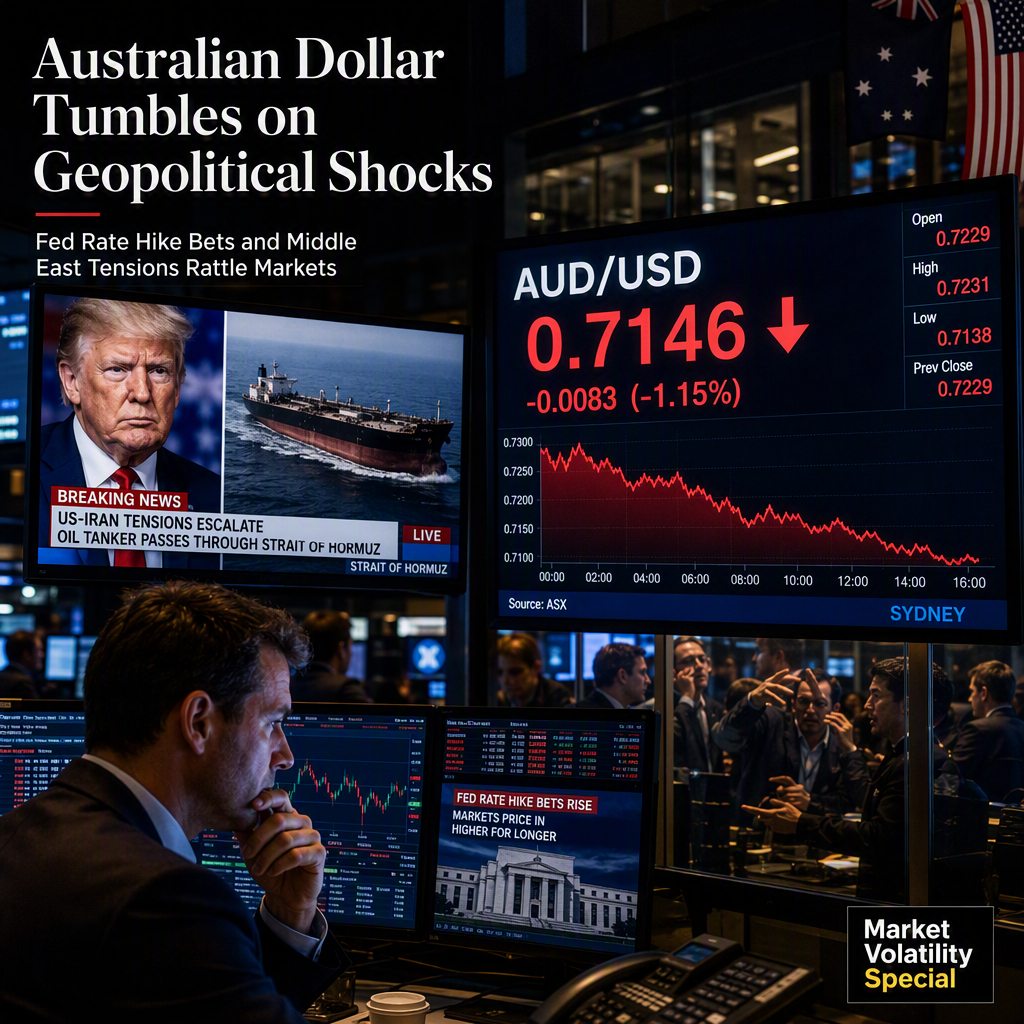
The Australian Dollar (AUD) fell by approximately 0.29% against the US Dollar (USD) on Tuesday, trading at 0.7146, as escalating conflict between the US and Iran increased demand for the USD's haven appeal [1]. Oil prices continued to decline despite ongoing attacks between the US and Iran, with US President Trump warning Tehran against retaliation, stating they would be 'totally wiped out as a country' [1]. US economic data released included JOLTS job openings for July, which rose to 7.27 million but remained below estimates, and the ISM Manufacturing PMI for August, which eased from 55.6 to 54.6, also below forecasts but still indicating expansion in the manufacturing sector [1].
US Treasury yields climbed, with the 10-year benchmark note rising by over 4 basis points to 4.796%, driven by surging energy prices linked to the Strait of Hormuz situation. Investors are now pricing in a nearly 72% probability of a 25-basis-point rate hike by the Federal Reserve, according to Prime Terminal [1]. Fed Governor Michael Barr adopted a hawkish stance, stating he is prepared to raise rates if inflation does not moderate soon, citing a 'stable' labor market and low unemployment rate [1].
Market participants are awaiting further US jobs data, including Challenger Job Cuts for August, Initial Jobless Claims, and the crucial August Nonfarm Payrolls report scheduled for Friday [1]. In Australia, attention is focused on Wednesday's release of second-quarter 2026 Gross Domestic Product (GDP) data. GDP is expected to expand by 0.3% quarter-on-quarter, unchanged from the previous reading, while annual growth is forecast to slow from 2.5% to 1.8% year-on-year, according to most economists [1].
Technically, AUD/USD trades at 0.7147 and maintains a mildly bullish near-term bias, holding above the cluster of 50-, 100-, and 200-day Simple Moving Averages (SMAs) near 0.7021. The Relative Strength Index (14) is around 59, suggesting constructive momentum. Initial resistance is at 0.7198, while primary support is at the grouped SMAs near 0.7021. A daily close below this area could signal a deeper corrective phase [1].
CONCLUSION
The Australian Dollar's decline is primarily driven by heightened geopolitical tensions and increased expectations of a US Federal Reserve rate hike. While technical indicators suggest a mildly bullish bias, upcoming US jobs data and Australian GDP figures are likely to influence further market direction. Investors remain cautious amid ongoing uncertainty in the Middle East and shifting monetary policy expectations.