
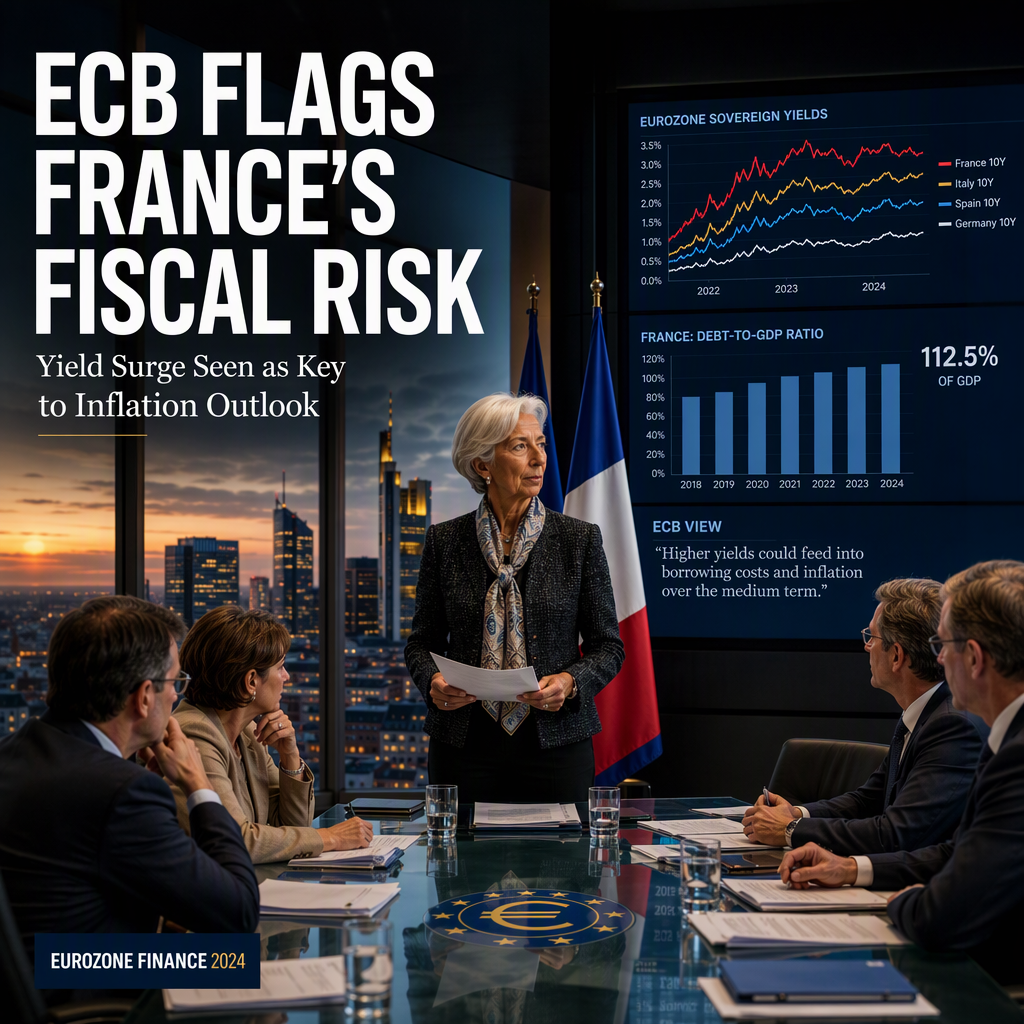
European Central Bank (ECB) President Christine Lagarde has raised concerns about France's fiscal position, describing the country's debt situation as 'serious at 120% of GDP and without a path to lowering it' in an interview with La Croix [1]. Lagarde emphasized the need for France to establish a credible budget trajectory and implement reforms to restore confidence in its fiscal management [1]. Despite these concerns, she noted that the European financial system is currently more robust than during the 2008 and 2011 crises [1].
Meanwhile, ECB Governing Council member Isabel Schnabel commented on the broader Eurozone economic environment, stating that high costs are being passed through to consumers more quickly when the economy is resilient [2]. Schnabel suggested that the recent surge in global yields could dampen price pressures, potentially helping to return inflation to target levels more gradually, provided that inflation expectations remain anchored [2]. She also observed that robust credit dynamics indicate financial conditions are not yet restrictive [2].
Market data from the sources show that the Euro's performance has varied over different timeframes. On the day of reporting, the Euro was strongest against the Australian Dollar [1], while over the month, it was strongest against the New Zealand Dollar [2]. These currency movements reflect ongoing market sensitivity to ECB commentary and Eurozone fiscal developments.
Lagarde also addressed speculation about her political future, stating that running for French president 'would not be a good idea at all,' and clarified that if she were to leave the ECB early, it would only be by a few months [1].
CONCLUSION
The ECB leadership has highlighted significant fiscal risks in France and pointed to the potential for higher yields to help moderate inflation. While the Eurozone financial system is seen as stable, the need for credible fiscal reforms in France and the impact of global yields on inflation remain key market considerations.