
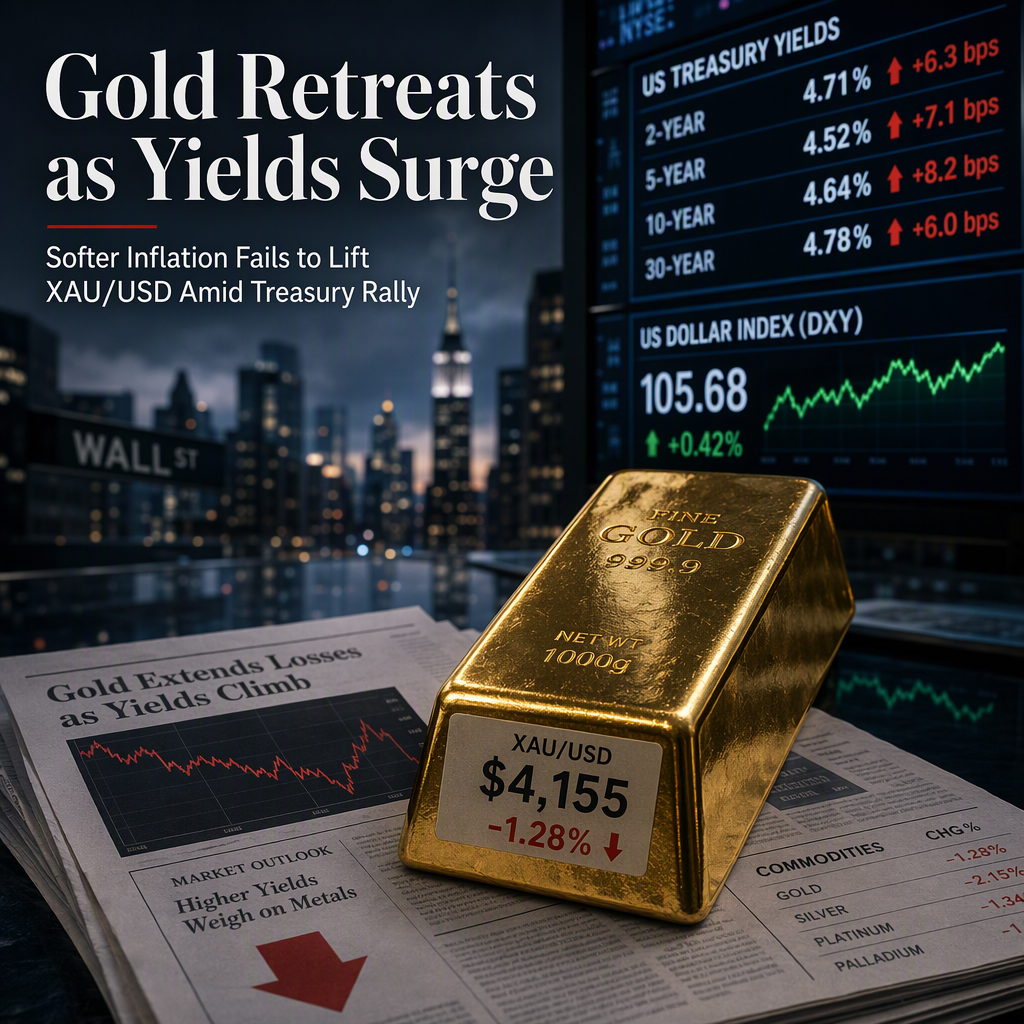
Gold prices (XAU/USD) declined by 0.6% on Wednesday, trading at $4,155, following the release of US inflation data that came in above the Federal Reserve’s 2% target but below market estimates [1]. The core Personal Consumption Expenditures (PCE) Price Index, the Fed’s preferred inflation gauge, remained unchanged from July at 3.0% year-over-year in August, undercutting forecasts of 3.3%. The headline PCE print was also unchanged at 3.4%, below expectations for a rise to 3.7% [1].
Despite the softer inflation readings, US Treasury yields rose sharply, with the 30-year bond yield climbing 8 basis points to 5.647% and the 10-year benchmark note yield increasing nearly 7 basis points to 5.302% [1]. This surge in yields overpowered the less hawkish repricing of Federal Reserve policy, as money markets shifted to price in a 62% probability that the Fed will hold rates steady at its October meeting, according to Prime Terminal [1].
The US Dollar Index (DXY) exhibited a mixed reaction, initially falling to a low of 101.02 before rebounding to the 101.30 area and turning positive on the day [1]. Additional economic data showed that the US economy grew by 2.2% in Q2 2026 (final reading), surpassing forecasts of 1.5% growth, while the trade deficit widened in August based on US Commerce Department data [1].
Technical analysis indicates that gold remains in a downtrend, with the Relative Strength Index (RSI) still bearish and sellers maintaining control. Key support levels for XAU/USD are identified at $4,100, $3,996 (July 29 swing low), $3,959 (July 17 low), and the year-to-date low at $3,941. For a bullish reversal, gold would need to reclaim the 100-day Simple Moving Average at $4,287 [1].
Looking ahead, traders are focusing on upcoming Federal Reserve speakers, jobless claims, and the release of September’s Nonfarm Payrolls data on Friday, which could further influence market direction [1].
CONCLUSION
Gold prices retreated as rising US Treasury yields outweighed the impact of softer-than-expected inflation data. The market is now anticipating further signals from the Federal Reserve and upcoming labor market data, with technical indicators suggesting continued downside risk for gold in the near term.