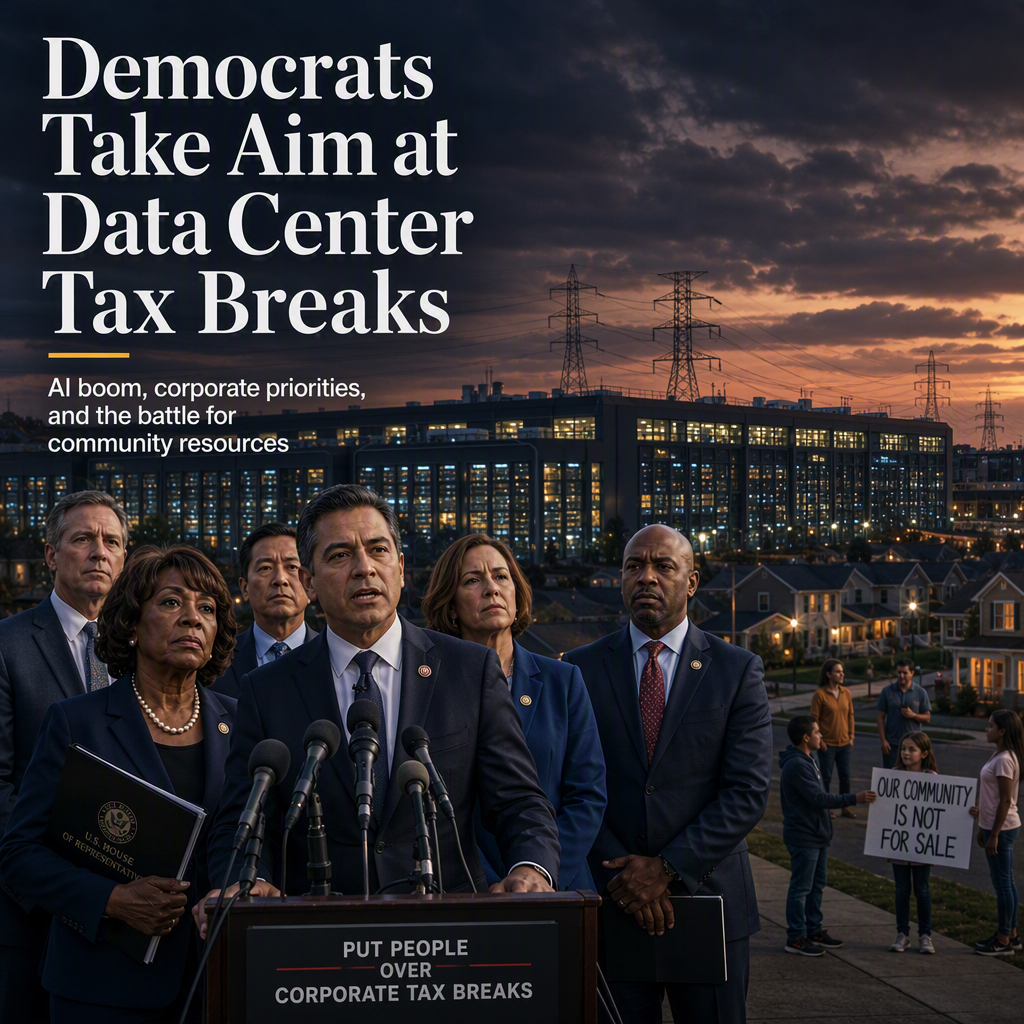
House Democrats have introduced legislation aimed at blocking data centers from accessing certain federal investment incentives, as the rapid expansion of artificial intelligence (AI) accelerates the growth of these facilities nationwide [1]. The proposed bill, unveiled by Reps. Kristen McDonald Rivet (D-Mich.) and Don Davis (D-N.C.), is supported by 21 additional House Democrats, including Rep. Jimmy Panetta (D-Calif.), a member of the Ways and Means Committee [1].
The legislation comes as President Donald Trump has made the expansion of U.S. data centers a central component of his American AI agenda, seeking to streamline permitting and accelerate development to maintain U.S. competitiveness in the tech industry [1]. However, Democrats argue that the substantial tax breaks, while not originally designed for AI or data centers, disproportionately benefit large technology companies at the expense of American families and local communities [1].
At a news conference, Rep. McDonald Rivet criticized the current policy, stating, "Washington is giving handouts to Big Tech companies while American families are drowning," and described the incentives as "backward priorities" that favor corporate interests over working people [1]. Rep. Deborah Ross (D-N.C.) raised concerns about data center developers bypassing local input and straining electricity and water resources, while Rep. Chris Pappas (D-N.H.) noted that the facilities contribute to higher costs for constituents and called for greater community control over their placement [1].
The debate highlights growing tensions between federal efforts to promote AI infrastructure and local and environmental concerns, with Democrats seeking to shift the focus of tax incentives away from large tech companies and toward broader community needs [1].
CONCLUSION
The introduction of this legislation signals a significant challenge to President Trump's AI-driven tech agenda, as House Democrats seek to curtail federal tax breaks for data centers. The move reflects broader concerns about resource use, local control, and the prioritization of corporate interests over community needs, potentially impacting the pace and scale of future data center development.