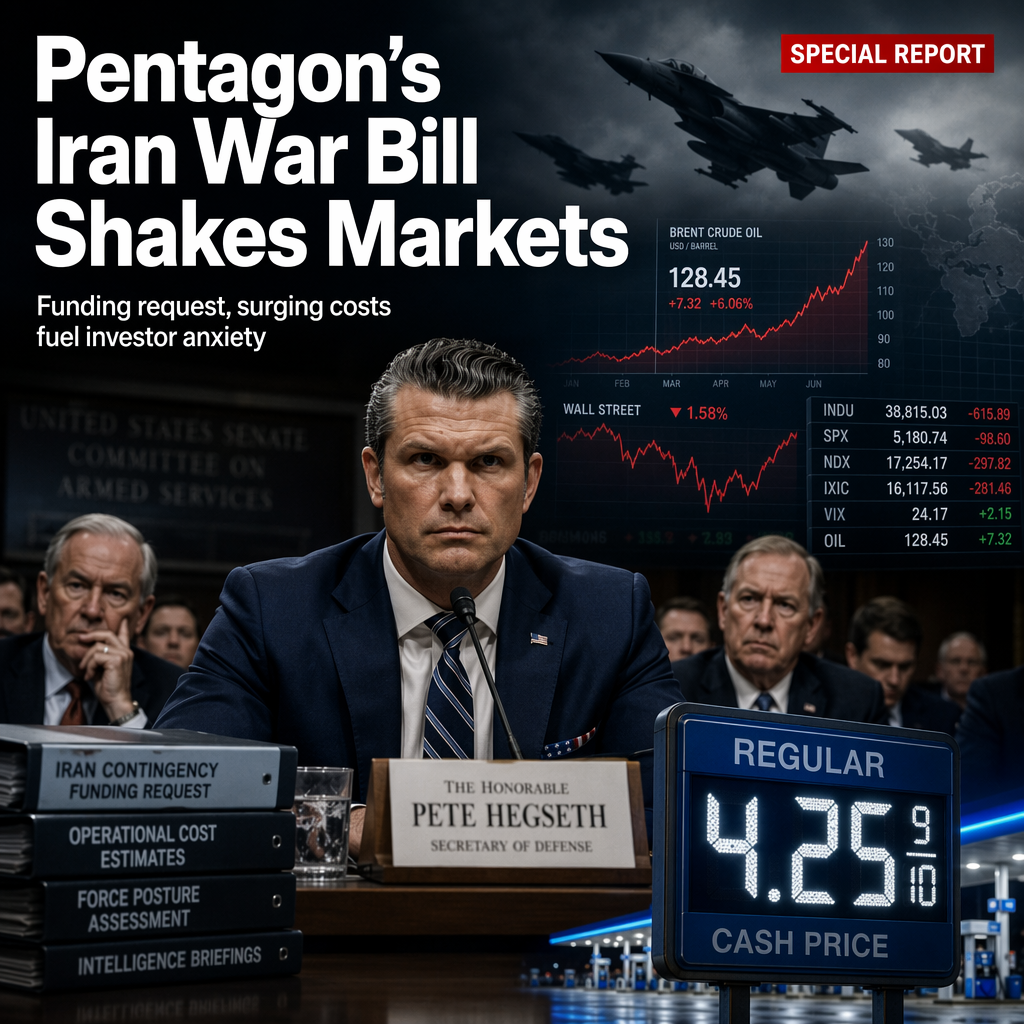
On July 21, 2026, Defense Secretary Pete Hegseth appeared before a Senate committee to defend the Trump administration's request for nearly $67 billion in supplemental funding to continue military operations against Iran, as the cost of the war escalates rapidly [1][2]. Hegseth put the cost of the Iran war so far at $37.5 billion, a figure that has increased from the roughly $30 billion estimate presented earlier in the month [2]. However, NBC News reported that the Defense Department’s internal overall cost for the war, including repairing damaged U.S. military bases, replacing destroyed aircraft, and replenishing weaponry, is estimated at $80 billion to $100 billion, according to three U.S. officials [2]. The Pentagon’s acting comptroller clarified that this higher estimate, which had not been updated since April, included the cost of replenishing munitions but not rebuilding bases [2].
The Senate hearing was contentious, with lawmakers pressing Hegseth for transparency and accountability regarding the ballooning defense budget and the strain on U.S. resources [1][2]. Senate Democrats criticized the administration for the lack of progress in the war, with Sen. Gary Peters, D-Mich., accusing the Trump administration of seeking a "blank check" and calling its efforts a failure [2]. Hegseth defended the administration’s strategy, stating, "Your characterization of this incredible effort as a failure is reckless, and I think it’s irresponsible" [2].
The intensifying conflict follows the collapse of an April ceasefire deal and the recent deaths of three U.S. service members [2]. Iranian attacks on U.S. allies and a U.S. naval blockade in the Strait of Hormuz have brought shipping to a near standstill, heightening concerns over global energy supply disruptions [1][2]. As a result, gas prices have surged above $4 per gallon nationwide, with technical resistance noted near $4.25 and support at $3.80, reflecting increased geopolitical risk and market volatility [1]. Market analysts warn that continued conflict could further impact oil prices, and traders remain cautious, with some advising clients to hedge against further volatility in energy sectors [1].
The administration’s funding request comes after $891 billion was previously approved to carry the Pentagon through September 30, and President Trump is separately requesting $1.5 trillion for the 2027 fiscal year starting October 1 [2]. Notably, there is a discrepancy between President Trump’s repeated claims that the U.S. has already won the war and Hegseth’s acknowledgment that Iran still retains military capabilities, despite the damage inflicted by U.S. operations [2].
The hearings underscored the broader financial risks of the ongoing conflict, including potential impacts on defense stocks and the energy market, with the prevailing mood among investors described as one of uncertainty as they await clearer guidance from Washington [1].
CONCLUSION
The escalating cost of the Iran war and the administration's request for an additional $67 billion have heightened market uncertainty, driving up gas prices and raising concerns about further volatility in energy and defense sectors. Lawmakers remain divided over the strategy and financial transparency, while investors and analysts are bracing for continued instability as the conflict intensifies.