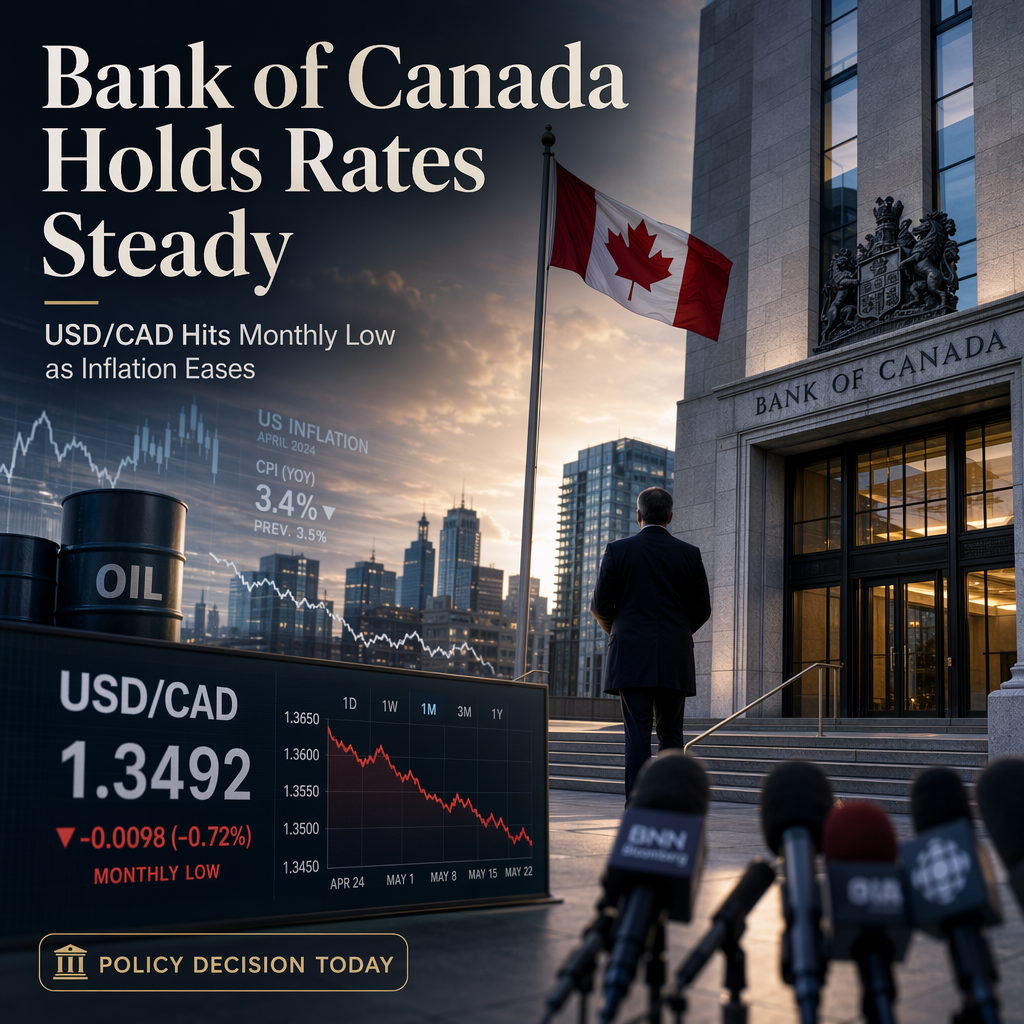
The Bank of Canada (BoC) is widely expected to keep its policy rate unchanged at 2.25% for the sixth consecutive meeting, maintaining a patient stance as policymakers balance lingering inflation risks against an economy in excess supply [10]. The central bank anticipates inflation to hover around 3% in the near term before gradually easing toward its 2% target, with core inflation at 2.2% and headline CPI rising 3.2% year-on-year in May [10]. Governor Tiff Macklem emphasized that any future policy move will depend on economic conditions, reiterating that economic weakness continues to weigh on prices and that incoming data has evolved as expected [10]. Societe Generale analysts note that the BoC is unlikely to make major revisions to inflation projections unless views on spare capacity and excess supply change, and market pricing suggests a 25bp hike before year-end cannot be dismissed [2].
USD/CAD has retreated from recent highs, slipping below the nine-period EMA and recording nearly a monthly low of 1.4039 during European hours on Wednesday, with the 50-day EMA at 1.4014 acting as a key support [1]. Technical analysis indicates the pair is testing the lower boundary of a symmetrical triangle, and a decisive close below this support could signal a strong continuation or reversal to the downside, potentially targeting the 21-month low of 1.3481 recorded on January 30 [1]. Societe Generale highlights that the breakdown below 1.41 could extend on short-covering unless US PPI surprises, with next supports at 1.3970 (50-DMA) and 1.3850 [2]. On the upside, a rebound toward the nine-day EMA at 1.4130 could support a test of the upper boundary near 1.4240, aligned with the 15-month high of 1.4248 reached on June 24 [1].
MUFG reports that the Canadian Dollar has benefited from weaker US CPI and higher oil prices, with spreads pointing to modest further gains versus the US Dollar [8]. However, the BoC's cautious stance and mixed macro data limit CAD gains, and current rates pricing leaves CAD risks skewed to the downside, especially as nearly 20bps of tightening are priced by year-end [8]. The crude oil/Brent correlation is not particularly stable, and with the BoC set to remain sidelined, CAD risks are skewed to the downside given rates pricing (80% priced for hike by year-end) [8]. The CAD was the strongest against the Swiss Franc today, up 0.15%, and showed modest gains against other majors, reflecting relative strength in the G10 FX space [1].
Analysts and market participants expect the BoC to announce its policy decision at 13:45 GMT, followed by a press conference with Governor Macklem at 14:30 GMT [10]. Pablo Piovano at FXStreet points out that further gains in USD/CAD appear limited by the 1.4250 zone, with selling pressure likely to revisit multi-week troughs near 1.4050 and deeper retraces exposing the 55-day SMA at 1.3930 and the 200-day SMA at 1.3850 [10].
CONCLUSION
The Bank of Canada is set to keep rates steady, reinforcing a cautious outlook amid mixed economic signals and persistent inflation. USD/CAD has dropped to monthly lows, with technical and fundamental factors suggesting further downside risk unless US data surprises. While CAD shows relative strength, market pricing and BoC caution point to limited upside, keeping traders focused on key support levels and upcoming policy communications.