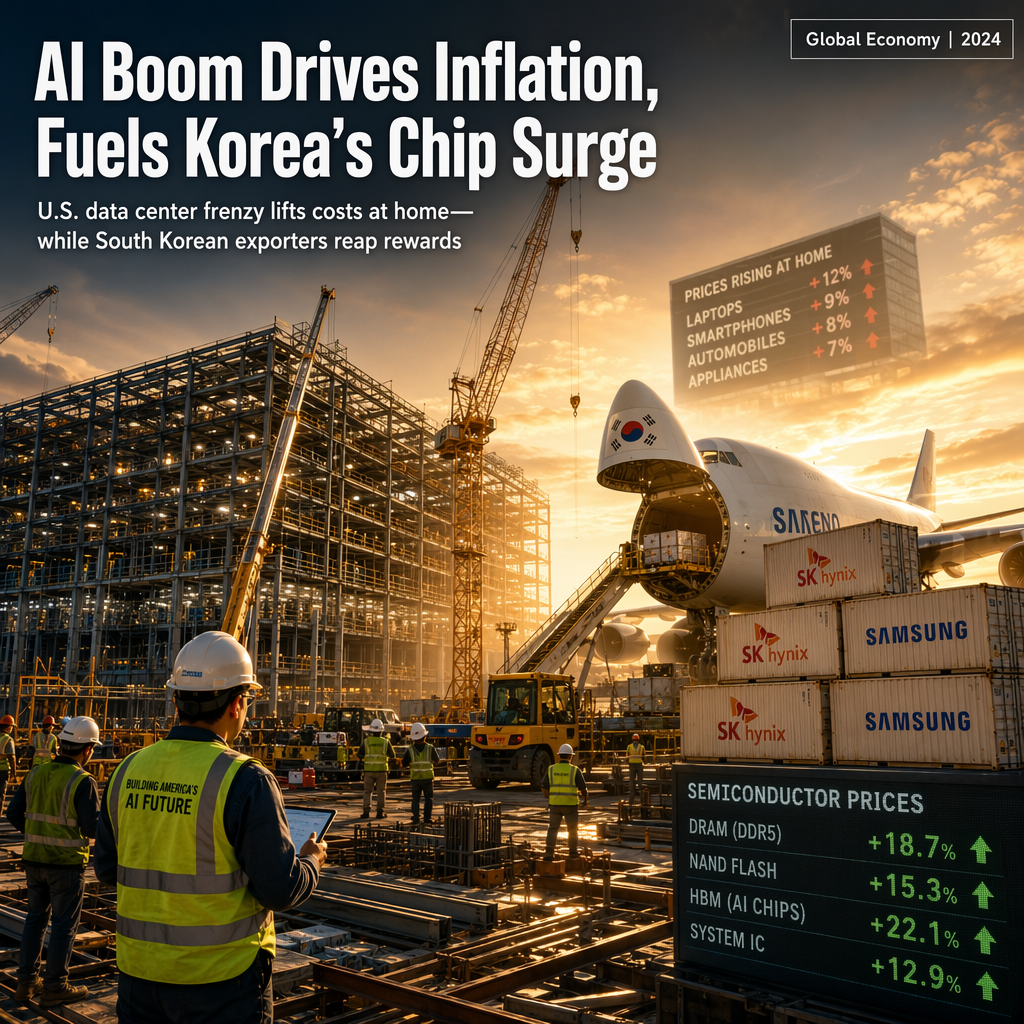
The United States is investing hundreds of billions of dollars into artificial intelligence infrastructure, primarily through the construction of massive data centers. However, the anticipated immediate boost to U.S. GDP has not materialized, with most economic growth benefits accruing to exporters such as South Korea's SK Hynix and Samsung, who have seen significant increases in export revenues and profits due to surging demand for advanced semiconductors and related components [1].
The construction boom in U.S. data centers has driven up prices for semiconductors, resulting in short-term inflationary pressures. These rising costs are affecting a range of sectors, including technology, manufacturing, and the automobile industry, where carmakers are considering price hikes in response to soaring memory chip prices [1].
Industry analysts cited in the article emphasize that while the AI infrastructure buildout is laying the groundwork for future economic growth, its near-term effects are characterized more by inflation and increased input costs than by broad-based expansion in the U.S. economy. The main beneficiaries so far have been chip exporters in South Korea and other countries supplying critical technology and components to U.S. buyers [1].
The article underscores the complex global dynamics of the AI boom, noting that the U.S.'s substantial investments have not yet translated into proportional domestic economic gains, but have significantly boosted the fortunes of key international suppliers [1].
CONCLUSION
The AI infrastructure surge in the U.S. is currently resulting in higher input costs and inflation, with limited immediate GDP growth domestically. In contrast, South Korean chipmakers like SK Hynix and Samsung are experiencing substantial gains, highlighting a shift in economic benefits toward international suppliers.