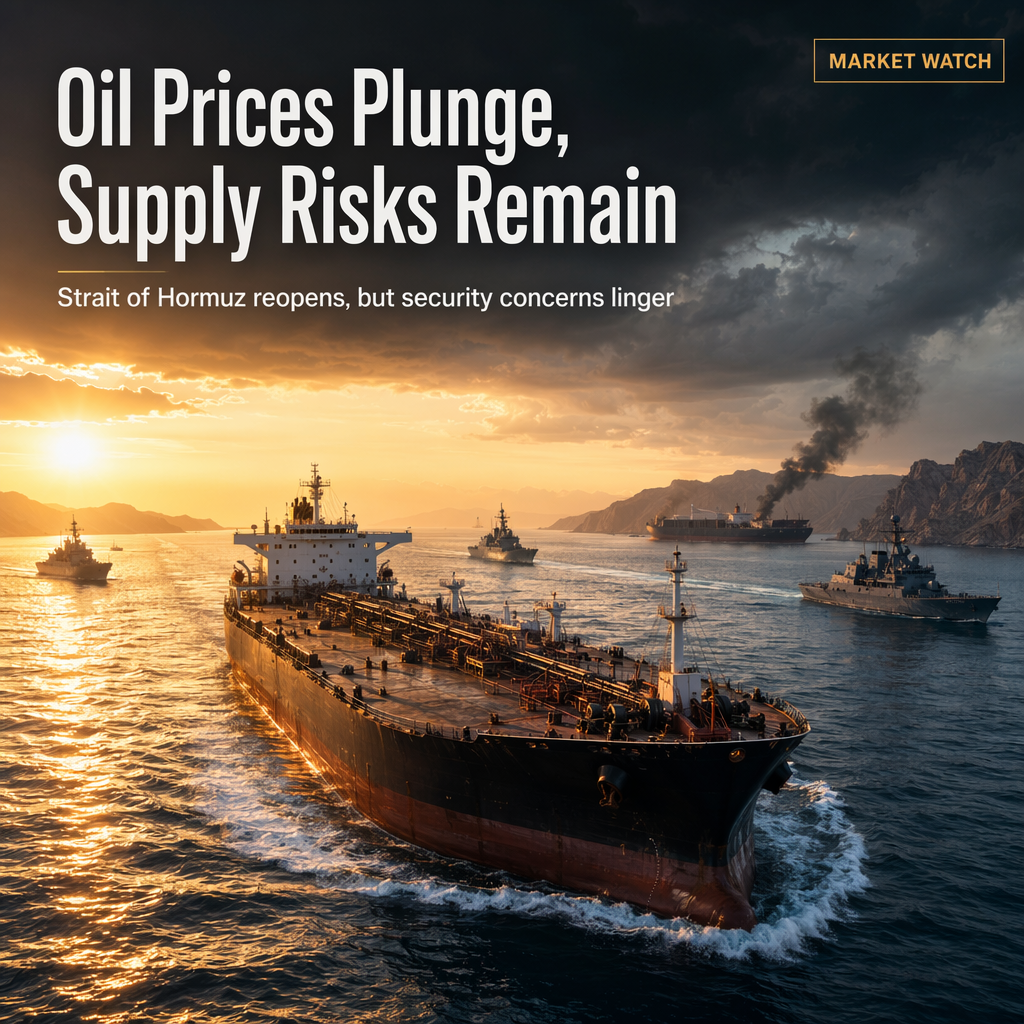
Brent oil prices have experienced a sharp decline, falling more than USD30 per barrel since early May and now trading below USD80 per barrel, following optimism over the reopening of the Strait of Hormuz after a US–Iran deal [1]. This optimism has led markets to price in a smooth normalization of oil shipments from the Middle East, with the expectation that supply disruptions will quickly subside [1][3]. However, both OCBC and Commerzbank analysts caution that these expectations may be premature, as security risks and supply disruptions remain a concern [1][3].
OCBC strategists Sim Moh Siong and Christopher Wong maintain their end-2026 Brent forecast at USD80/bbl, with a gradual drift toward the low USD60 range in 2027–28, but warn that near-term risks of supply disruption could slow further price declines [1]. They note that overnight, crude prices edged higher as doubts emerged over the durability of the US–Iran deal, especially after a cargo ship was struck in the Strait of Hormuz, causing significant damage to its bridge. The Wall Street Journal reported Iran may be responsible, though this remains unconfirmed, highlighting the fragility of the situation and raising questions about how quickly oil flows can truly normalize [1].
Commerzbank's commodity team, led by Barbara Lambrecht, echoes these concerns, stating that tanker traffic through the Strait of Hormuz is only gradually recovering and that US inventories are 7% lower than usual for this time of year [3]. They argue that if tanker transits do not increase more strongly in the coming week, market skepticism could grow, potentially causing oil prices to rise again [3]. The sharp decline in oil prices has also led to a notable shift in the Brent forward curve, with time spreads narrowing and the front end now slightly in contango [3].
The oil shock and its inflationary impact are also affecting other markets, notably gold. According to TD Securities’ Bart Melek, higher US rates and a firmer dollar, driven in part by oil shock–related inflation and a restrictive Federal Reserve stance, have pushed gold below $4,000/oz, with the potential for further declines to a few hundred dollars below the $3,900/oz long-term support level [2]. Melek suggests that if the oil shock persists, the market may price in additional rate hikes, increasing the carry and opportunity costs for gold holders [2]. However, he also sees a path for gold to recover to new record highs above $5,300/oz next year if oil-driven inflation pressures fade and the Fed pivots toward its maximum employment mandate [2].
CONCLUSION
While oil prices have dropped sharply on hopes of a swift Strait of Hormuz reopening, analysts from OCBC and Commerzbank warn that supply risks and security concerns remain unresolved. The market may be underestimating the potential for renewed disruptions, which could reverse recent price declines. The ongoing oil shock is also weighing on gold, with the potential for further volatility in both commodities if Middle East tensions persist.