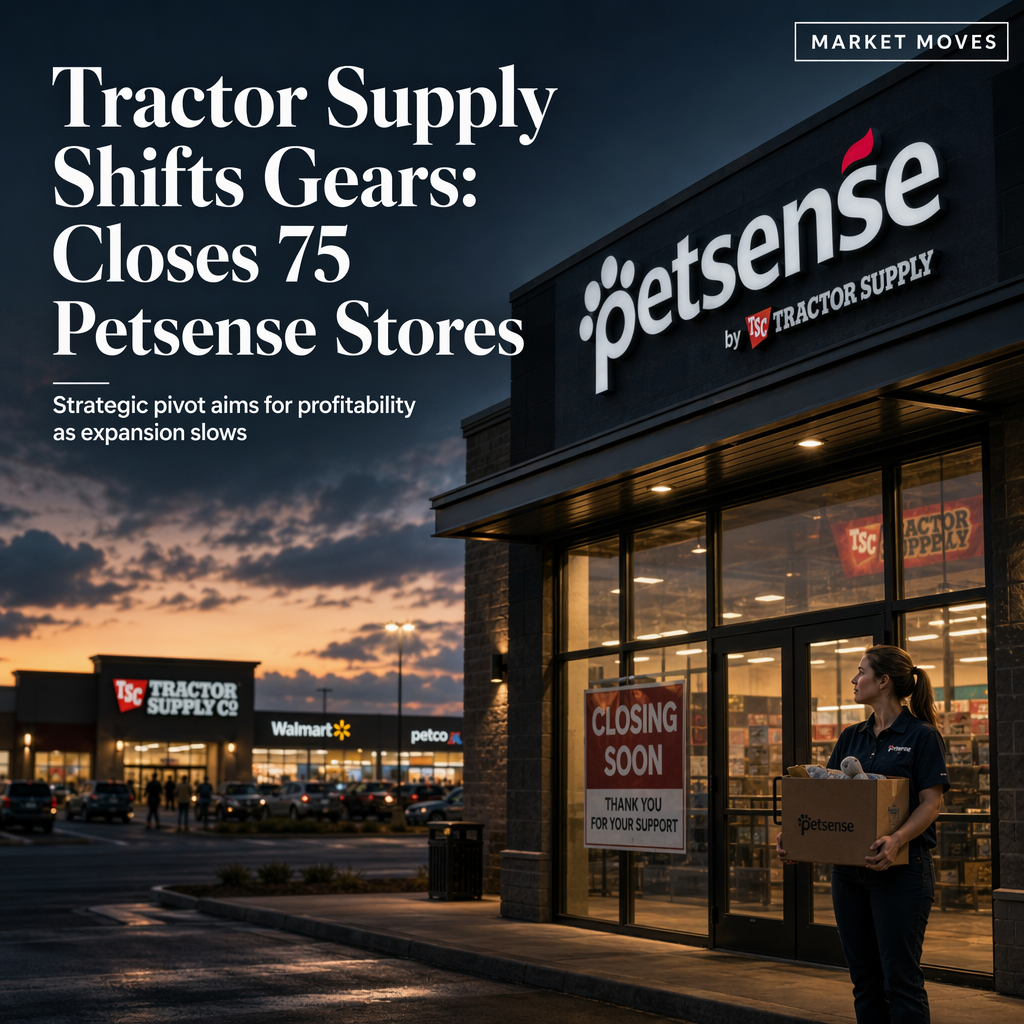
Tractor Supply Company announced plans to close approximately 75 Petsense locations nationwide following a disciplined review of its pet store portfolio, as revealed in its latest earnings report last week [1]. As of late June, there were 209 Petsense by Tractor Supply stores across 23 states [1]. CEO Hal Lawton stated that the closures target underperforming stores with negative four-wall cash flow, meaning their sales were insufficient to cover local costs such as rent, labor, and inventory [1]. By closing these stores, Tractor Supply aims to improve returns, simplify its business, and redirect resources toward higher growth and higher return opportunities [1].
Lawton expressed confidence that after the closures, the company will maintain a "very strong, profitable Petsense business" that will integrate well with its broader pet ecosystem, which includes Allivet and VIP Petcare [1]. CFO Kurt Barton echoed this sentiment, noting that the strategic repositioning of Petsense is expected to create a healthier, more profitable business that complements Tractor Supply stores and strengthens the company's ability to serve pet customers across its integrated pet ecosystem [1].
In addition to the store closures, Tractor Supply is adjusting its expansion plans. The company now expects to open approximately 85 to 90 new stores in 2027, down from its previous expectation of 100 new stores [1]. Funds saved from the reduced store openings will be redeployed toward initiatives such as Project Fusion, which focuses on remodeling and improving the performance of the existing store base [1].
Following the announcement, Tractor Supply's stock (TSCO) closed at $31.80, up $0.78 or 2.51% [1].
CONCLUSION
Tractor Supply's decision to close 75 underperforming Petsense stores and slow its expansion reflects a strategic shift toward profitability and operational efficiency. The market responded positively, with TSCO shares rising 2.51%. The company aims to strengthen its core business and pet ecosystem while investing in store remodels and targeted growth.