
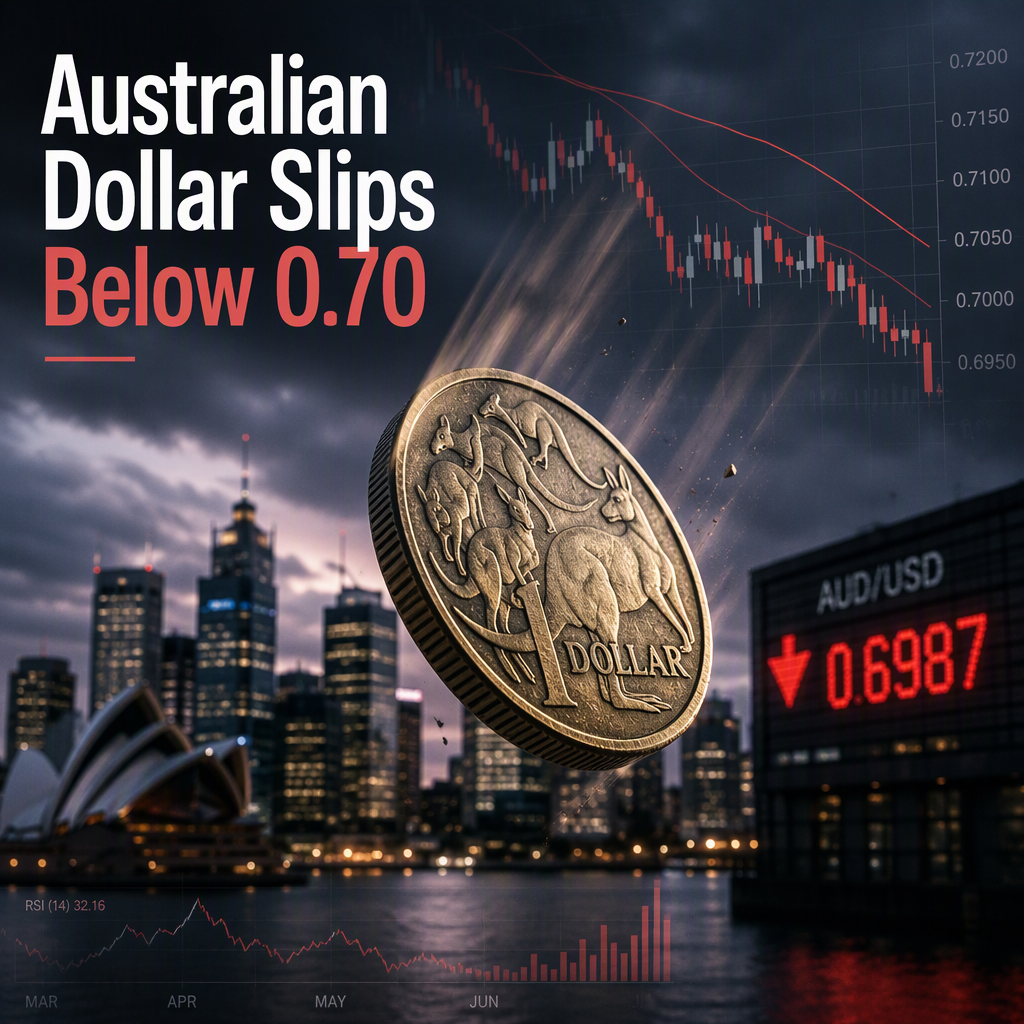
The Australian Dollar (AUD) declined by over 0.40% against the US Dollar on Tuesday, dropping below the 0.7000 threshold, despite the Reserve Bank of Australia (RBA) raising its policy rate to 4.60% [1]. The market reaction was driven by RBA Governor Michele Bullock's post-meeting comments, which signaled a mild-dovish stance and suggested that monetary policy could already be restrictive enough to bring inflation back to target, even as the RBA left the door open for further rate increases [1].
On the technical front, AUD/USD traded at 0.6987, extending its corrective slide and moving further away from recent highs. The pair's near-term bias remains bearish, with the price trading below the 50-, 100-, and 200-day simple moving averages clustered around 0.7093, which now act as resistance levels. The Relative Strength Index (14) has slipped toward the 30 region, indicating emerging oversold conditions, but this only softens the downside momentum rather than reversing it as long as the price remains under the key moving average cluster [1].
In the US, Wall Street ended the session with losses, and US Treasury yields remained elevated, with 5- and 10-year note yields above 5%, and the 20- and 30-year bond yields at 5.61% and 5.56%, respectively. The US Dollar Index (DXY) dipped from daily highs of 101.50 to 101.25, poised to end the day with modest gains of 0.20% [1]. US economic data showed the Conference Board Consumer Sentiment index fell sharply to 81.9, its lowest since early 2014 and below forecasts of 89.0, while job openings dropped to 7.079 million in August, also below expectations, indicating a balanced labor market [1].
Looking ahead, the Australian economic docket will feature the release of inflation data, with the Trimmed Mean CPI for August expected to remain unchanged at 3.6% year-over-year [1].
CONCLUSION
The Australian Dollar's drop below 0.70 reflects market disappointment with the RBA's dovish guidance, despite a rate hike to 4.60%. Technical indicators suggest a bearish outlook for AUD/USD, while upcoming inflation data will be closely watched for further direction.