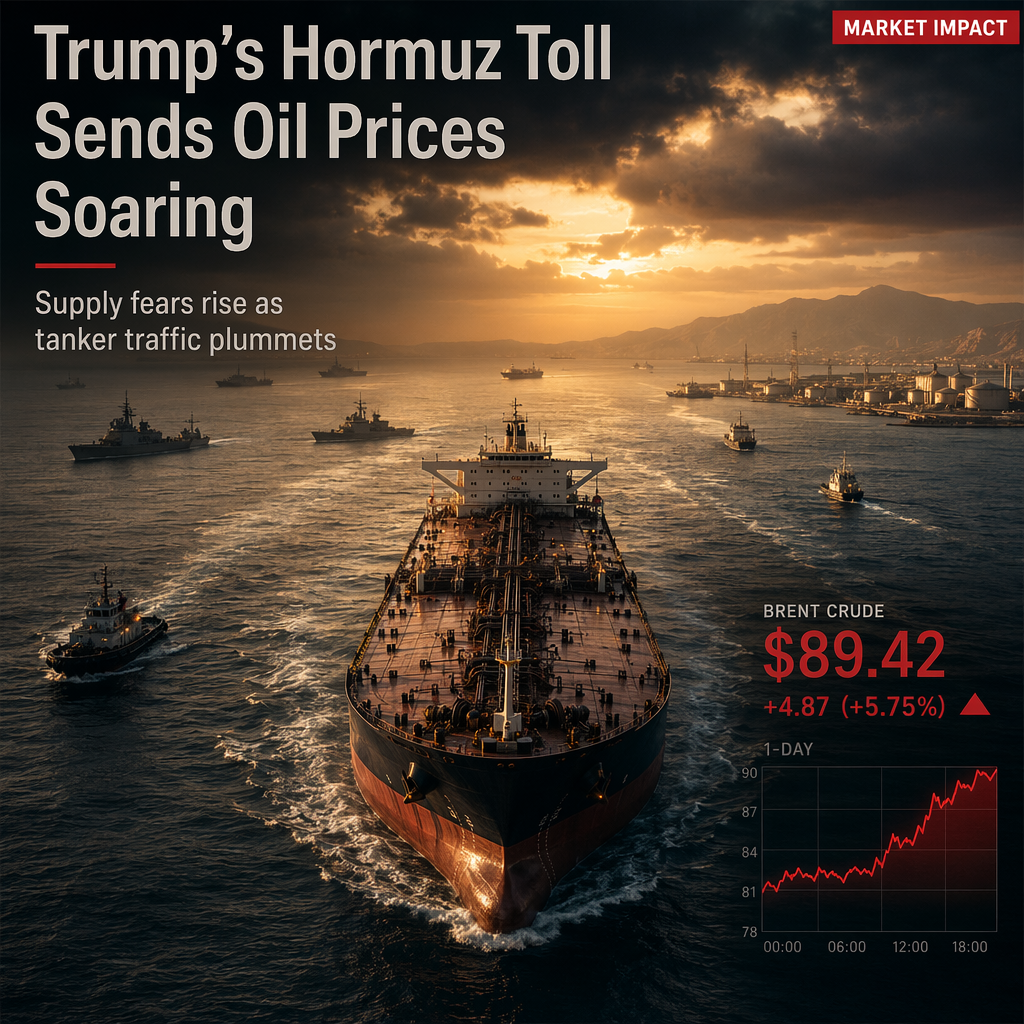
President Donald Trump has proposed a 20% fee on cargo passing through the Strait of Hormuz, a move that has reignited concerns over global oil supply risks [1]. According to Lipow Oil Associates, this proposed fee would effectively add about $16 per barrel to oil shipped through the strait, though the administration has not yet clarified how the charge would be implemented [1]. The announcement comes after recent optimism about stronger oil supplies following a U.S.-Iran memorandum of understanding signed last month, but analysts now warn that these surpluses are in jeopardy, especially if the strait is completely shut down [1].
Market reactions were swift: U.S. West Texas Intermediate futures for August delivery rose 2.27% to $79.91 per barrel, while international benchmark Brent crude futures for September delivery climbed 2.14% to $85.11, extending gains after a 9.6% surge in the previous session [1]. Vessel traffic through the Strait of Hormuz has already fallen sharply, with Kpler data showing just 14 ships crossing the waterway on Sunday, including four crude tankers, compared to 37 vessels a week earlier [1]. This decline in traffic raises the risk that exporters may be unable to ship crude out of the Gulf, potentially forcing producers to reduce output if storage tanks fill up [1].
Analysts highlighted that the proposed levy matters less for its direct cost than for the heightened risk it signals. Citi warned that implementing the fee could increase the likelihood of a broader military confrontation in the near term, and suggested that the Iranian regime might walk away from the memorandum of understanding until after the mid-term U.S. elections—a scenario that could result in 'higher for longer' oil prices [1]. Henry Hoffman, co-portfolio manager at Catalyst Energy Infrastructure Fund, noted that while the immediate impact is supportive of oil prices, the more significant issue is the risk of renewed physical supply losses [1].
CONCLUSION
Trump's proposed 20% fee on Hormuz cargo has driven oil prices higher and raised fears of supply disruptions and potential military escalation. Analysts warn that the risk of physical supply losses and prolonged higher oil prices has increased, with vessel traffic through the strait already declining sharply. The market is now focused on the possibility of further disruptions and the broader geopolitical implications.