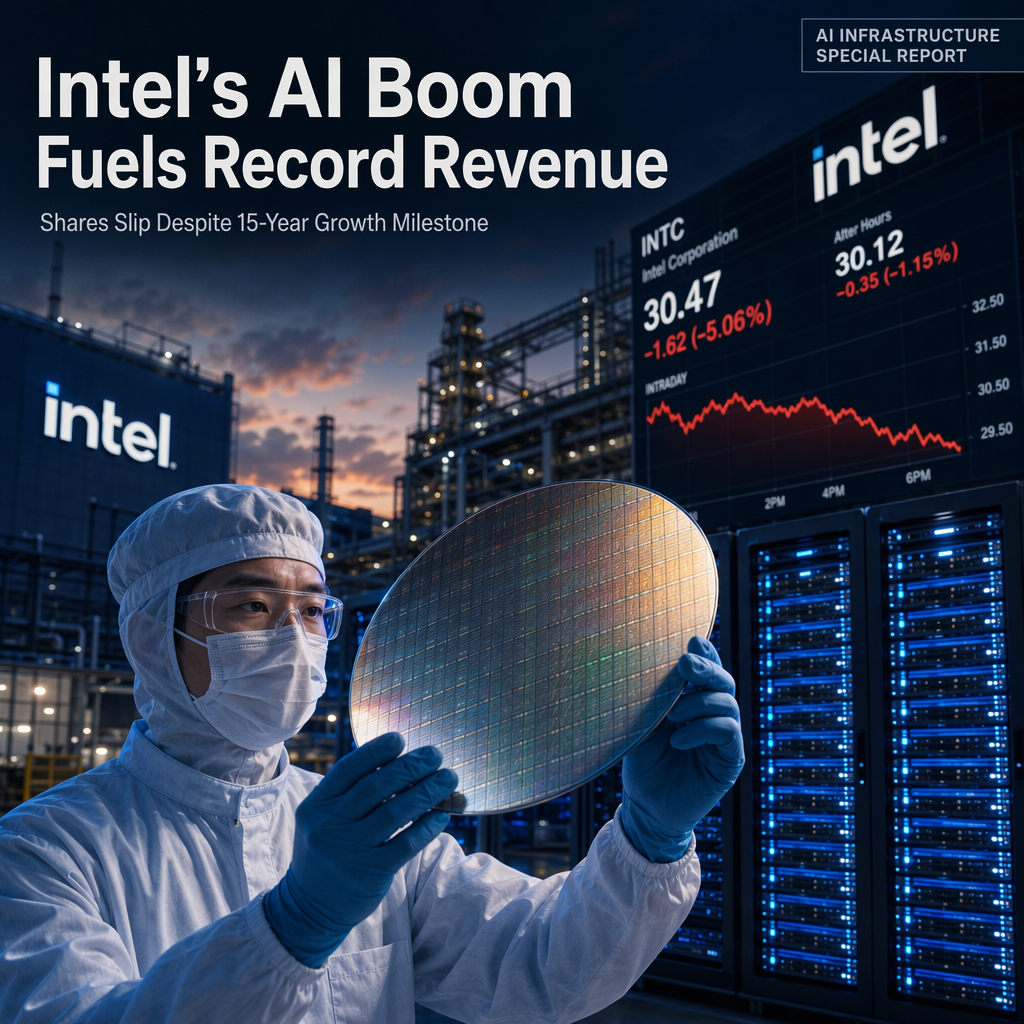
Intel reported its fastest quarterly revenue growth in over 15 years, driven by soaring demand for central processing units (CPUs) as artificial intelligence (AI) infrastructure expands globally [1][2]. The company's revenue surged 25% to $16.1 billion, surpassing analyst expectations of $14.42 billion, and marking the most robust growth since the third quarter of 2011 [2]. Adjusted earnings per share reached 42 cents, nearly double the 21 cents expected by analysts [2].
The primary catalyst for this growth was Intel's data center and AI segment, which posted a 59% revenue increase to $6.3 billion [1][2]. The client computing group, responsible for PC chips, also saw a 13% rise to $8.9 billion, though Intel anticipates flat PC sales in the upcoming quarter due to a memory shortage [2]. Intel noted that CPU demand is now nearly equal to that for GPUs, signaling a significant industry shift as AI capabilities are scaled up [1].
Despite the strong financial performance and positive guidance—Intel forecasts adjusted earnings per share of 38 cents and revenue between $15.8 billion and $16.8 billion for the current quarter, both above analyst expectations—market reaction was mixed [2]. Shares initially climbed after the report but declined during Friday trading, with the stock down 28% in July despite being up over 170% year-to-date as of Thursday's close [2].
Intel is responding to the AI-driven demand by entering long-term agreements with customers for its server CPUs, with ten such deals already secured. CFO David Zinsner stated that the company is currently supply constrained, with data center customers requesting more than Intel can deliver [2]. CEO Lip-Bu Tan emphasized, "AI is driving unprecedented demand for compute," and expressed confidence in Intel's positioning for sustainable growth in its CPU franchise [2]. The company is also planning a "meaningful increase" in capital expenditures next year as it seeks to expand its manufacturing capabilities [2].
CONCLUSION
Intel's record-setting revenue growth highlights the transformative impact of AI on the semiconductor industry, particularly in the data center segment. While the company exceeded expectations and issued strong guidance, recent share price volatility reflects ongoing market uncertainty. Intel's strategic moves to secure long-term customer agreements and boost manufacturing signal confidence in continued AI-driven demand.