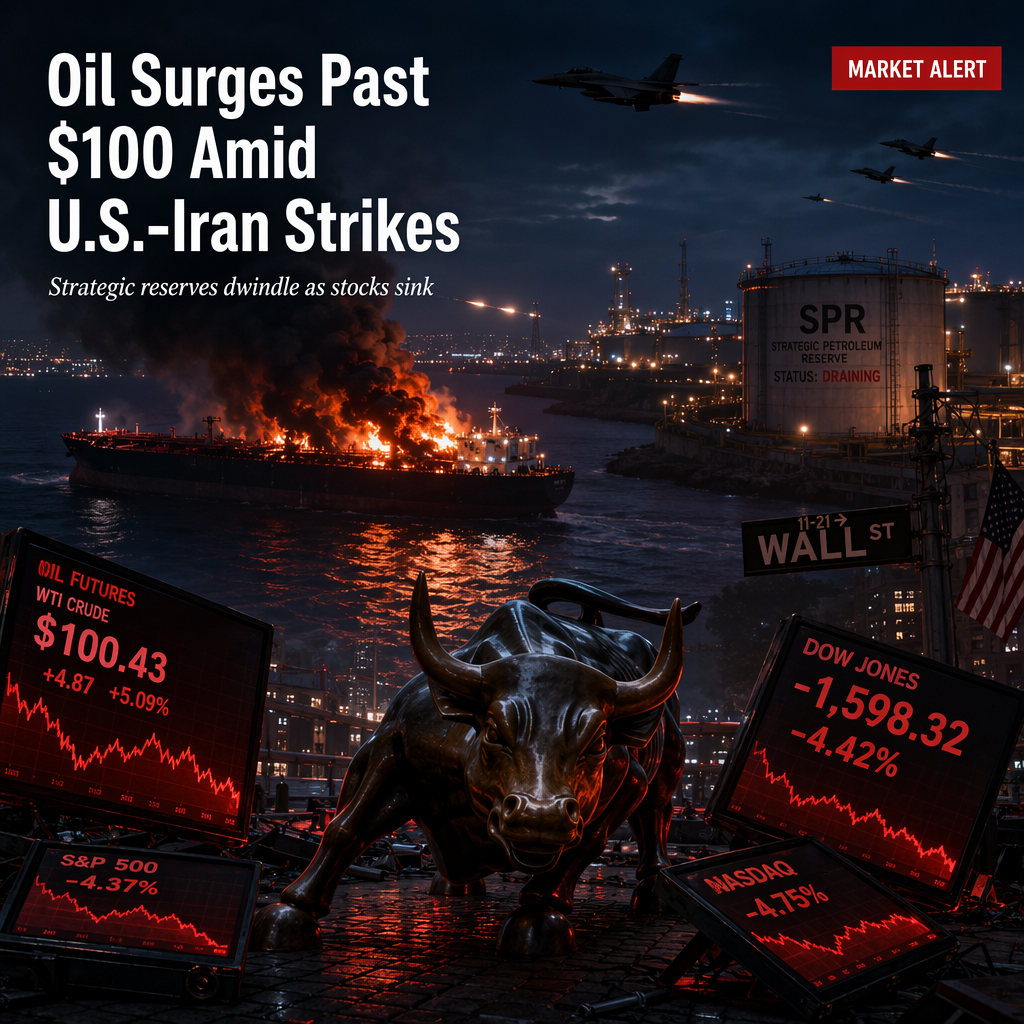
Crude oil prices have surged above $100 per barrel amid escalating conflict between the U.S. and Iran, with the U.S. Strategic Petroleum Reserve (SPR) now at its lowest level since 1983 [1][2]. The U.S. has conducted air strikes against Iran for 12 consecutive nights, and reports of a tanker attack off the coast of Saudi Arabia have further fueled market volatility [2]. The depletion of the SPR is a direct response to surging oil prices and ongoing volatility caused by the conflict, which has triggered oil shortages across Asia and heightened uncertainty in global energy markets [1].
Market analysts warn that the SPR's declining reserves limit the government's ability to respond to future supply disruptions, increasing the risk if another supply shock occurs [1]. Technical analysis indicates rising momentum in oil prices, with traders watching resistance levels at $105 and $110, and support near $98. If oil breaks above $110, a run toward $120 per barrel is expected [1]. Western Texas Intermediate Crude futures jumped 6% to $92 per barrel, up more than 28% from lows below $70 earlier this month [2].
The surge in oil prices has had a significant impact on U.S. equities. Major stock indexes tumbled on Thursday, with the S&P 500 heading for its biggest decline in a month and now down about 2% since the U.S. strikes began on July 12 [2]. The 10-year Treasury yield broke through 4.7%, its highest since January 2025, and 30-year rates are solidly above 5% [2]. Steve Sosnick, chief strategist at Interactive Brokers, commented, "It's too hard to ignore $100 oil. It's too hard to ignore 10-year rates that are above 4.70%. It's too hard for the stock market to ignore 30-year rates that are solidly above 5%." [2]
Earlier in the year, the S&P 500 fell more than 7.5% at its low point as oil surged nearly 70% following the start of the U.S.-Iran war, raising concerns about stagflation [2]. However, a series of de-escalation announcements and renewed optimism in the artificial intelligence sector led to a strong rebound in April and May [2]. JPMorgan equity strategists have advised using equity weakness caused by the Iran conflict as a buying opportunity, anticipating that President Donald Trump would seek an off-ramp to end the war rather than face prolonged economic and political fallout [2].
Sentiment in the energy market remains bullish as long as the Iranian conflict persists, with traders closely monitoring government announcements regarding SPR strategies and the possibility of coordinated international actions to mitigate shortages [1].
CONCLUSION
The escalation of the U.S.-Iran conflict has driven oil prices above $100 per barrel and pushed the U.S. Strategic Petroleum Reserve to its lowest level in four decades, creating significant volatility in both energy and equity markets. With equities falling and yields rising, market participants are bracing for further turbulence, while some strategists see potential buying opportunities if geopolitical tensions ease. The situation remains highly fluid, with ongoing risks tied to both supply disruptions and policy responses.