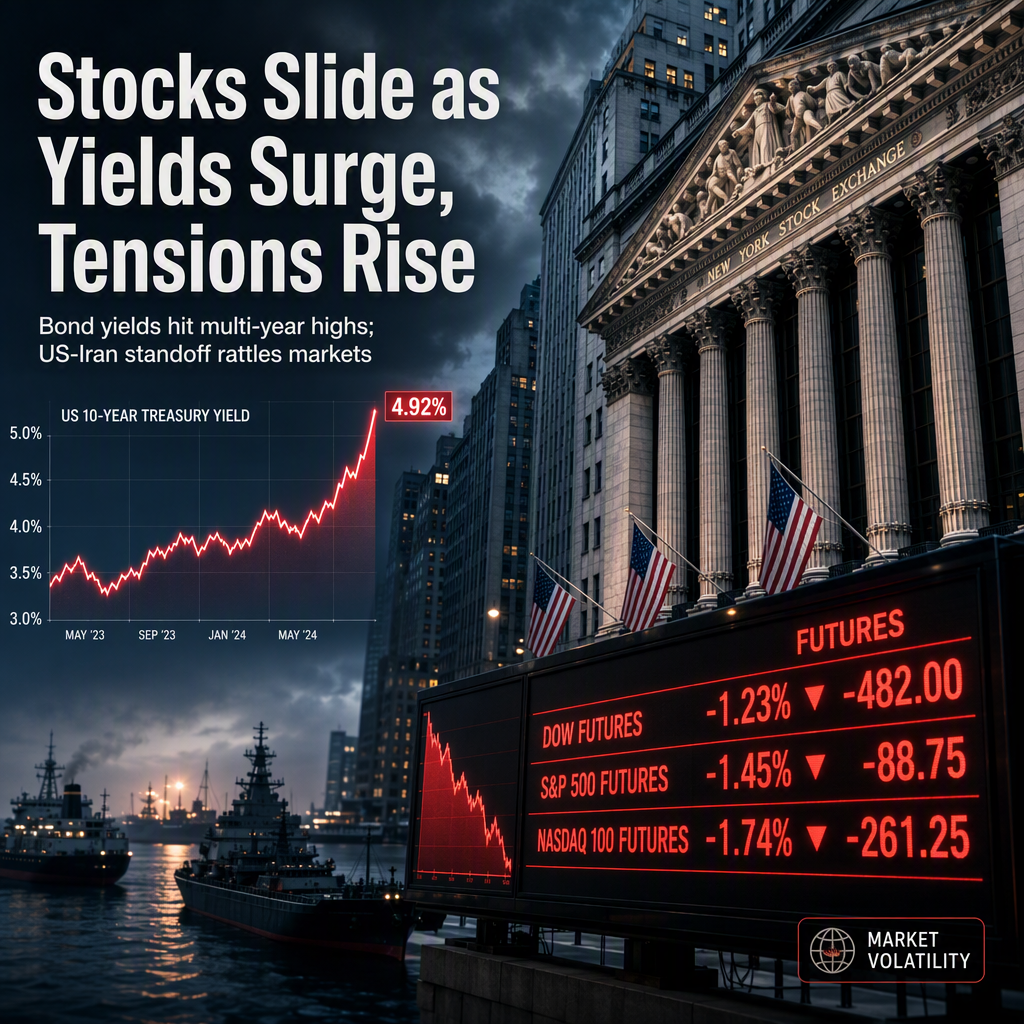
US stock futures experienced notable declines during European trading hours on Tuesday, with Dow Jones futures falling by 0.25% to around 53,410, S&P 500 futures dropping 0.52% to near 7,730, and Nasdaq 100 futures slipping 0.92% to approximately 29,820 [1]. The downturn was triggered by a surge in global bond yields, which reached multi-year highs amid concerns over massive government spending and persistent inflationary pressures. Specifically, the 10-year US Treasury yield climbed near 4.75%, approaching its highest level since January 2025, while the 30-year yield rose above 5.33%, marking its highest point since 2007 [1]. Rabobank analysts highlighted that US 30-year bond yields now stand at 5.31%, the highest since July 2007, and similar increases were observed in UK, Eurozone, and Japanese long-term yields, underscoring a synchronized rise in borrowing costs across major economies at a time when fiscal positions are already stretched [1].
Market anxiety was further exacerbated by escalating tensions in the Middle East and rising oil prices, following diminished prospects for a new peace agreement between the US and Iran. US President Donald Trump stated he has no interest in renewing the expiring pact, citing the ongoing naval blockade of Iranian ports as leverage and reiterating his proposal to declare the strategic waterway as US territory under total American control [1]. In response, Iranian Foreign Ministry spokesman Esmail Baghaei emphasized that a deal remains elusive due to security complexities and "obstructionist behavior of destructive elements," insisting that Washington must lift its blockade first [1].
On Monday's regular session, the Dow Jones dropped 0.51%, the S&P 500 declined 0.52%, and the Nasdaq Composite lost 0.32% [1]. Investors are now turning their attention to upcoming retail earnings reports from Home Depot, Lowe’s, and Walmart later this week, which are expected to provide insights into the health of consumer spending [1].
CONCLUSION
US stock futures are under pressure as surging global yields and heightened geopolitical tensions drive market volatility. The synchronized rise in long-term borrowing costs across major economies and uncertainty surrounding US-Iran relations have intensified investor caution. Upcoming retail earnings reports will be closely watched for further signals on consumer sentiment and market direction.