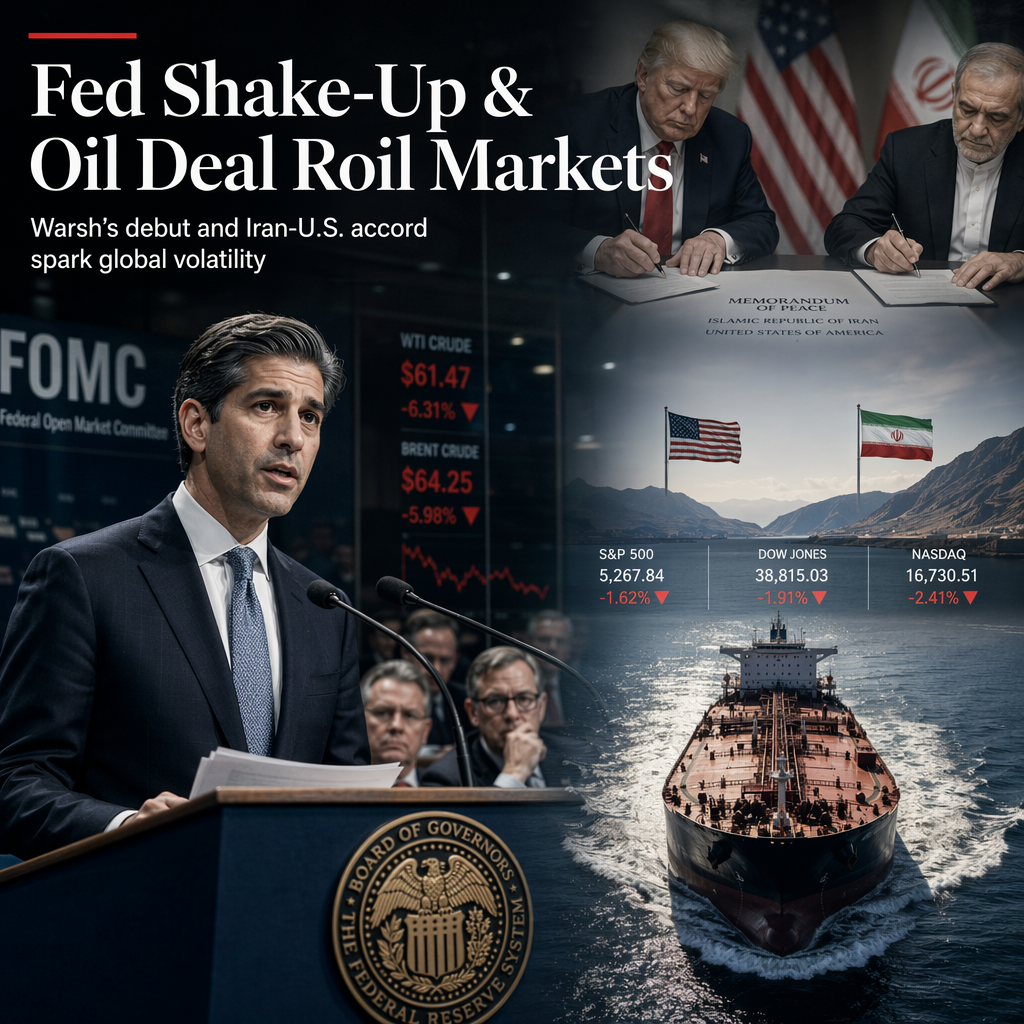
Federal Reserve Chairman Kevin Warsh concluded his first Federal Open Market Committee meeting on June 17, 2026, introducing several changes and leaving markets uncertain about future monetary policy. Warsh announced the creation of five task forces, including those focused on the Fed's communications and balance sheet, and revamped the Fed's policy statement to be 'a bit shorter, a bit simpler, and it dispenses with some older language.' Notably, Warsh refrained from contributing to the 'dot plot' that shows policymakers' rate expectations, adding to the ambiguity surrounding the Fed's direction [1].
U.S. stocks declined on Wednesday, and Treasury yields climbed, reflecting investor uncertainty as multiple Federal Reserve officials signaled a potential rate hike this year to curb inflation [1]. This suggests heightened caution in the markets as participants await clearer guidance from the Fed.
On the geopolitical front, President Donald Trump announced the signing of a memorandum of understanding with Iranian President Masoud Pezeshkian, aimed at ending the war. The deal includes the restoration of energy shipments via the Strait of Hormuz, which has led to a drop in oil prices. However, the introduction of a toll system has complicated the long-term protocol for navigation through this critical waterway [1]. The International Energy Agency (IEA) stated that resolving the Middle East conflict could result in significantly higher supply volumes and potentially spark a major oil overhang next year, following the energy supply shock caused by the Iran war [1].
Despite the agreement, Trump remarked that he liked the idea of blaming Vice President JD Vance if the deal fails, raising concerns about the durability of the peace accord [1]. These developments have significant implications for global energy markets, with the prospect of increased supply likely to impact oil prices and market dynamics.
CONCLUSION
Kevin Warsh's first Fed meeting introduced policy changes but left investors uncertain about future rate hikes, resulting in a decline in U.S. stocks and rising Treasury yields. The Iran-U.S. peace deal has eased tensions and lowered oil prices, though questions remain about its long-term effectiveness. Both events are driving significant market volatility and shaping investor sentiment.