
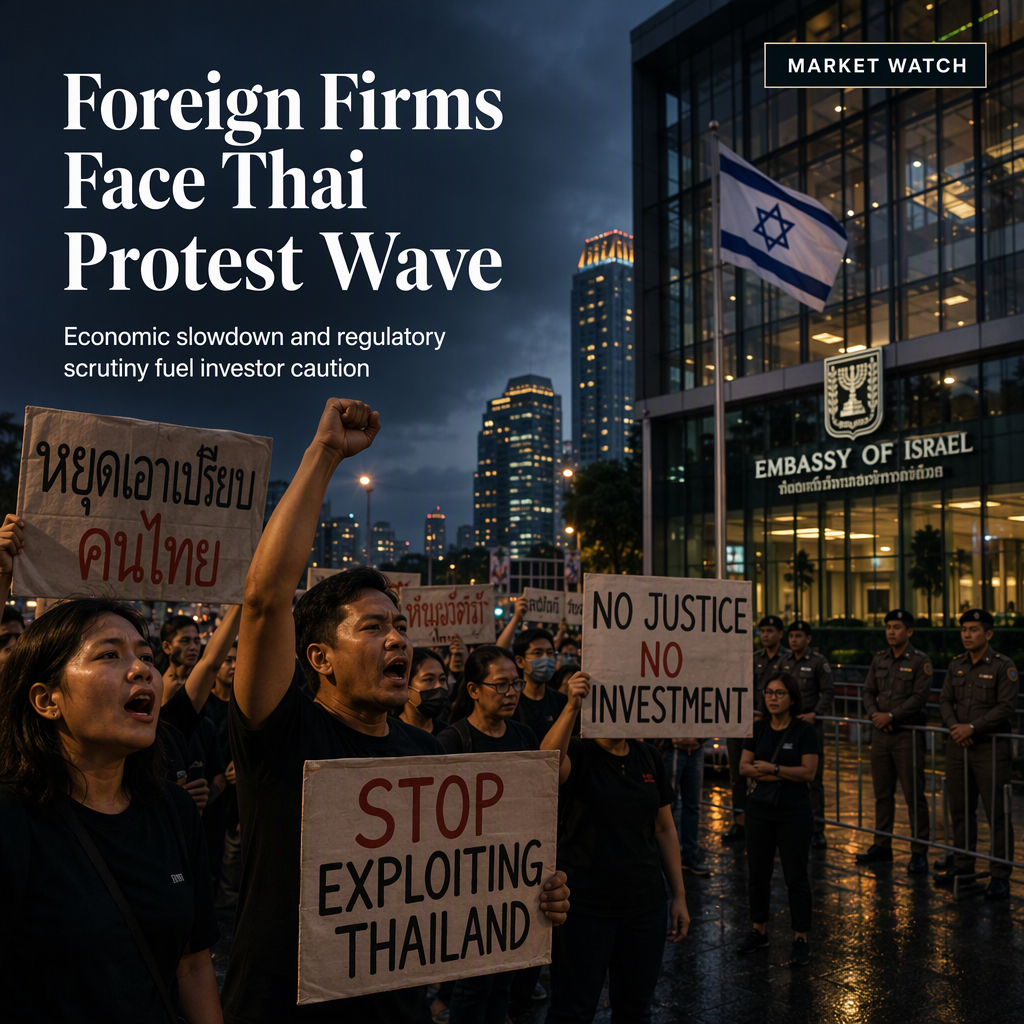
A protest movement has emerged in Thailand, targeting companies from China, Israel, and other countries for allegedly circumventing ownership rules, as the country's economic growth slows. Thai activists recently staged a rally at the Israeli embassy, protesting against alleged exploitation and legal violations by foreign companies operating in Thailand [1]. The protests coincide with the Thai government's consideration of a crackdown on ownership loopholes, which could have significant implications for foreign investment and the broader economy [1].
Concerns among protesters center on foreign companies exploiting regulatory gaps to gain a disproportionate share of the market, particularly in critical sectors. This sentiment is heightened by Thailand's Q2 GDP growth decelerating to 1.9%, attributed to energy and travel challenges [1]. Market analysts warn that a broad government crackdown could impact foreign direct investment inflows, especially from China, which has become increasingly active in Thailand's real estate, technology, and automotive sectors. One local market analyst stated, "If regulations are tightened without clear guidelines, this could create uncertainty and dampen investor sentiment" [1].
The government is reportedly gathering data on the use of nominee structures and other methods employed by foreign enterprises to circumvent restrictions on foreign ownership. New measures may be announced in the coming months, and the ongoing protests and potential regulatory changes are being closely watched by investors [1]. Market participants are advised to monitor developments, particularly regarding possible shifts in foreign ownership regulations, which could affect stock prices of companies with significant foreign shareholding and sectors such as real estate, tourism, and technology [1].
No major trading advice or specific price levels were disclosed in the article, but the overall market sentiment remains cautious, with stakeholders awaiting further government announcements [1].
CONCLUSION
The protests and potential regulatory changes in Thailand have created a cautious market environment, with investors closely monitoring developments. Any shift in foreign ownership regulations could impact foreign investment and key sectors, particularly those with significant foreign shareholding. Stakeholders are advised to await further government announcements before making major investment decisions.