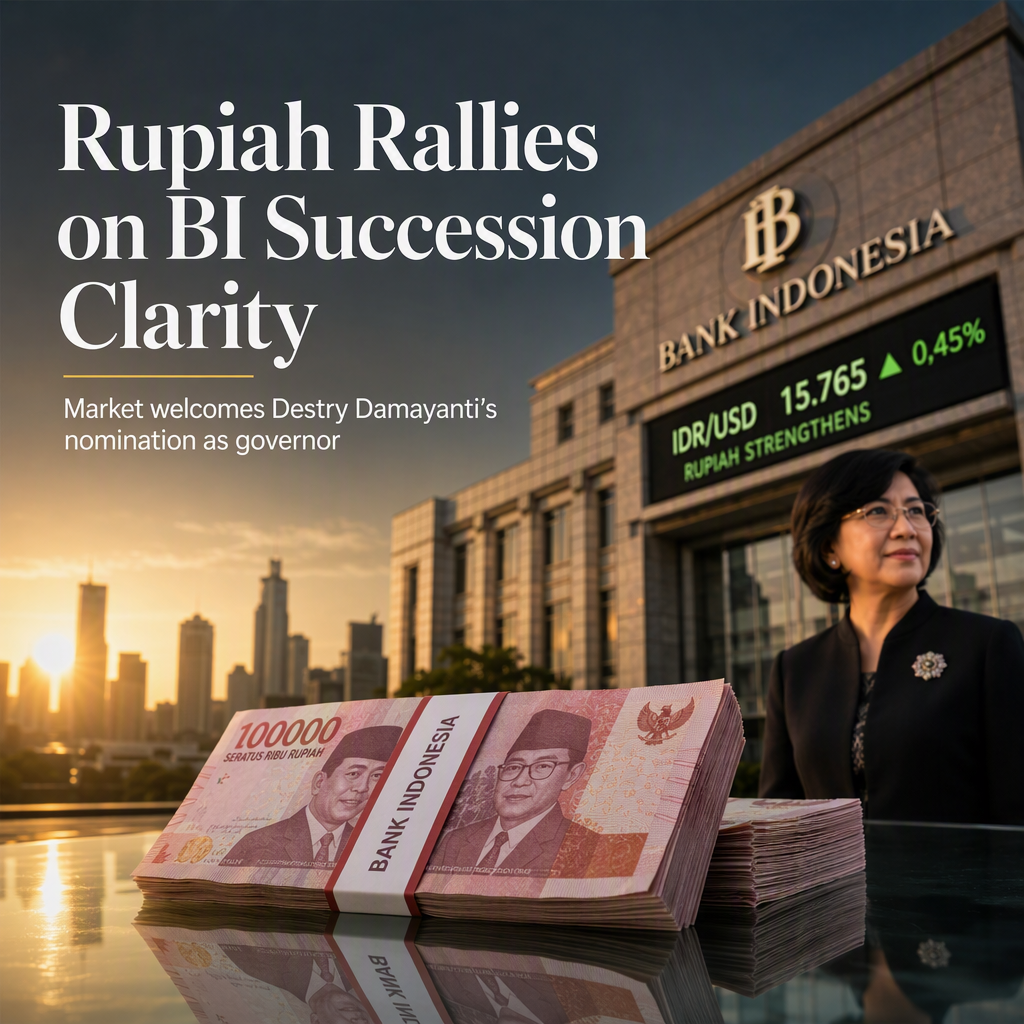
The Indonesian Rupiah (IDR) strengthened to near a two-month high against the US Dollar (USD) following a combination of weaker US payroll data and increased clarity regarding the leadership of Bank Indonesia (BI) [1]. According to OCBC analysts Sim Moh Siong and Christopher Wong, the nomination of Destry Damayanti as the sole candidate for BI governor by President Prabowo provided a significant domestic catalyst, alleviating uncertainty after Perry Warjiyo's departure [1]. Markets responded positively to Destry's extensive experience at BI and her emphasis on currency stability, which is expected to ensure policy continuity [1].
The analysts note that the IDR's recent strength is also supported by a softer USD backdrop, with technical analysis indicating bearish momentum for USD/IDR. The daily chart shows a bearish crossover, with the 21-day moving average cutting below the 50-day moving average, and the Relative Strength Index (RSI) approaching oversold conditions [1]. Key support levels for USD/IDR are identified at 17,680, 17,620, and 17,580, while resistance is seen at 17,840 and 17,950/970 [1].
Looking ahead, the main risks for the IDR include the upcoming US Consumer Price Index (CPI) release, fluctuations in oil prices, and the next BI meeting scheduled for August 19 [1]. The market appears to be taking comfort in the expectation of policy continuity under Destry Damayanti, which, combined with the current external environment, is likely to keep the IDR supported in the near term [1].
CONCLUSION
The Indonesian Rupiah's recent appreciation is attributed to both external factors, such as weak US payrolls, and domestic developments, notably the nomination of Destry Damayanti as BI governor. Market sentiment is positive due to expectations of policy continuity and currency stability, though upcoming US CPI data, oil prices, and the next BI meeting remain key risks to monitor.