
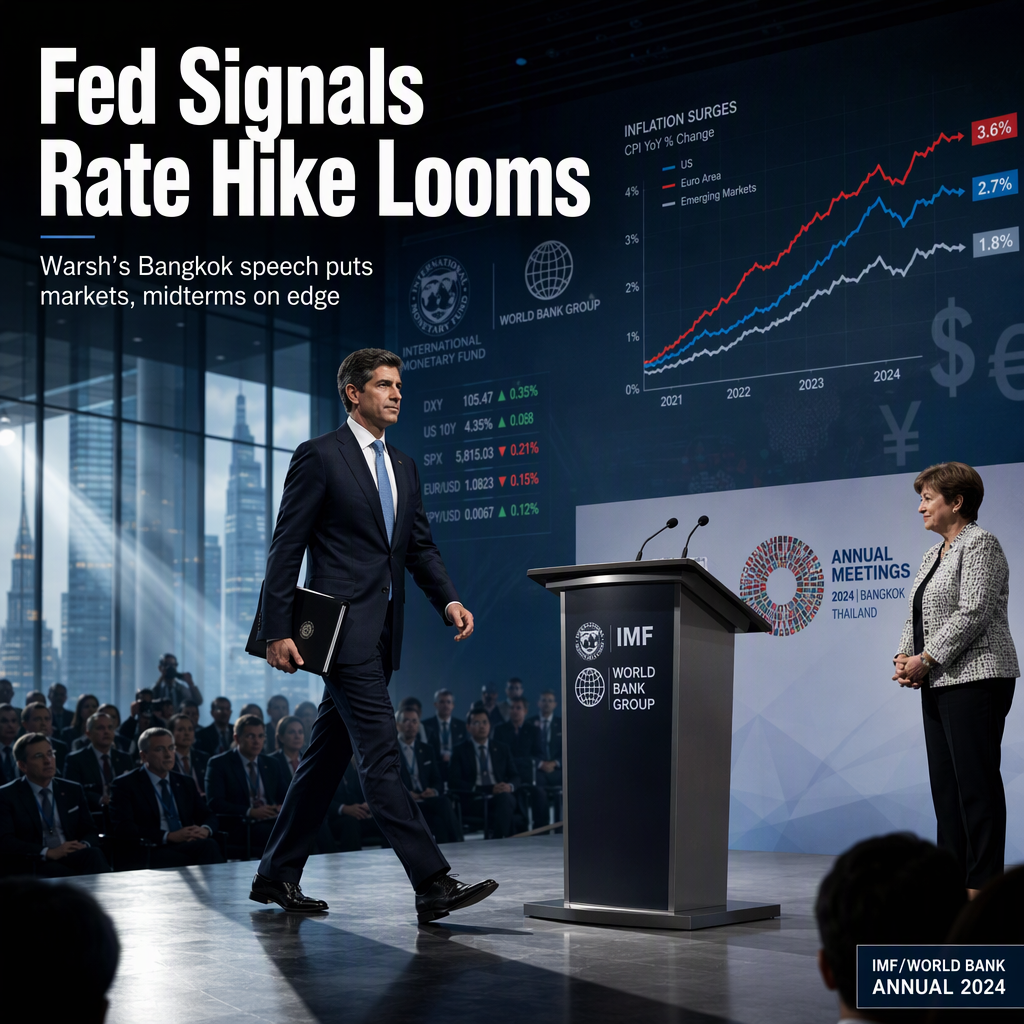
Federal Reserve Chairman Kevin Warsh is set to deliver a highly anticipated speech in Bangkok on Friday morning at the annual meeting of the International Monetary Fund and the World Bank, where he will be interviewed by IMF Managing Director Kristalina Georgieva [1]. This event is drawing intense scrutiny from investors, economists, and politicians, especially in light of recent government reports indicating that inflation is accelerating for both consumers and businesses [1]. The urgency surrounding Warsh's speech is heightened by speculation over whether the Fed will raise interest rates before or after the Nov. 3 midterm elections [1].
Bank of America analysts noted that 'broad based' inflation 'strengthens the case for an October hike,' citing AI and Iran as key sources of inflation pressure [1]. The upcoming speech will be the last public appearance by a Fed official before the central bank enters a 'blackout' period starting Saturday, which lasts until the next interest rate meeting scheduled for Oct. 27 and 28 [1].
American consumers are already facing financial strain due to soaring interest rates, rising energy prices, and stagnant wage growth, and another rate hike could exacerbate these challenges [1]. Political implications are also significant, as polls show voter dissatisfaction with President Donald Trump’s handling of the economy, and a further rate hike could increase pressure on Republicans ahead of the midterms [1]. Trump has attempted to lower gas and diesel prices through various policy measures, but these efforts have not yet resulted in meaningful price reductions [1].
Inflation, as measured by the consumer price index, had declined to 2.3% four months into Trump’s term, but subsequent tariffs and the war against Iran led to a resurgence, with inflation breaching 3% in September and jumping as high as 4.1% in May [1]. Analysts suggest that these inflationary pressures are unlikely to abate soon, reinforcing expectations for a potential rate hike [1].
CONCLUSION
Chairman Warsh's speech is expected to provide critical clues about the Fed's next move on interest rates, with analysts and market participants closely watching for signals of an October hike. Persistent inflation driven by AI and geopolitical tensions, particularly with Iran, has intensified speculation and heightened market sensitivity. The outcome of this event could significantly impact both financial markets and the political landscape ahead of the midterm elections.