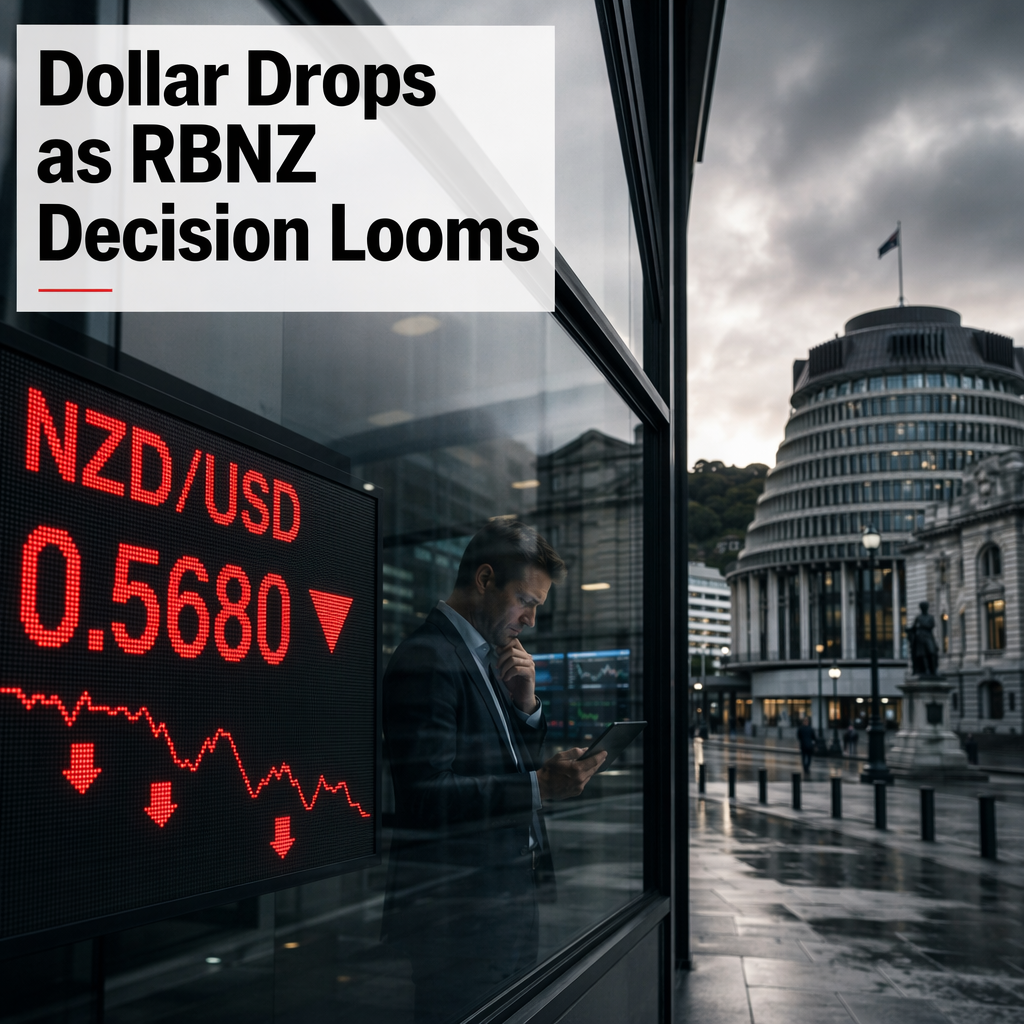
The New Zealand Dollar (NZD) slipped against the US Dollar (USD), with NZD/USD trading near the 0.5680 level as investors awaited the Reserve Bank of New Zealand's (RBNZ) upcoming policy decision scheduled for Wednesday [1]. The US Dollar remained supported by cautious remarks from Federal Reserve officials, notably New York Fed President John Williams, who stated that the US economy is growing at a steady pace, the labor market remains stable, and inflation is still elevated [1].
Recent US labor data showed the ADP Employment Change 4-week average eased to 21K from 24.25K, indicating softer private hiring, but this did not significantly weaken the Greenback [1]. In contrast, the RBNZ is widely expected to raise the Official Cash Rate (OCR) by 25 basis points, from 2.25% to 2.50%, which would end a three-meeting pause. However, economists remain divided following May’s close 3-3 split, when Governor Breman cast the deciding vote to hold rates steady, suggesting uncertainty around the central bank's next move and potential for market volatility [1].
Technical analysis shows NZD/USD trading at 0.5675, below both the 20-period SMA at 0.5697 and the 100-period SMA at 0.5707, indicating a bearish near-term bias. The Relative Strength Index (RSI) at 42.8 has slipped below the midline, reinforcing the view that rallies are likely to face selling pressure beneath clustered moving-average resistance. Immediate resistance is noted at 0.5688, with further resistance between 0.5693 and 0.5699, while initial support is at 0.5672, below which the pair could seek new lows [1].
No explicit forward-looking statements from analysts were provided, but the divided economist outlook and technical setup suggest that the RBNZ decision could trigger significant volatility in NZD/USD [1].
CONCLUSION
The New Zealand Dollar is under pressure ahead of the RBNZ policy decision, with technical indicators pointing to a bearish bias and economists split on the outcome. The market is bracing for potential volatility, as a rate hike could end the central bank's recent pause but uncertainty remains high.