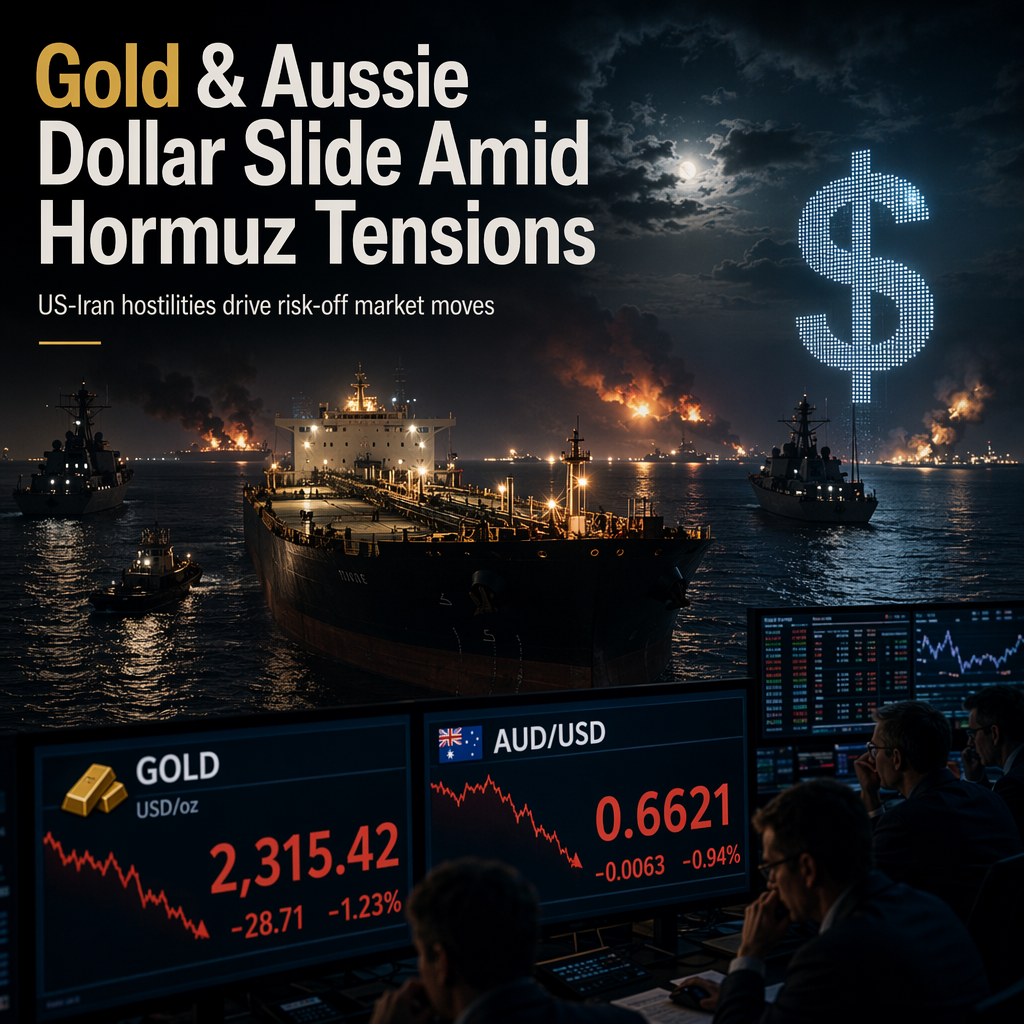
Renewed hostilities between the US and Iran have triggered significant market movements, with gold prices edging lower to around $4,100 and the Australian Dollar (AUD/USD) dropping to two-day lows at 0.6928 during the early Asian session on Wednesday [1][2]. The escalation follows US Central Command's announcement of a series of strikes against Iran in response to attacks on three oil tankers in and around the Strait of Hormuz, a critical international waterway [1]. According to reports, the US military targeted Iranian weapon launch sites and air defenses, with further strikes expected to last for hours [2].
The heightened geopolitical tensions have led to a surge in demand for safe-haven assets, notably the US Dollar, which saw the US Dollar Index (DXY) rise by 0.26% to 101.12 [2]. The market's risk-off sentiment pressured the Australian Dollar, which fell 0.39% on the day, and weighed on gold despite its traditional safe-haven status [2][1]. The renewed tensions come shortly after an interim peace deal between Washington and Tehran, which had previously ended fighting and reopened the strait [1].
On the economic front, the US reported a disappointing June Nonfarm Payrolls (NFP) figure, with only 57,000 jobs added compared to 129,000 in May and below expectations of 110,000, prompting traders to scale back Federal Reserve rate hike bets in the near term [1]. However, the NY Fed Survey of Consumer Expectations indicated that one-year inflation expectations rose from 3.5% to 3.7% in June, and traders now see a 100% chance of a Federal Reserve interest rate hike in 2026, according to Prime Terminal data [2].
In Australia, the economic calendar was quiet, but the Reserve Bank of Australia (RBA) has raised rates three times in 2026 and maintains a neutral stance, remaining open to further hikes if necessary [2]. Technical analysis shows AUD/USD remains under bearish pressure, trading below key moving averages and trend lines, with the Relative Strength Index (14) at around 40 [2].
Looking ahead, markets are awaiting the release of the Federal Reserve's June meeting minutes and US Initial Jobless Claims for the week ending July 4, which could further influence sentiment and asset prices [1][2].
CONCLUSION
The escalation of US-Iran tensions near the Strait of Hormuz has sparked a flight to safety, boosting the US Dollar while pressuring both gold and the Australian Dollar. With inflation expectations rising and key central bank decisions ahead, markets remain highly sensitive to further geopolitical and economic developments.