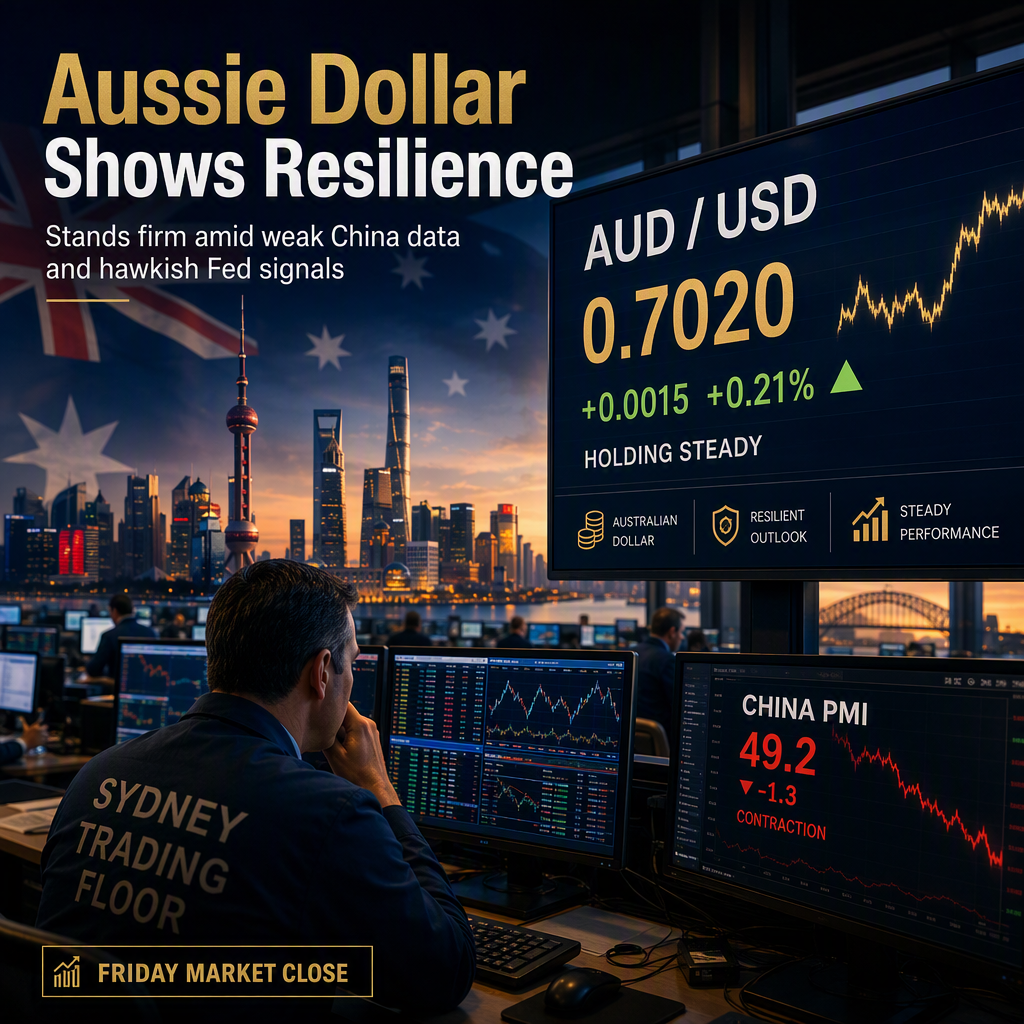
The Australian Dollar (AUD) remained resilient around the 0.7020 level against the US Dollar (USD) during Friday's American session, despite facing headwinds from disappointing Chinese economic data and renewed hawkish commentary from US Federal Reserve officials [1]. China's National Bureau of Statistics reported that the Manufacturing Purchasing Managers' Index (PMI) dropped to 49.2 in July from 50.3 previously, falling below the 50.0 consensus and signaling a return to contraction territory. The Non-Manufacturing PMI also declined to 49.0 from 50.2, missing expectations and reinforcing concerns about slowing demand in China, Australia's largest trading partner [1].
On the domestic front, Australia's Producer Price Index (PPI) accelerated to 3.6% year-over-year in the second quarter, up from 3.0% previously, indicating persistent pipeline inflation pressures. However, this stronger inflation reading was not enough to counterbalance the negative sentiment stemming from weak Chinese data and a stronger US Dollar [1].
The US Dollar found additional support after Dallas Fed President Lorie Logan delivered hawkish remarks, stating that monetary policy is not restraining the economy and warning that inflation is not on track to return to the Fed's 2% target. Logan expressed a preference for a 25-basis-point rate increase and suggested that modest tightening now could reduce the need for more aggressive action later [1].
From a technical perspective, AUD/USD trades at 0.7025 with a mild bullish bias, holding above key moving averages and showing firm, though not extreme, upside momentum. Initial resistance is seen at 0.7039 and 0.7045, while support lies at 0.7025 and further down at 0.6992, with additional demand zones around 0.6982 and 0.6980 [1].
CONCLUSION
Despite negative signals from China and hawkish Fed commentary, the Australian Dollar has shown resilience, supported by domestic inflation data and technical factors. However, the outlook remains cautious as external pressures from China and the US persist, limiting the AUD's upside potential in the near term.