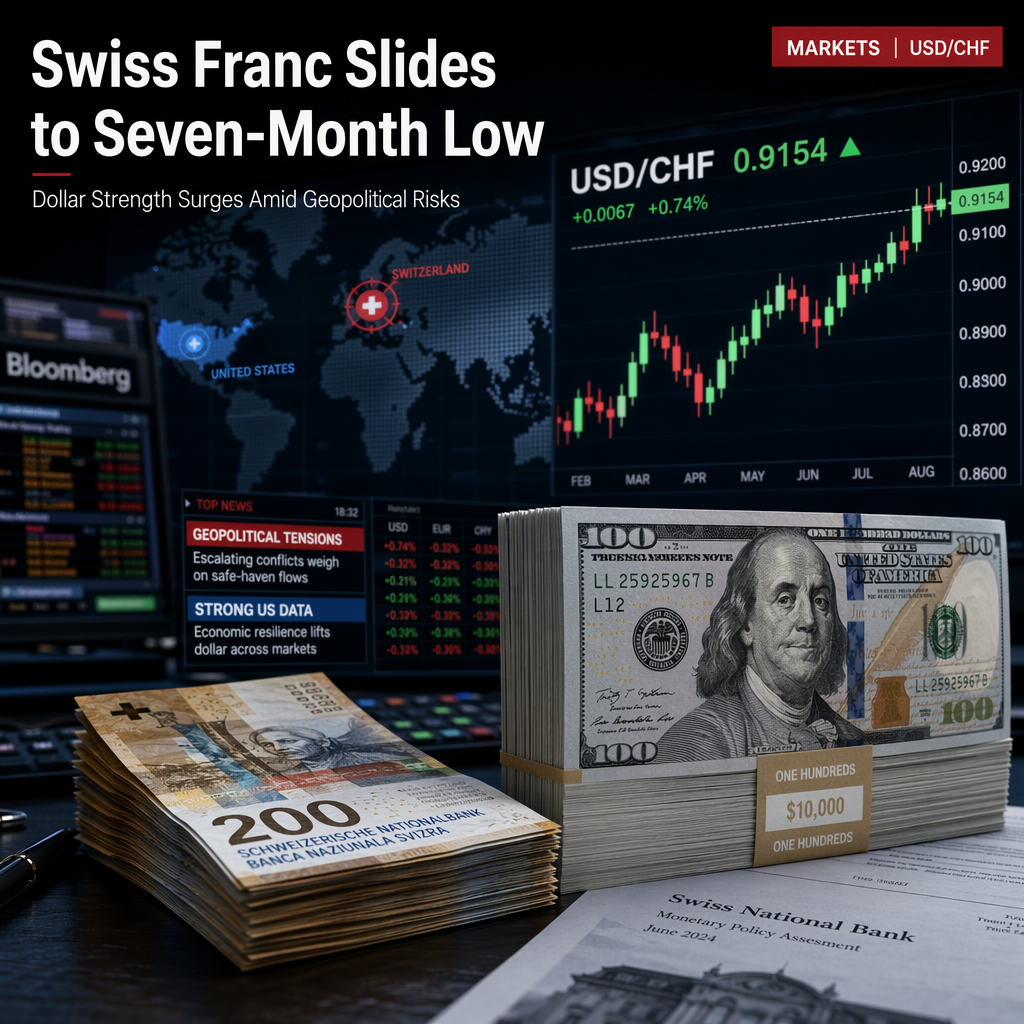
The Swiss Franc weakened to a seven-month low against the US Dollar, with USD/CHF extending its gains for the sixth consecutive day and reaching 0.8107 during Asian trading hours on Wednesday [1]. This decline in the Franc comes as the US Dollar strengthens, driven by ongoing geopolitical tensions in the Middle East and robust US economic data [1]. Specifically, the US S&P Global Composite PMI for June rose to 52.2 from May's 51.5, indicating healthy business expansion. The manufacturing output increased to 55.7 from 55.1, surpassing forecasts of 54.8, while the Services PMI edged up to 51.3 from 50.7, also beating the consensus estimate of 51.0 [1].
Geopolitical developments contributed to market volatility, with US President Donald Trump announcing that Iran had agreed to open its nuclear facilities to inspections, though Iranian officials quickly downplayed the progress, stating that substantive negotiations had not begun. Iran's chief negotiator also warned that the Strait of Hormuz would remain under Iranian oversight, while diplomatic talks between Israel and Lebanon continued in Washington [1].
Market expectations for US monetary policy shifted, as the CME FedWatch tool showed traders now pricing in an 86.1% chance of a Federal Reserve rate hike in December, up from 61% before the previous week's FOMC meeting [1]. This more hawkish outlook for the Fed further supported the US Dollar's rally against the Swiss Franc [1].
On the Swiss side, the Swiss National Bank (SNB) kept its policy rate unchanged at 0% for the fourth consecutive meeting in June, maintaining its stance to support price stability and economic growth. However, the SNB raised its inflation forecast and reiterated its willingness to intervene in foreign exchange markets to curb excessive Franc strength [1]. Traders are also awaiting the Swiss ZEW Survey Expectations for June and the Q2 SNB Quarterly Bulletin for further guidance [1].
CONCLUSION
The Swiss Franc's slide to a seven-month low against the US Dollar reflects a combination of strong US economic data, heightened geopolitical risks, and shifting expectations for US monetary policy. The SNB's steady policy stance and readiness to intervene have so far not prevented the Franc's decline. Market participants are closely watching upcoming Swiss economic releases for further direction.